Continued from the previous article
Ⅶ. The Labourer and Poetry: Jesus Christ, ed
In this context, it seems reasonable to conclude that Weil is referring to the Catholic Eucharist, or Eucharistia hostia. This is, of course, an intuitive conjecture, yet it remains plausible to suggest that Weil maintained a critical perspective towards the monotonous and arduous nature of factory labour. Moreover, she implies that the hostia has been reduced to a mere habit—an observation aligned with her critique of the increasing materialism and secularisation of the Church. I argue that this insight emerged from her personal experience as a labourer, leading her to realise that the act of consuming food and drink, devoid of the accompanying physical effort, could be seen as a more materialistic pursuit.
My preference for Weil, over many other philosophers and theologians, lies in her focused exploration of the condition of the ‘labourer’. Furthermore, her spiritual ‘turns’, which many find challenging to interpret, are consistently anchored in the figure of Jesus Christ. The issue of poverty tied to labour remains a pervasive and universal challenge, even in modern contexts. It is also worth noting that Jesus himself had a profound connection to labour, given that Joseph, his foster father, was a carpenter.
***
・Travail manuel. Pourquoi n’y a-t-il jamais eu un mystique ouvrier ou paysan qui ait écrit sur l’usage du dégoût du travail ? La pesanteur et la grâce
・(Manual labour. Why has there never been a labourer or peasant mystic who wrote about the experience of disgust towards work?)
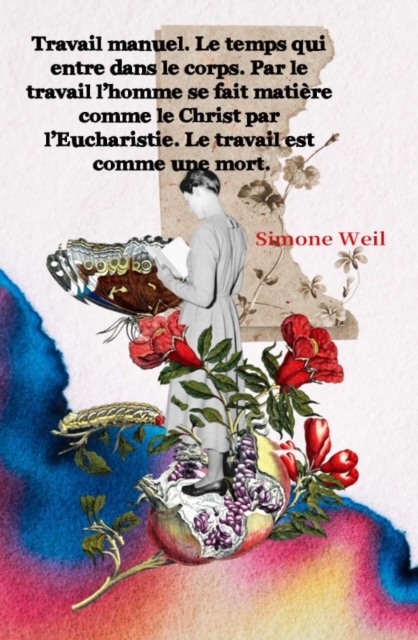
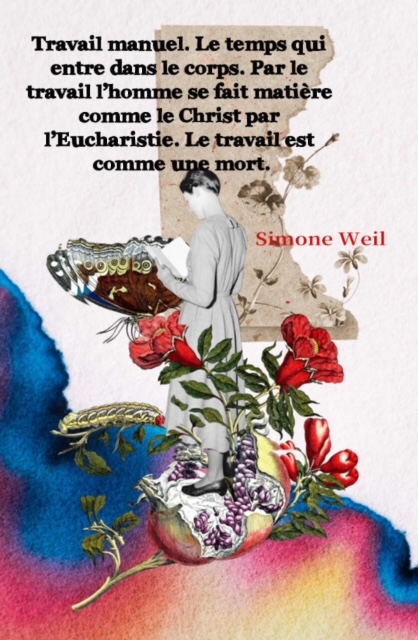
・Travail manuel. Le temps qui entre dans le corps. Par le travail l’homme se fait matière comme le Christ par l’Eucharistie. Le travail est comme une mort.
(Manual labour. Time enters the body through labour. Through work, man becomes matter, just as Christ becomes matter through the Eucharist. Labour is akin to death.)
***
This assertion appears in Gravity and Grace (La pesanteur et la grâce), where Weil reflects on the mystery of labour, drawing a parallel between work and the transformation that Christ undergoes in the Eucharist. This connection evokes Christ’s anguished cry from the cross: “My God, my God, why hast thou forsaken me?”—an expression of divine abandonment. Christ suffered fully as a human being, and conveying the meaning behind these beliefs can be profoundly challenging. Faith is often deeply intuitive and internal, making it difficult to articulate through rational discourse alone. From a Catholic perspective, reflecting on why one might embrace Catholicism involves recognising the inherent contradictions within the institution, which may serve as part of its appeal.
In early Christianity, the teachings of Jesus were transmitted orally and through personal encounters, embodying a distinctly spiritual and individual approach to faith. As the Church’s influence expanded within the Roman Empire, however, faith became increasingly institutionalised, with doctrines and rituals formalised over time. This evolution established faith as an entity rooted in institutional authority, often intertwined with political power. Catholicism continues to value mystery and intuition, yet these elements have also been absorbed into its institutional framework. Although Weil’s exact reasons for embracing Catholicism remain unknown, I believe it was the very contradictions within the faith that captivated her. Amidst the materialism and corruption that taints some members of the clergy, she found solace in her connection with the humanitarian Fr Perrin. When I challenged Fr Perrin on the Church’s practice of excommunication, he replied in writing, comparing it to an act of weeping. Regrettably, this letter never reached Weil.
Weil recounts three significant encounters with Catholicism following her factory experience. The first occurred in a small Portuguese village, where she witnessed fishermen’s wives singing sorrowful hymns. This encounter led her to perceive Christianity as a “religion of slaves,” realising that those who suffer need faith for solace—and that she, too, was one of these “slaves.” The second encounter took place in Assisi in 1937, where, for the first time, she knelt in a small chapel associated with St Francis, experiencing a profound reverence for God. She also immersed herself in the liturgy at Solesmes, enduring severe headaches but finding comfort in the beauty of the hymns and words. These experiences offered her a glimpse into the possibility of understanding divine love beyond human suffering, etching the Passion of Christ deeply into her spiritual consciousness.
For her third encounter, Weil committed to reciting the Lord’s Prayer (Pater) in Greek each morning with complete focus. During these prayers, she often experienced a profound silence, sometimes feeling as though her thoughts transcended her physical body, enabling her to sense the loving presence of Christ. This practice of prayer became a vital means of direct contact with the divine for her. Her engagement with Catholicism left a significant imprint on her thoughts and beliefs.
The term “Catholicism” in this context encompasses the formal doctrines, rituals, and institutions of the Catholic Church, along with its social and cultural impact. The Pope is viewed as the supreme authority, and Catholicism emphasises the institutional and public dimensions of tradition-based education and social action. It can be described as an “outward-looking” phenomenon, centred on the officially recognised doctrines and institutions of the Roman Catholic Church. Although personal “intuition” remains vital for practising Catholics, it is noteworthy that Weil—despite her deep involvement—never received baptism, or passed away before she could do so, suggesting that her spirituality transcended institutional boundaries.
Weil’s factory experience allowed her to empathise with the suffering of others and to recognise herself as a “slave.” This realisation profoundly shaped her spirit, leading her to see herself as an anonymous figure within society, much like Christ, who bore the weight of human suffering.
The Psalms of the Old Testament offer a poetic connection between God and humanity, expressing a spectrum of emotions through praise, prayer, and lament. Other biblical texts, such as the Song of Solomon, Job, Proverbs, Lamentations, and sections of Jeremiah and Isaiah, also contain poetic elements. However, the New Testament does not portray Jesus Christ in poetic form.
Why, then, is Jesus not praised through poetry? This absence may reflect the early Christian focus on spreading the faith and establishing communities within the material world. The practical need to communicate teachings clearly and accessibly took precedence over poetic expression, leaving any poetic sentiment about Jesus to the reader’s interpretation. The narrative structure and instructive parables used in the Gospels were essential for conveying the message to diverse audiences across different cultures and languages.
In this context, Weil’s concept of the ‘labourer’ serves as a symbolic connection to Jesus. It is not merely physical sustenance that labourers require, but rather the nourishment of the soul and imagination.
Even today, the issues surrounding poverty and labour are not easily categorised as either social problems or matters of personal responsibility; they remain deeply intertwined, presenting challenges without clear solutions. Viewing poetry solely as an act of creative expression reflects a subjective perspective, reminiscent of Plato’s theories. However, my focus has been on Weil’s engagement with Catholicism, despite her not being baptised.
Can we view labourers not as mere material beings but as individuals who share in Christ’s suffering?
While the hostia, representing Christ’s flesh, may exist within sacred rituals, it is undeniable that institutional corruption often reduces it to mere bread. Labourers need more than this—they require a poetic sentiment capable of inspiring and enriching their lives. Historically, poetry has expressed devotion and reverence towards God, articulating moral and ethical ideals. To what extent, though, can humanity embrace such ideals today?
Weil does not deny the necessity of bread in addressing physical hunger; rather, she distinguishes between this and the spiritual nourishment she seeks. Her writings call for a deeper exploration of suffering and the human experience, frequently referencing Jesus Christ as a guiding figure. In doing so, she reveals a profound religious intuition that underpins her perspectives on contradiction and transformation.
Ⅷ. Reflections
Perhaps you may glimpse poetic sentiment in the theme of ‘light and shadow.’ I wonder what thoughts stir within you as you observe the shadows cast by trees and the way light dances upon an outdoor wall. The delicate interplay between light and shadow conjures countless associations. Shadows, it could be said, are ephemeral—born from the presence of light, yet perpetually shifting and fleeting. If we draw upon Plato’s allegory of the cave, we might surmise that what we perceive as reality is but a shadow of the true essence, a projection on the wall that we mistake for the real. This enchanting scene offers only a fragment of truth, revealing but a glimpse of a larger whole.
In Japanese thought, this interplay evokes the concept of mujo—impermanence—capturing the transient meeting and parting of light and shadow. In Japanese literature, cherishing such seemingly insignificant moments is, in itself, a literary act. Gaston Bachelard, for his part, refrained from naming such experiences, instead drawing profound meaning from the essence of the fleeting moment.
While some may interpret this view as offering solace to labourers, my perspective has been shaped by Christian evangelism. Light and shadow, deeply symbolic throughout tradition, reveal beauty wherever the heart is open to see it. Yet if we are to embrace the full scope of Weil’s reflections on ‘labour,’ we must look beyond the mere interplay of light and shadow. We are called to confront the very symbol of ‘labour’ itself, not in its economic sense, but as a representation of poverty. Symbols, which merge the tangible with the abstract, demand both conceptual understanding and authentic engagement with reality.
One might say that while poetic sentiment grants us a certain freedom, we must also tread the path of poverty that Jesus embodies.
In Matthew 25:40, Jesus offers a parable that illuminates his royal worthiness: “Whatever you did for one of the least of my brethren, you did for me.” Conversely, he warns, “What you did not do for one of these least, you did not do for me.” These words convey that service to the most vulnerable is, in essence, service to Jesus himself. Yet bound within this message are daunting challenges, tangled with complexity, leading us away from the realm of poetry and heartfelt inspiration.
Indeed, those who place their faith in Jesus Christ may encounter moments of profound intuition, a deep sense of spiritual insight. Yet to articulate the poverty that Jesus embraced, and to share its meaning with others, is no easy task. The human heart, it seems, is caught in tension—yearning to draw nearer to the divine mystery, while fearing to lose itself within it. In recognising my own impermanence, I discover within myself a compassion tinged with humility—a challenge that mirrors my understanding of Jesus. This reflection becomes the essence of my redemption: not a pursuit of abstract beauty, but of a beauty that longs to take tangible form.
Amid the complexities of doctrine and the mysteries of faith, I have anchored my thoughts in the figure of the ‘labourer.’ Honouring Joseph, the earthly father of Jesus, I pay tribute to Simone Weil, whose words resonate with this enduring theme. Through her eloquence, Jesus walks the landscape of the heart, emerging as a poetic sentiment. Though the New Testament does not portray Jesus in the language of poetry, it was perhaps Weil who most profoundly conveyed that the journey to discover this poetic truth lies within us.
Lastly, I have chosen to translate “Work” consistently as “Labour.” In English, “Labour” encompasses not only work but also the pains of childbirth, whereas French distinguishes between these meanings with different words. For Weil, however, the shared Latin root may have embodied a deeper connection. She left us with these poignant words in her notebooks: “Writing is akin to childbirth. One cannot help but strive to the point of feeling limits.” This is an experience familiar to anyone who has engaged deeply in writing, regardless of their grasp of Latin. Yet knowing Weil, it is likely she uncovered within this act a profound mystery.
In this light, perhaps she was indeed a ‘teacher’ in the truest and most profound sense.

Comments:
*Although this work does not engage with Kantian thought, it is possible to reflect elements of Kant’s philosophy.
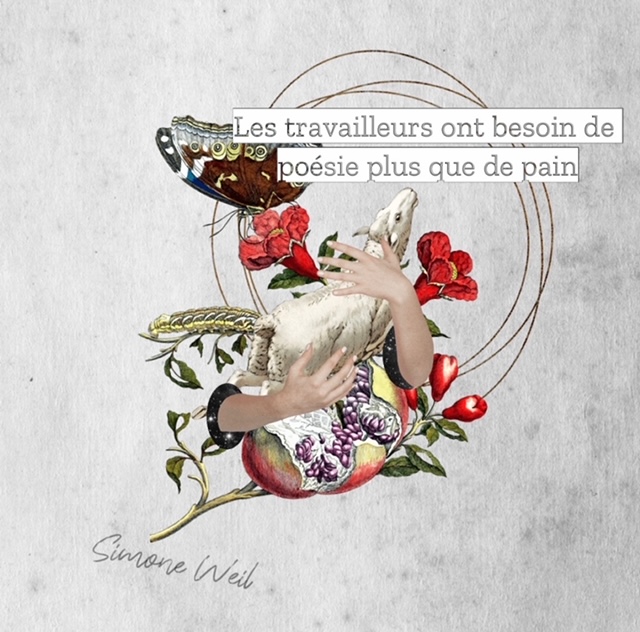
*Les travailleurs ont besoin de poésie plus que de pain is part of the “Workers and Mysteries” chapter in Gravity and Grace, and it continues with Seule la religion peut être la source de cette poésie. (Only religion can be the source of this poetry).
*I hope you will accept this critique, even though it references literature. While it does not mention Kantian thought, it can reflect it as well.
*Les travailleurs ont besoin de poésie plus que de pain appears in the “Workers and Mysteries” chapter of Gravity and Grace, followed by Seule la religion peut être la source de cette poésie. (Only religion can be the source of this poetry).
References:
• Simone Weil 『La pesanteur et la grâce』『La Condition ouvrière』『Attente de Dieu』『La pesanteur et la grâce』
• Tome VI, volume 2, Cahiers 2 (septembre 1941- février 1942), Paris, Gallimard, 1997.
• George G. Humphreys, Taylorism in France, 1904-1920: The Impact of Scientific Management on Factory Relations and Society
• Plato / Allen, R. (TRN), 『The Republic』
• 暗い時代の三人の女性, 晃洋書房
• シモーヌヴェイユ アンソロジー, 河出出版
Please note that, as of now, this paper does not provide references to literature specifically addressing Catholic sacraments. The relevant details will be submitted at a later date.


 Chris Kyogetu