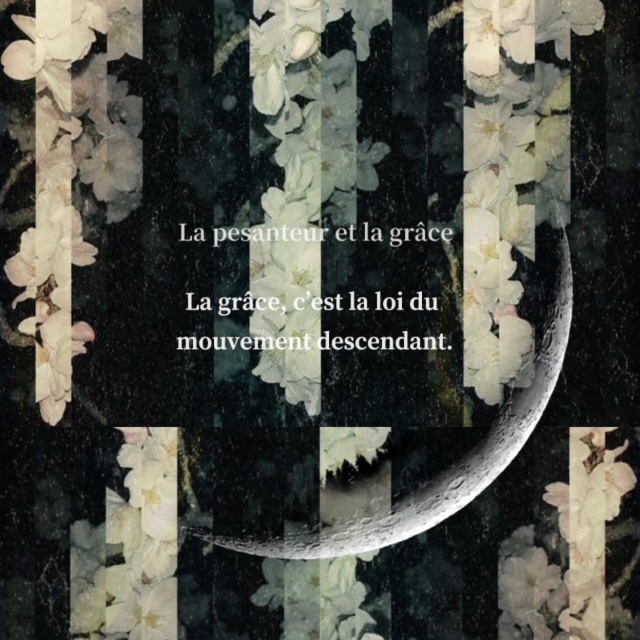
La pesanteur et la grâce (Gravity and grace)Simon Weil
・Tous les mouvements naturels de l’âme sont régis par des lois analogues à celles de la pesanteur matérielle. La grâce seule fait exception.
・Il faut toujours s’attendre à ce que les choses se passent conformément à la pesanteur, sauf intervention du surnaturel.
・Deux forces règnent sur l’univers : lumière et pesanteur.
Translation
・The natural movements of the soul follow laws similar to those of physical gravity, with the exception of grace.
・It is always to be expected that things will happen in accordance with gravity, unless supernatural forces intervene.
・The universe is governed by two forces: light and gravity.
note 1
So begins Gravity and Grace, a compilation of Simone Weil’s posthumous notebooks. She tries to explain human behaviour and interaction around the concepts of pesanteur (gravity) and grâce (grace).
She explains that the natural movements of our soul follow laws similar to the physical law of gravity. The only thing other than gravity is grace, and we should always expect things to proceed according to gravity, unless there is supernatural intervention.
“Tous les mouvements naturels de l’âme sont régis par des lois analogues à celles de la pesanteur matérielle. La grâce seule fait exception.“
The grammatical features of this sentence are as follows
Subject: ‘Tous les mouvements naturels de l’âme’ (all the natural movements of the mind)
Predicate: ‘sont régis par des lois analogues à celles de la pesanteur matérielle’ (governed by the same laws as physical gravity).
Auxiliary verb: ‘sont’ (to be).
Verb: ‘régis’ (to be governed).
Object: ‘des lois analogues à celles de la pesanteur matérielle’ (laws similar to those of physical gravity).
Adverb: ‘seule’ (the only one).
La grâce seule fait exception. (But only grace is an exception).
*It is as though the bestowal of grace rests solely in God, the epitome of singularity.
Le Roi Lear et la pesanteur.
・Pesanteur. – D’une manière générale, ce qu’on attend des autres est déterminé par les effets de la pesanteur en nous ; ce qu’on en reçoit est déterminé par les effets de la pesanteur en eux. Parfois cela coïncide (par hasard), souvent non.
・Pourquoi est-ce que dès qu’un être humain témoigne qu’il a peu ou beaucoup besoin d’un autre, celui-ci s’éloigne ? Pesanteur.
Lear, tragédie de la pesanteur. Tout ce qu’on nomme bassesse est un phénomène de pesanteur.
・D’ailleurs le terme de bassesse l’indique. L’objet d’une action et le niveau de l’énergie qui l’alimente, choses distinctes.・・・・・・
Translation
・Pesanteur. – Generally speaking, what we expect from others is determined by the effects of in us; what we receive from them is determined by the effects of gravity in them. Sometimes this coincides (by chance), but often it does not.
・Why is it that as soon as one person testifies that he needs another a little or a lot, the other person moves away? Pesanteur.
・Lear, tragedy of heavyiness. Everything that is called vileness is a phenomenon of gravity.
・Moreover, the term vileness indicates this. The object of an action and the level of energy that feeds it are different things. ・・・・・・
note2
Matthew 23:12 – says, ‘But whoever has exalted himself, shall be humbled. And whoever has humbled himself, shall be exalted.’, but here the scribes and Pharisees were sitting on Moses’ throne. They put heavy burdens on people’s shoulders, but they would not do anything themselves. Jesus told the crowd and his disciples that there was no ‘teacher’ or ‘master’ on earth, only Christ.
Simone Weil equated William Shakespeare’s King Lear with gravity. Lear asks his three sisters about the depth of their love for him. The two sisters were verbal, but the youngest, Cordelia, could not speak, but showed it from her heart. He could not forgive Cordelia, so he banished her and shared his territory with the other two who had shown him affection. Then his tragedy began. In making this superlative judgement of Lear, he was betrayed by two of his daughters and lost his soldiers through indecision.
What Lear shared with them was territory, a symbol of his wealth, but as if he had shared his organs, his fate was cast into exile. Having misjudged who to trust, Lear ends up losing Cordelia, who truly loved and saved him.
The Bible also says in Proverbs, “Whoever responds before he listens, demonstrates himself to be foolish and deserving of confusion.” (Proverbs 18:13), but also in verse 12, “The heart of a man is exalted before it is crushed and humbled before it is glorified.”, verse 15, “A prudent heart shall possess knowledge. And the ear of the wise seeks doctrine.”, not just superficial things, but a wise and enlightened mind.
The preoccupation with ”gift expaned” in Proverbs (Proverbs 18:16) is precisely what makes following Jesus a priority and warns against dependence between people: ‘Whoever loves father or mother more than me is not worthy of me. And whoever loves son or daughter above me is not worthy of me.’ (Matthew 10:37). “But it is not to be this way among you. Instead, whoever would become greater shall be your minister;and whoever will be first among you shall be the servant of all.” (Mark 10:43-44).
Coincidentally, Leah said these words when she lost her soldier. “O, reason not the need: our basest beggars “Lear here questions his own reason and his material needs. This line foreshadows the beginning of King Lear’s spiritual collapse and self-reflection, forcing him to reassess his own folly and values.
Again, it is interesting to note that reviewing one’s mistakes is also accompanied by spiritual collapse, falling into what psychologists call psychological defences or a collapse of self-esteem. Catholics (and Christians in general) regard the discovery of sin as the starting point for repentance and conversion. Indeed, recent trials involving Catholics have revealed a psychological defence mechanism to avoid a collapse of self-esteem in clergy who break church law, who protest their innocence, and in lay people who beat their victims. It is as if they cannot see themselves in the mirror (now they see dimly as in a mirror: 1 Corinthians 13:12), as if love is the key to perfect knowledge and understanding, and that perfection is realised in love, but they are unwilling to see even that love. So God’s love and human sin are opposites, but in the same reflection. The art of recognising this is shown in Psalm 51, where King David confesses his sins before God and asks for forgiveness with a repentant heart. I note that in this Psalm King David expresses that he “repents with a sincere heart, looks at his sins and is honest with God in the depth of his heart”.
Jesus Christ also speaks of His teaching in Matthew 18:21-22, which calls for forgiveness to be given to sinners “not seven times, but seventy times” (Matthew 18:21-22). This teaching points to a heart attitude of looking at the sins of others and offering forgiveness.
D’ailleurs le terme de bassesse l’indique. l’objet d’une action et le niveau de l’ The act of lowering is indeed King Lear’s misjudgement, but the ‘sustenance’ of the subsequent wavering of his spirit with the realisation of his folly towards himself is the equivalent of staring into a mirror. The ‘sustenance’ of King Lear’s subsequent wavering spirit with the realisation of his own folly is equivalent to his gazing into a mirror. He was able to recognise the love of his three wives because he had recognised their love for him. (Although Cordelia is killed.)
*Est-ce que (What) Interrogative
Vulgarity and Grace.
・Le bas et le superficiel sont au même niveau. Il aime violemment mais bassement : phrase possible. Il aime profondément mais bassement : phrase impossible.
・ ––− une vertu basse est peut-être à certains égards mieux à l’épreuve des difficultés, des tentations et des malheurs qu’une vertu élevée.
・La grâce, c’est la loi du mouvement descendant.
Translation
・The base and the superficial are on the same level. He loves fiercely but basely: possible proposition. He loves deeply but basely: impossible sentence.
・A low virtue is perhaps in some respects a better proof against difficulties, temptations, and misfortunes than a high virtue.
・Grace is the law of downward motion.
note3
––une vertu basse est peut-être à certains égards mieux à l’épreuve des difficultés, des tentations et des malheurs qu’une vertu élevée ––According to Simone Weil, a lower virtue may, in certain respects, prove to be more resilient in the face of difficulties, temptations, and misfortunes than a higher virtue. She contends that actions and feelings rooted in lower-dimensional motives and emotions hold equal value. In other words, she does not diminish the significance of lower dimensions but instead embraces them as if they represent the truth.
According to Weil, the concept of ‘gravity’ (pesanteur) represents the notion of ‘lower’ behavior and emotions in humanity. She argues that these ‘lower’ aspects are a manifestation of gravity. Additionally, she asserts that both ‘low’ and ‘superficial’ are comparable in their level of significance. The pronoun ‘he’ she uses alludes to the fact that intense emotions can coexist with lowly behavior, as exemplified by characters like King Lear. Moreover, Weil contends that it is impossible to simultaneously love in both a lowly and deep manner. She does not shy away from acknowledging the impact of heaviness and vulgarity in human behavior and emotions. It is as if she is gazing into a philosophical reflection, rather than an ecclesiastical one tied to religious institutions. Weil believes that actions and feelings originating from ‘lower motives’ are of equal value to those rooted in higher dimensions.
While there are no direct stories in Christianity that parallel King Lear’s mistakes, there are teachings and warnings in Christianity regarding human judgment and deceit. One such example is the parable of the Pharisees.
In the course of Jesus’ numerous miracles, the Pharisees are portrayed as religious leaders who sought to emphasize their adherence to religious laws and principles. However, they were self-centered and proud, as their focus on external actions and beliefs lacked inner transformation and genuine love for others. Through this parable, Christianity cautions against superficial faith and self-righteous attitudes, asserting that true faith is rooted in inner transformation and compassionate love for others.
In the case of King Lear, his initial choice may have appeared to be the right one, but it ultimately proved to be a mistake. This story not only teaches us the importance of focusing on inner truth and love rather than superficial judgments and words, but it also speaks to the concept of grace, which is bestowed upon us even though we cannot defy gravity.
Gravity can be succinctly translated as the scientific term ‘Zwaartekracht’, referring to the weight of an object on Earth due to the gravitational pull exerted by the planet. It encompasses the combined force of the universal gravitational pull of Earth and its rotation. The nature of mass suggests that objects do not attract each other directly, but instead, they distort the space around them, resulting in mutual attraction. While gravity governs the entire universe, its force is inherently weak, allowing birds to soar and us to move about freely. It remains weak as long as it asserts its dominion.
Leah’s ability to feel and suffer from Cordelia’s presence was subject to the influence of this never-ending, but never overpowering, force of gravity. So, too, her love must have been intertwined with God’s love.
This profound realization from Simone Weil’s choice of ‘Gravity’ suggests that the presence of gravity is necessary for the emergence of its opposite, ‘grace’.
*This is the Cahier, but if you have any suggestions, please contact us.

 Chris Kyogetu