Le faux Dieu change la souffrance en violence. Le vrai Dieu change la violence en souffrance.
“The false God turns suffering into violence. The true God turns violence into suffering”
Alors, où mettre le mal ?
“So, where does evil belong?”
Il faut le transférer de la partie impure dans la partie pure de soi-même, le transmuant ainsi en souffrance pure. Le crime qu’on a en soi, il faut l’infliger à soi.
“It has to be transferred from the impure part to the pure part of oneself, thus transforming it into pure suffering. We must inflict the crime within us upon ourselves”
Grammar
The use of the definite article, such as ‘Le faux Dieu’ or ‘Le vrai Dieu’, refers to a specific deity.
Verbs such as ‘change’, in the direct present tense, and ‘transférer’ refer to the transfer of a thing to another place.
Verbs such as ‘change’ in the direct present ‘transférer’ indicate that the thing in question is transferred to another place.
The expression ‘de soi-même’ is used to indicate the myself, the self.
The expression ‘qu’on a en soi’ indicates the self and refers to a sin related to the aforementioned part.
The expression ‘à soi’ indicates taking action against the self.
Note:
For some reason, ‘So where does evil belong’ was of interest to me. Weil seems to speak only to his own inner ‘mystery’ and ‘imperfection’. It seems like Nietzsche’s ‘self-transcendence’, which argued that the purpose of human life is self-realisation and transcending one’s own limitations and constraints.
However, the evil in the Catholic prayer ‘Lead us not into temptation, but deliver us from evil’ means ‘Satan’, so Weil, although a philosopher, is influenced by Catholicism, so in this case evil includes Nietzschean evil, but is also close to the Satan positioned by Catholicism is also close to the Devil.
Here, briefly, about Satan. The etymology of the word exorcism does not mean exorcism, but is derived from the Greek word ‘to swear severely, to declare’.
It is a declaration of faith by a person possessed or seduced by an evil spirit, acknowledging the absolute rule of God in Jesus.
Just as in the film The Vatican Exorcist, ‘sin finds itself’, so in the Gospels Jesus speaks of taking up his cross.
Satan, I can’t say for sure at the moment because I have no experience of exorcism ceremonies regarding Satan myself, but I think the story wanted to say that the true God turns violence (satanic) into suffering (cross), and with a false God, when he claims to perform miracles of God, he makes them satanic.
Reference
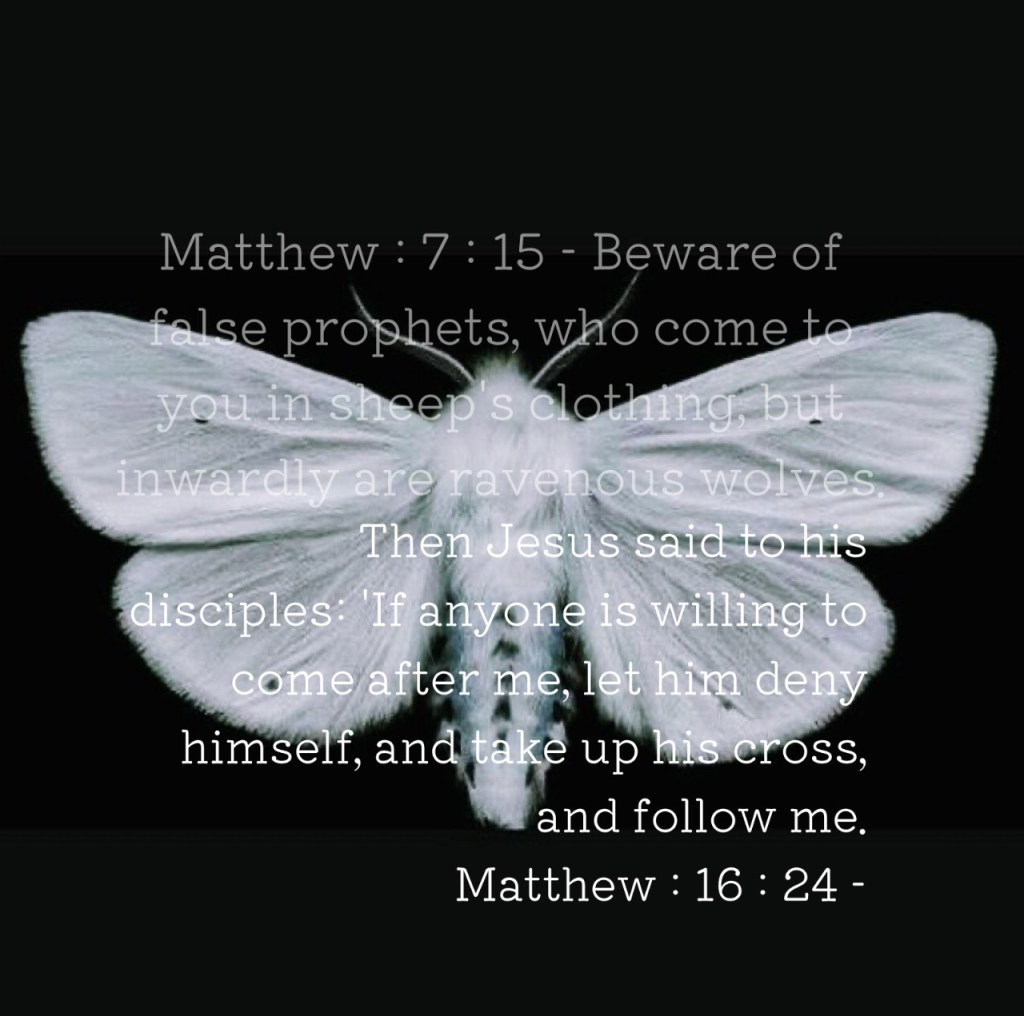
Matthew : 16 : 24 – Then Jesus said to his disciples: ‘If anyone is willing to come after me, let him deny himself, and take up his cross, and follow me.
Luke : 9 : 21 – But speaking sharply to them, he instructed them not to tell this to anyone,
Luke : 9 : 22 – saying, ‘For the Son of man must suffer many things, and be rejected by the elders and the leaders of the priests and the scribes, and be killed, and on the third day rise again.’
PATER noster, qui es in caelis, sanctificetur nomen tuum. Adveniat regnum tuum. Fiat voluntas tua, sicut in caelo et in terra. Panem nostrum quotidianum da nobis hodie, et dimitte nobis debita nostra sicut et nos dimittimus debitoribus nostris. Et ne nos inducas in tentationem, sed libera nos a malo. Amen.
Some people say the Bible is a piece of literature, but I believe the words of the unknown man who said, “The Bible is not literature. When I was a young aspiring writer, I started by accepting that I didn’t exist, like an “unnamed worm”. Fiction is also a way to leave behind what you want to say, but you can’t leave it behind if you write it the way it is. This is why it was necessary to think calmly and reject ideas by revising. Embracing that cruelty, with the Bible at the top, my ego is humbled. Because everything is written in the legacy of the past, with the Bible above:There is no virgin in the imagination, and that was the beginning of my life as a writer. It was about “writing a cruelty story”, especially about “Mob Justice”. The quotation from Romans, “The wages of sin is death”, continued to move across the manuscript as it has been rewritten many times:Sometimes it was the introduction, sometimes characters who never came into the world spoke about this quotation. Actually, the words of the Bible continue. “but the gift of God is eternal life in[a] Christ Jesus our Lord.“and it will be explained that Jesus offers forgiveness to those who cannot break the flow of sin, and that the dead cannot sin.
And Then There Were None and Bergson’s philosophy
I also preferred Agatha Christie’s “And Then There Were None” during my recuperation from 2018 onwards. There are no detectives in this story. From the perspective of the third person, each corpse appears to speak, and the truth is summed up in the letter of Aposiopesis. There are ten people gathered here who have committed crimes that cannot be judged by the law. One of the murdered victims, Emily Brent, was a fanatic who had driven her pregnant servant to suicide. Ten individuals gathered here have committed crimes that cannot be tried by law. One of the victims, Emily Brent, was a fanatic who forced her pregnant maid into suicide.
Maybe she thought she would be killed afterwards, but she tried to stabilize her mind with Psalm 91, which promises God’s salvation;” You will not fear the terror of night, nor the arrow that flies by day, nor the pestilence that stalks in the darkness, nor the plague that destroys at midday. But his prayers failed and he was bitten dead by a bee.
The tragedy of this isolated island is orchestrated by a plot to kill Justice Wargrave. In the relentless passage of time, it is Bergsonian that the time of consciousness and the time of the world do not always coincide, but Emily’s decisions in the inner world of faith distort the outer world. He focused on the sins of the unpunished. Pure and inner awareness does not necessarily mean pure and enduring Christian love, light and goodness: Philosophical purity refers to universality and does not limit itself to ethics.
Killing by sanction is the unwritten law of that which emerges when philosophy and theology are trapped and concealed by ethics. Our sins are condemned by our faith and remitted by God. However, that is not always the case in the society in which we were born. The judge looked at this and came up with this plan. The best part of the story, the apparent killing puppet, was based on a poem from Mother Goose.This poem is also old and was originally written by the poet Mother Goose, and is translated as “Indian doll” or “soldier doll”. This poem is also originally symbolized black people, but was later changed to Indians.
Imitate murder is performed with dolls symbolizing the occupation and persecution. Matter is memory, the dualism of mind and matter is present this murder story. The time on the island is not owned by anyone, the protagonists themselves do not exist, and they are manipulated by a fictional being, U. N. Owen who have invited ten people. Formlessness controls the destiny of this island. Matter, space and memory, the relationship between them, passes unnoticed as a philosophy by most people. Nevertheless, like dolls, they are aware as soon as the material becomes suggestive, and they are in danger of being themselves. They find significance in the poems and dolls of Mother Goose, and live in the plans of the true criminals. Elusive sounds live fluidly as aural sensations, a gramophone playing a mysterious voice that exposes the wrongs of each person. We find ourselves even frightened of the interplay of matter and spirit, a philosophy that makes us dull and sleepy.
Judge Wargrave must have been pleased with the sight. Like table manners, as if it were a rule that passes for manners, he enjoys playing the killing dinnder.【killing game】 With the sound of a gunshot, the killer Wargrave, made it look like he was dead. Rising from it, his Ghost Play accelerates further. Wargrave’s self-absorption is evident in the way he likens himself to the biblical Cain and Abel.
Cain committed the first murder in the Bible and lied about it, but God would not let Cain take his revenge. Therefore, the Judge is a clown with an aesthetic illusion of justice. Because God’s wish is that there should be no Mob Justice. However, Mob Justice and aesthetics are two sides of the same coin. The Thaumatropes, whose cage and bird are painted apart, looks like a bird in a cage.If you turn the picture, you can see the bird in the cage, as if they co-exist and are involved with one another. Literature was attracted to that. Other arts, including painting and music, do not deal with ” Mob Justice” Painting is confined to religious or “Public punishment” when it comes to judgement.
Words have various roles, from God’s word to poetry, proverbs, fiction and journalism. Painting and music are not taken seriously by everyone, while language is mastered by everyone, and everyone takes it seriously, sometimes speaking of love, sometimes speaking of lies. Words means simply disappear and disappear over time. For example, the phrase “I love you” also fades away, because words require perception, memory and experience. Love cannot live by words alone. Love is accompanied by feelings and actions. In addition, the word “love” is often associated with many human beings. Even before an incomprehensible love, we can recognize the direction. When love works, it knows that it is love by its deeds.:On the other hand, private killings and retributions do not allow us to easily understand feelings of cause and effect. The Indian poem of Mother Goose is a cruel poem, and the last Indian hangs himself. These ten people are enough to understand the meaning of the Indian poem. Their lives are threatened so that the pure continuity of consciousness and time ceases to be a theory, and they end up in the past ≒ memory without redemption.
Souls by Mob Justice
Like the ten invited guests, we do not see memory, time and space as separate objects.
According to Plato’s three ideas, (1) is the true, (2) beauty, (3) interest towards the good. Sternberg refers to this aesthetic interest in beauty. In the Bible we find such a composition in the Old Testament story of Hagar. Abraham’s wife Sarah could not have children, so she gave birth to a slave, Hagar. She gave the child the name Ishmael. Hagar’s situation is similar to that of Emily Brent, but in the end, Hagar is saved by God.
In the biblical world, “Thou shalt not kill” (Exodus 20.13) is based on faith, on the absolute God. In the biblical world, “Thou shalt not kill” (Exodus 20.13) is based on faith, on the absolute God. But does literature write about evil, breaking its promises with mischief? “Literature and Evil”, Georges Bataille made us believe that the best of literature is to search for evil in the veins of the world. Writers sometimes sort philosophically if it is necessary to write only imagination or experience.Then imagination is no longer enough, and they seek to make everyday life more than a dramatic statement. So this story is quiet. In And Then There Were None, the characters, with the exception of the murderer, can only see the surface of humanity. There is no investigator in the movie, and evil is not the key to unlocking good. If there is any confirmation of God’s existence, it is when the “fishing boat” accidentally picks up the confession that the judge put in a bottle and was never meant to be picked up. Christianity has a profound connection with fishermen. Peter was a fisherman, and Jesus told him that he would be a fisherman who would catch men. Within the framework of a mystery novel, however, this point of view would be like wash for gold. (Gold dust) But wouldn’t the real world be insipid without such a ‘point of view’ and ‘consciousness’? The paintings are useless when they burn, as the paintings of Carel Fabritius are displayed as survivors of an explosion. How does literature affect people? Literature is of the nature that what words and concepts represent and people’s feelings do not have a fixed Buddhist substance. Therefore “And Then There Were None” shows the cruelty of the writing world.
Painting can be explained in words, but it must exist as a picture. Literature can be placed beside the Bible, but it fails to achieve a visible space and form. In the past, when I painted, they congratulated me on my ability to draw and my sense of color. I was looking for myself in painting, with ideas and concepts. This is probably when my philosophical reflections became more impulsive. What cannot be put into words seeks no form, and then tries to rely on something to paint. It was a passion that emerged in my youth, but I wanted something more mature. I couldn’t stand the self-image that bounced back from my consciousness and my technique. It was a passion I had when I was young, but I wanted something more mature.
I couldn’t stand the picture of myself bouncing off my consciousness and technique.: Like Van Gogh with his sunflowers and his obsession with color, I could not do it, I only saw thoughts of love and existence.
In the 21st century, philosophy and psychology are moving away from the soul. That is because it requires an ethical, moral, or religious viewpoint to describe them. But literature is still allowed to write the soul. Nietzsche described vengeful feelings as Ressentiment. By morality, the weak demonize the strong. This inversion of values is weakened in Agatha Christie’s “And Then There Were None”. Murderers took pleasure in the guise of revenge by proxy. They were not killed with such vengeance or moral slavery. It all comes down to poems and puppets by ten Indians, killed and gone. The artist’s need for approval is said to be greater in the story, which explains this killer. His hidden desires and the realization of his pleasures took place on an isolated island. If he had wanted social honor, he would not have committed such a crime. He threw away his confession in a bottle, not knowing whether it would be picked up or not, which is another way of checking the soul. It is a “Mob Justice”. There is an impulse that can only be asserted in this way. In literature, “Mob Justice” is not an actual sanction. He throws his confession into a bottle, not knowing if we’ll pick it up or not. The only way to be sure of one’s soul is to leave it to chance at last. This is the end of the “Mob Justice”
I did not select to paint flowers, my quest was collected as a bird’s nest and tried to form and It was a beautiful feeling, both as phenomenology and as poetical feeling. The plants and trees collected by the habits and coincidences of the birds are also the Word of God, but some herbs do not bear the image of God. It is the root rot, the weak grass, the dying grass,
I would write such an “evil” in the next piece.
Literature and Mob Justice Overview
It took me six years to work on this theme. Writing about cruelty, like journalism, is not about separating oneself from others. Sometimes you have to reveal your own malice.
I dealt with Agatha Christie’s “And Then There Were None” and Bergson’s philosophy. An unfamiliar subject, matter and spirit, is criticized as abstract when read as philosophy, but in the face of a murderous game everyone understands its meaning.
Understood the meaning. Indian dolls represent their lives and die according to an unintelligible Mother Goose poem.
Philosophical consciousness is not a need to be confined to morality or ethics. It means that there is no necessity for religious goodness, and I have summarized these ideas in this introduction. I have tried to make my unpublished novel the main topic of this
Article. Mob Justice is the desire for recognition of the oppressed and erased soul. I do not consider myself a victim of being driven in this way. I will be back.
Some people argue that the Bible is a form of literature, but I am more inclined to agree with the sentiment expressed by an unknown figure who proclaimed, ‘The Bible is not literature.’ When I was a young aspiring writer, I began by embracing the notion that my presence was akin to that of an ‘unnamed insect.’ While fiction serves as a means to articulate one’s innermost thoughts, the challenge lies in presenting these thoughts in a manner that resonates with readers. This necessitates a discerning eye during the process of revision, with a willingness to excise what does not align with the intended message.
Embracing this narrative of brutality, with the Bible serving as the pinnacle, I found my ego humbled. Recognizing that the entirety of past legacies is encapsulated within the Bible’s teachings, I embarked on my journey as a writer, mindful of the absence of virgin territory in the realm of imagination. One lingering challenge that persisted for me was the task of ‘penning tales of cruelty,’ particularly in the context of ‘vigilante justice.’(mob justice)
The passage from the Letter to the Romans, ‘For the wages of sin is death,’ traversed my manuscript in various iterations, at times serving as the prologue, while on other occasions, being voiced by characters who never graced the narrative world. It is pertinent to note that the biblical text extends beyond this aphorism to elucidate, ‘but the gift of God is eternal life in Christ Jesus our Lord,’ underscoring the concept of redemption offered by Jesus to individuals ensnared in the cycle of transgression, where the departed are absolved of the capacity to sin.
And Then There Were None and Bergson’s philosophy
During my recuperation from 2018 onwards, I also came to appreciate Agatha Christie’s “And Then There Were None.” This story does not involve a detective. It is narrated in the third person, where each deceased body seems to speak, and the truth is eventually encapsulated in a letter of Aposiopesis. Gathered here are ten individuals who have committed crimes that evade legal judgment. Among the victims was Emily Brent, a zealot who had driven her pregnant maid to suicide.
Perhaps anticipating her own demise, she sought solace in Psalm 91, which promises divine salvation: “You will not fear the terror of night, nor the arrow that flies by day, nor the pestilence that stalks in the darkness, nor the plague that destroys at midday.” However, despite her prayers, she met her end being fatally stung by a bee.
The unfolding tragedy on this secluded island is masterminded by a scheme to eliminate Justice Wargrave. Amidst the relentless passage of time, a Bergsonian disconnect between the time of consciousness and the time of the world is observed. Emily’s internal worldview of faith influences her outward decisions. She fixates on unpunished sins. Pure and inner awareness does not necessarily equate to enduring Christian love, light, or goodness: Philosophical purity extends to universality and transcends ethics.
The act of sanctioned killing illustrates the unwritten laws that emerge when philosophy and theology are constrained by ethical considerations. While religion offers admonition for human sins and promises divine forgiveness, societal justice does not always mirror these principles. The judge turned his attention to this disconnection and conceived this narrative. The enigmatic centerpiece of the story, the staged murders through figurines, draws inspiration from a Mother Goose poem.
Originally symbolizing black people, the poem was later reimagined to depict Indians. These figurative killings, mirroring oppression and persecution, blur the lines between matter, memory, and the ethereal nature of the mind. Time on the island is elusive, as none lay claim to it; the very existence of the characters becomes transient, manipulated by the enigmatic entity U.N. Owen, who has lured ten individuals to the island. Incorporeal forces dictate the island’s fate.
The relationship among matter, space, and memory, often overlooked as mere philosophical abstractions by most, manifests tangibly, particularly when the material takes on suggestive undertones. Individuals uncover meaning in Mother Goose’s verses and symbolic dolls, as they unwittingly play into the orchestrated plans of the true culprits. A mysterious gramophone voice exposes each individual’s missteps, echoing as haunting aural sensations that unsettle even the most stalwart of characters, eliciting fear in the interplay between matter and spirit—a philosophical quandary that may leave one drowsy and disoriented.
The scene must have been quite favorable for the magistrate who orchestrated it. Just like good table manners(killing game) at a meal, he carried out the murders in a beautifully orchestrated manner. As the sound of a gunshot rang out, the culprit, Wargrave, feigned his death. Then, as he rose, his spectral drama intensified. Wargrave’s self-absorption is evident in his association of himself with biblical figures Cain and Abel. Cain, responsible for the first murder in the Bible, also resorted to lies. Despite this, God prevented Cain from seeking revenge. Consequently, the judge found himself ensnared in an aesthetic illusion of justice. This is because private punishment or vigilantism(mob justice) goes against the will of God. However, private retribution and aesthetic perception are inherently intertwined.
For example, ‘soma rope’ drawn separately.
A ‘soma rope’ depicting a birdcage and a bird separately creates the illusion of a bird within the cage. By turning the ‘soma rope,’ the interplay between the bird and its enclosure suggests a symbiotic coexistence. This Literature is likely to have honed in on this nuanced relationship. Unlike literature, other artistic mediums such as painting and music avoid delving into the realm of ‘mob justice.’ When it comes to rendering judgment, paintings tend to veer towards religious iconography or stop short at depicting ‘public punishment’.
Words serve various roles, from divine scriptures to poetry, proverbs, fiction, and journalism. While painting and music may not be taken seriously by everyone, language is a skill possessed by all, capable of expressing love or falsehood, engaging individuals earnestly. However, words simply come and go with time. Even the declaration ‘I love you’ fades, as words necessitate perception, memory, and lived experiences. Love cannot subsist on words alone; it requires emotions and actions as companions. Nevertheless, the term ‘love’ readily evokes associations for many. Despite the elusive nature of profound love, a sense of direction can often be discerned.
Love prompts actions, enabling one to recognize it through conduct. On the contrary, the emotions of cause and effect behind acts like murder or vigilante justice are not easily comprehended. Mother Goose’s Indian poem, a stark depiction, concludes with the image of the last Indian tragically taking his own life by hanging. These ten individuals grasp the full significance of the poem. The existential threat to their lives transforms the pure continuity of consciousness and time from mere theoretical musings into poignant realities. Furthermore, their narratives do not culminate in penance, but rather conclude within the realm of the past as intertwined with past ≒ memory.
Souls by Mob Justice
“Like the ten invited guests, we do not see memory, time and space as separate objects.
According to Plato’s three ideas, (1) is the true, (2) beauty, (3) interest towards the good. Sternberg refers to this aesthetic interest in beauty. In the Bible we find such a composition in the Old Testament story of Hagar. Abraham’s wife Sarah could not have children, so she gave birth to a slave, Hagar. She gave the child the name Ishmael. Hagar’s situation is similar to that of Emily Brent, but in the end, Hagar is saved by God.
In the biblical world, “Thou shalt not kill” (Exodus 20.13) is based on faith, on the absolute God. But does literature write about evil, breaking its promises with mischief? Georges Bataille made us believe that the essence of literature lies in uncovering evil. Writers sometimes ponder whether to write based solely on imagination or experience. Eventually, they find that imagination alone is insufficient, and they seek to capture the essence of everyday life. That’s why this story is serene, providing only a surface-level view of the characters, as no detectives are present in the narrative.
If there is any confirmation of God’s existence, it’s when a fishing boat accidentally discovers a confession that a judge had placed in a bottle, never meant to be found. Christianity’s association with fishermen is deep-rooted, and such unexpected occurrences can challenge our perceptions. In the grand scheme of mystery novels, these aspects may seem insignificant, yet they add a layer of depth to our understanding of the world.
Paintings, if destroyed, lose their meaning, similar to Carel Fabritius’s artworks after the explosion. Literature, on the other hand, has the power to impact individuals in unique ways, transcending physical space and form. How does literature leave a mark on people? It serves as a vessel for abstract concepts and emotions, portraying the fluid and ever-changing nature of human experience. The phrase ‘And Then There Were None’ encapsulates the brutal reality of the literary realm.
Art faces its true test when it remains as a solely tangible form, bypassing any need for verbal explanation. While painting is tangible, literature remains alongside the Bible but lacks a visual aspect. As I reflect on my past as an artist, it becomes clear that my pursuit was not of painting flowers but of exploring existence and love through art.
In the modern world, we find a disconnect between philosophy, psychology, and the soul, necessitating a return to a more religious perspective in order to address these fundamental aspects. Nevertheless, literature remains a powerful medium for delving into the complexities of the human soul. Nietzsche’s concept of Ressentiment and the inversion of values find echoes in Agatha Christie’s ‘And Then There Were None’.
The murderer in the story indulges in his desires under the guise of proxy revenge and pleasure, embodying hidden motives and selfish pursuits on the isolated island. His actions reveal an inner struggle for acceptance and validation. Ultimately, his act of discarding his confession into the ocean signifies a search for absolution, where chance plays a pivotal role in determining his fate. This narrative unfolds as a cautionary tale of vigilante justice.
My artistic exploration, akin to a gathering of twigs for a bird’s nest, aimed to give form to beauty and emotion. Despite the thorns and perils, every element in this artistic creation is akin to a word from a higher power. The process remains an introspective journey into the essence of existence and beauty, yearning for a deeper understanding of the human psyche.
In my next work, I aspire to delve into the darker aspects of existence, much like the shadows that lurk beneath the surface of our consciousness.”
Literature and Mob Justice Overview
It took me six years to work on this theme. Writing about cruelty, akin to journalism, does not involve separating oneself from others. At times, it necessitates exposing one’s own malice.
I delved into Agatha Christie’s ‘And Then There Were None’ in light of Bergson’s philosophy. While the subject matter of matter and spirit, when explored philosophically, is often criticized for its abstraction, in the context of a deadly game, everyone comprehends its significance.
In this predatory tale, Indian dolls symbolize their lives as they perish according to the cryptic verses of a Mother Goose poem.
Philosophical consciousness does not mandate adherence to morality or ethics. It indicates a lack of necessity for religious notions of goodness, which I have encapsulated in this introductory exposition. My aim is to elevate my unpublished novel to the focal point of this narrative.
‘Mob Justice’ embodies a yearning for acknowledgment of the downtrodden and marginalized soul. Despite being driven to the brink, I do not view myself as a mere casualty. I shall return.



 Chris Kyogetu