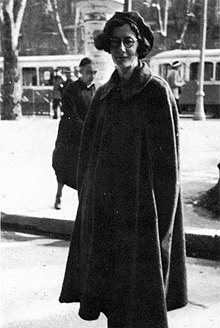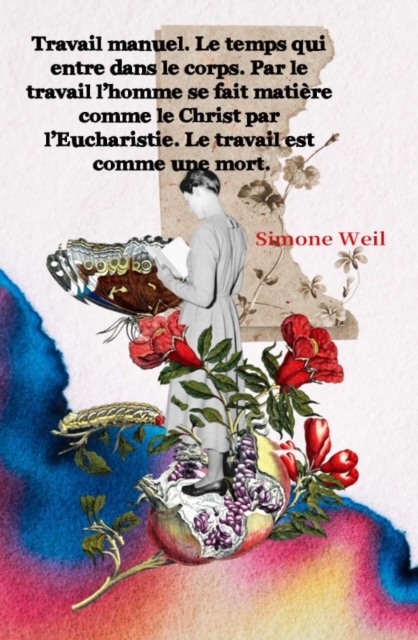
The Beauty and Poetry of Labour(1) Simone Weil /English

Les travailleurs ont besoin de poésie plus que de pain.
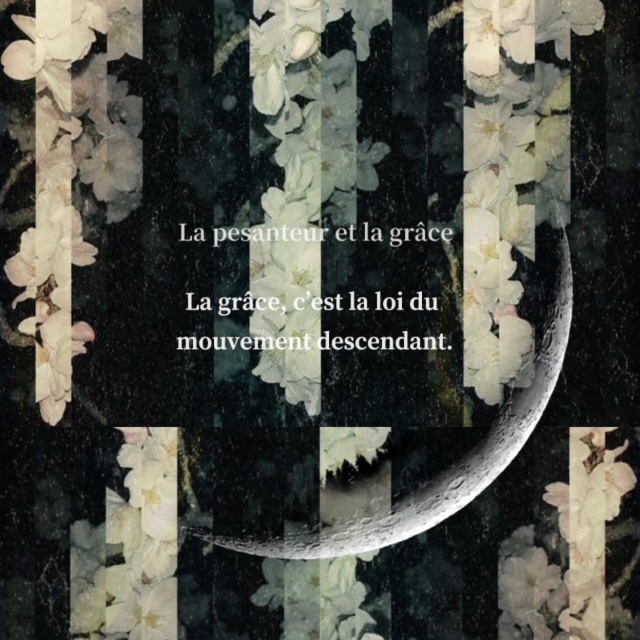
La pesanteur et la grâce Simone Weil

  1. Ⅰ.Introduction
  2. Ⅱ.Premonition
  3. Ⅲ .Turning Points and Contradictions
  4. Ⅳ ouvrière and ouvrier
  5. Ⅴ The labourer and Poetry’ (1) Plato, ed. 
  6. Continued in ‘Labour and Poetry (2): The Christ Edition.

Ⅰ.Introduction

Simone Weil’s life and philosophy were characterised by numerous intricate twists, as reflected in her writings, which offer a breadth of interpretations that often elude certainty as to whether she herself foresaw them. Her notebooks comprise a collection of fragmented reflections, which, after her death, were organised, edited, and published by her friends and fellow believers. Among her works, the celebrated Gravity and Grace (La pesanteur et la grâce) stands as a masterpiece, owing in no small part to the editorial contributions of Gustave Thibon.

The recurrent themes of ‘turning points’ and ‘contradictions’ in her philosophy, I argue, demonstrate a persistent consistency throughout Weil’s thought, especially in relation to her spiritual quest and profound engagement with Jesus Christ. Weil’s exploration of Jesus Christ led her to confront numerous religious and philosophical questions, which, I believe, served as a central axis that imparted coherence to her seemingly disparate transformations. Her efforts to reconcile faith with reason, and to deepen her understanding of life’s inherent suffering, demand thoughtful reflection, no matter how often one revisits them.

For me, engaging with her work remains an enduring source of profound joy.

Ⅱ.Premonition

In 1932–1933, a year before beginning her work in a factory, Simone Weil travelled to Germany to gain deeper insight into the foundations of fascism. In a letter dated 20 August, she observed that the Nazi Party had garnered support not only from the petit bourgeoisie but also from a significant number of unemployed individuals and other vulnerable groups. Although her stay in Berlin lasted just over two months, she retained vivid impressions of the city’s atmosphere. Former engineers struggled to obtain even a cold meal, yet no military personnel were visible on the streets.

At that time, Germany was grappling with widespread unemployment and severe hardship. In 1942, Weil confided in a letter to Father Perrin, with whom she shared a close relationship, expressing an inner conflict: “I know that if twenty German youths were to sing a Nazi song in unison before me at this moment, a part of my soul would instantly resonate with that of the Nazis. This is my profound vulnerability, yet it is how I exist.”

Upon her return from Germany, her analysis of the country encountered criticism from orthodox Marxists. Nevertheless, she endeavoured to support German exiles to the fullest extent possible.

Ⅲ .Turning Points and Contradictions

In his book Strength to Love, Martin Luther King Jr. draws on a quote attributed to a French philosopher, asserting that “a person who lacks a clear and prominent antithesis in their character is not strong.” However, the identity of the philosopher in question remains uncertain. King frequently invoked philosophical concepts in his speeches and writings, often referring to thinkers like Hegel to emphasise the necessity of balancing opposing forces to achieve harmony and progress. Hegel’s notion that truth emerges through the synthesis of thesis and antithesis aligns with King’s message of deriving strength and understanding through the reconciliation of differences and unity. Moreover, King observed that Jesus also preached about the fusion of opposites, as seen in his admonition: “I am sending you out like sheep among wolves,” and the instruction to “be wise as serpents and innocent as doves.” Although this teaching is undoubtedly demanding, it reflects the expectations that Jesus placed on his followers.

That said, Hegel was a German philosopher, which raises the question: which French philosopher might King have been referencing? Given the period, Gaston Bachelard is a plausible candidate. However, I argue that Simone Weil is equally likely. In late 1934, having resigned from her teaching post, Weil began working as a press operator in a factory, driven by a determination to confront the demands of the “real world.” Before embarking on this factory work, she had been preoccupied with the idea of creating “masterpieces” and “posthumous works.” Yet, the ideals she cherished proved difficult to sustain in the face of the harsh realities of factory life. She reflected on these experiences, recording: “I can’t help but think that interchangeable parts are like labourers. The parts seem to have more citizenship than we do,” as she entered the factory gate, displaying her numbered ID.

Simone Weil left behind a pivotal statement that encapsulates her philosophy: “What labourers need is not bread, but poetry.” During her time in Germany, she observed the plight of the unemployed and expressed her feelings of inadequacy to Father Perrin. The contradictions she grappled with in her philosophical and theological inquiries reflect the inherent complexity of human existence. Indeed, the notion that human essence is fundamentally complex has been explored by philosophers long before the advent of psychology. Plato’s tripartite conception of the soul and Aristotle’s examination of human nature in relation to logical virtues laid the foundation for this discourse. The exploration of human reason, emotion, and self-awareness evolved through the works of philosophers such as Descartes, Kant, and Hegel during the Middle Ages and Renaissance, expanding our understanding of the human mind. In the modern era, Freud’s scientific approach marked a critical turning point in this tradition.

Returning to Simone Weil, her assertion that “What labourers need is not bread, but poetry.” might appear paradoxical when juxtaposed with the brutal conditions of factory work. In such an environment, uncovering beauty and poetry presents a profound challenge. This tension echoes Hegel’s dialectic of thesis and antithesis. However, Weil’s philosophy, I contend, offers a distinctive perspective that requires deeper engagement with the complexities of the human spirit and psyche.

Weil also recognised that poetry could seem irrelevant to labourers, given the harshness of their daily struggles. She herself experienced the exhaustion and disillusionment intrinsic to physically demanding labour. Her philosophical explorations, particularly those rooted in biblical engagement, reflected the inner turmoil she faced. She even recorded that her distress in the factory was so overwhelming that she contemplated suicide by throwing herself into the River Seine.

Weil’s intellectual transitions and fragmented thoughts seem to form an inclusio structure, wherein statements that appear contradictory—much like the reflections of Koheleth in the Old Testament—gain coherence when examined in relation to one another. While Weil acknowledged that artistic expression had little relevance in the context of labour, she also explored the interplay between timepieces and artistry. She remarked that a clock, even when crafted with precision, functions without love, whereas a work of art requires love to resonate meaningfully. One may wonder why Weil insisted that “What labourers need is not bread, but poetry.” Even if we were to systematically outline the logical implications of her statement, conveying the mental state induced by labour at that time remains an arduous task.

I intend to unravel this challenge in my own way.

Ⅳ ouvrière and ouvrier

The direct translation of Simone Weil’s La Condition ouvrière is The Condition of the Labourer. The term ouvrière refers to female labourers, and in this work, Weil distinguishes between ouvrière and ouvrier, using the former to denote female labourers, including herself, and the latter to refer to male labourers. This distinction follows standard French grammatical conventions.

I am close to concluding that the salvation of a labourer’s soul depends primarily on their physical constitution.” While this idea is subjective, her use of ouvrier reflects an awareness of the collective and universal role of labourers. This distinction thus signifies both the importance of individual existence and a broader, societal perspective.

“mais jusqu’à quel point tout cela résisterait-il à la longue ? – Je ne suis pas loin de conclure que le salut de l’âme d’un ouvrier dépend d’abord de sa constitution physique. Je ne vois pas comment ceux qui ne sont pas costauds peuvent éviter de tomber dans une forme quelconque de désespoir – soûlerie, ou vagabondage, ou crime, ou débauche, ou simplement, et bien plus souvent, abrutissement – (et la religion ?). La révolte est impossible, sauf par éclairs (je veux dire même à titre de sentiment). D’abord, contre quoi ?” On est seul avec son travail, on ne pourrait se révolter que contre lui –La Condition ouvrière Simone Weil

Next, we turn to:

“But to what extent would all this endure over time? I am close to concluding that the salvation of a worker’s soul depends primarily on their physical constitution. I cannot see how those who are not robust can avoid falling into some form of despair—whether it be drunkenness, vagrancy, crime, debauchery, or simply, and far more often, stupefaction—and what of religion? Revolt is impossible, except in fleeting moments (even as a feeling). First, against what? One is alone with their work; one could only rebel against it.”

Weil’s expressive power is paradoxically revealed through her encounter with the flower of evil, exemplified by her exposure to the Bessarabo Affair (l’affaire Bessarabo) in 1920, when a man was murdered by his wife, and his body transported by train. This incident reflects the human longing for goodness, even in the midst of moral decay. Weil argues that the concept of sainthood—particularly of a female saint—is ultimately flawed. She possessed the strength to maintain opposition to idealised moral righteousness. Furthermore, her factory experience gave her first-hand insight into the lives of individuals lacking the resilience she had cultivated.

By ‘individuals lacking resilience,’ Weil refers to those without the physical and psychological endurance necessary to withstand harsh conditions. In this context, the physiological and psychological composition of the individual becomes critical in resisting social and economic pressures. For those with limited physical capacities, the risk of succumbing to despair in difficult environments increases substantially, often manifesting in addiction, social deviance, delinquency, or emotional paralysis. Moreover, their rebellions are typically reduced to brief emotional outbursts; without a clear target of opposition, the potential for meaningful change remains blocked.
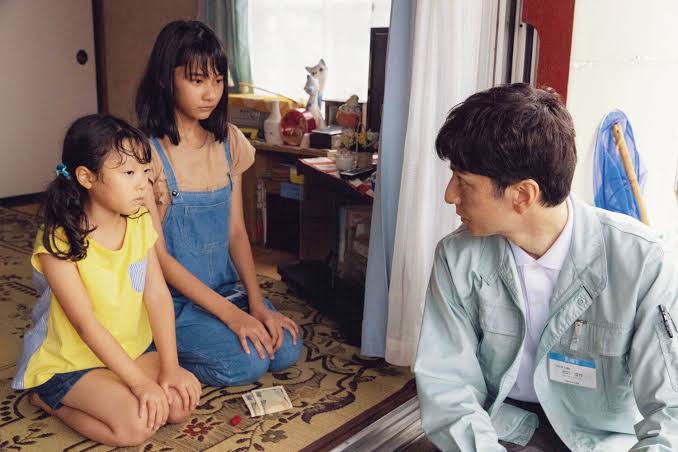
映画:「渇水」

(Drought -渇水)

This tension is also evident in the increasingly complex nature of contemporary poverty. The film Drought (渇水) portrays the struggles of a municipal water department worker tasked with visiting households and businesses in arrears on their water bills. When payment cannot be collected, he must carry out water shut-offs, cutting off access to water. During a summer heatwave, the residents affected by these shut-offs do not always present sympathetic cases. Some have fallen into despair, losing any sense of priority or financial planning. Others appear selfish, failing to pay their bills due to gambling addictions. In some cases, mothers in arrears prioritise their smartphones over their families’ essential needs.

In this context, the term labourers primarily refers to the water department employees. These workers often bear the brunt of public frustration, facing insults such as, “You’re just working for taxpayer money.” This conflict illustrates the tension between institutional policy and individual responsibility. Water shut-offs are implemented based on public policy, which must be applied uniformly to all users to maintain fairness and sustainability. However, these workers, despite being agents of the system, are human and must enforce these policies while facing resentment from those unable to pay. This dynamic extends to vulnerable groups, including single mothers, some of whom depend on men who leave them financially and emotionally stranded. In such cases, financial survival—not mere pleasure—drives their behaviour. Even under these circumstances, the water department employee may assist by helping families store water before shutting off their supply.

(Social Support and Institutional Constraints)

Support systems within institutions and society must continuously evolve to accommodate the needs of the vulnerable. Conversely, decisions to withdraw support on a personal level become necessary to safeguard mental health and the sustainability of shared resources. As individuals do not possess infinite emotional or material resources, boundaries must sometimes be established to preserve long-term relationships. In practice, however, people rarely have the clarity to assess these considerations when overwhelmed by hardship. This may partly explain why society often seems indifferent to individual tragedies.

Weil’s writings highlight how institutional inadequacies and injustices—such as precarious employment and insufficient social security—constrain individuals and perpetuate cycles of poverty. However, her reflections transcend the conflict between institutions and individuals by focusing on human fragility. Her philosophical inquiries explore what individuals can do and what emotions ought to be nurtured between people. Yet, the boundaries of these inquiries remain ambiguous. Weil’s search for meaning unfolds through the ‘hypothetical truths’ she articulated in her factory diaries. It is here that her concepts of ‘turns’ and ‘contradictions’ demand both lived experience and abstract understanding.

Ⅴ The labourer and Poetry’ (1) Plato, ed. 

In the secondary literature surrounding Simone Weil’s renowned work “Poetry for the Labourer,” many interpretations suggest that labourers may find salvation by cultivating sensitivity and mystical richness through engaging with poetry. However, I find that this reading does not align with my understanding of her text.

First and foremost, poetry revolves around ‘intuition,’ a concept that both the author and the reader must grasp. Yet, articulating such a concept within an academic or self-help framework is exceedingly difficult. Intuition resides in a realm that language may only partially express, never fully resolving it. While language is a powerful medium for conveying human experience and emotion, it remains inherently limited.

Spiritual fulfilment and cultural experiences often transcend the boundaries of language, relying on intuitive understanding and sensitivity. This realm encompasses complexities, depth, and contradictory emotions that resist verbal expression, manifesting instead as inner transformations and profound realisations. Weil herself noted that persuading others is challenging when relying solely on impressions without concrete evidence, yet she asserted that human misery could only be expressed through impressions: “Misery is constituted solely of impressions.” Through her writing, she captures the nuanced layers of human experience that extend beyond words.

In early 20th-century France, Taylorism—a system of scientific management developed by Frederick Winslow Taylor in the United States—was widely criticised. Taylorism divided labour into smaller tasks to maximise productivity, clarifying the roles of individual workers. However, the outbreak of World War I forced France to adopt Taylorist principles to facilitate the mass production of munitions. The need for efficiency and large-scale output led to the application of task specialisation and standardisation, improving productivity but rendering the work more monotonous and exhausting. Labourers faced faster-paced tasks with reduced autonomy, and both women and children entered the workforce. After the war, France pursued economic reconstruction and industrialisation, often under difficult conditions. Many factories operated with lax safety standards, subjecting workers to long hours and constant risks of injury. Wages were low, leaving working-class families in crowded, dilapidated housing, barely able to meet their basic needs. In this environment, Weil encountered the dehumanising aspects of factory work and observed the suppression of labourers’ potential.

Despite its limitations, recognising the value of language remains essential for fostering empathy and holistic understanding. Beauty, sensitivity, and intuition play crucial roles in bridging the gaps left by verbal expression. At the age of 16 in 1925, Weil demonstrated an early appreciation for the symbolic nature of wisdom, observing that “Plato’s thought is most beautiful when revealed through myths.” Although she frequently referenced Plato, her interpretations of Books VI and VII of The Republic were uniquely her own.

Weil engages with Plato’s metaphor of the ‘gigantic animal’ (θηρίον μέγα) in Book VI of The Republic, in which the state and society are likened to a vast and ferocious creature. This creature possesses distinct likes and dislikes, controlled by a ‘keeper’ who knows its tendencies well. What the creature favours is deemed “good,” and what it rejects is labelled “evil.” The key insight of this metaphor is that moral judgments are dictated by the preferences of the masses, symbolised by the animal. Plato warned of the dangers posed by societies governed by such relative and arbitrary standards. Weil aligns with this critique, emphasising that social morality is merely the reflection of collective preferences—nothing more than the likes and dislikes of a gigantic animal. She contended that morality, governed by social necessity, is inherently relative and can only be transcended through divine intervention. True goodness, in her view, must be directly revealed by God to the human soul.

Weil extends her engagement with Plato by reinterpreting Book VII of The Republic through the lens of love and ethics. Using the famous allegory of the cave, she argues that “humans must turn towards the good and love beyond themselves,” advocating for ethical growth grounded in a relationship with God rather than in intellectual achievements alone. Her interpretation moves beyond Plato’s educational theories, emphasising the moral and religious dimensions of human development. In Plato’s original text, the allegory of the cave depicts the gradual progression from ignorance to knowledge. While the focus is not on love, Weil reinterprets the allegory as a meditation on the capacity to love and the impossibility of self-love, comparing the eye’s inability to see itself directly with the limits of self-love.

Even in modern times, based on my own experience, when I worked part-time as a newspaper collector in 2013, I had to visit households to collect payments. The area I was assigned to mainly consisted of elderly people living in poverty. As solicitation and collection were handled by different personnel, I often received complaints about discrepancies between what had been promised and what was delivered. When payments could not be collected, I had to visit the same households two or three times. In practice, several elderly individuals were locked into auto-renewed newspaper subscriptions, unable to read what they purchased or withdraw cash due to physical infirmities. In some instances, I found elderly women wearing adult nappies, unable to dress themselves, calling out for help. Despite their circumstances, collectors could only leave notifications of unsuccessful payment attempts. Rooms were often filled with neglect and strong odours, a testament to the overwhelming difficulties these individuals faced.

Collectors lacked the authority to cancel contracts, even when it was clear that the other party could not fulfil their obligations. Without an explicit request to cancel, I had no power to advise them otherwise. These experiences revealed the limitations of personal enlightenment and sensitivity in addressing poverty and incapacity.

Collection work, while straightforward, does not cultivate transferable skills or essential competencies. It is a task that even children could perform, offering those without experience or qualifications an opportunity to earn a modest income. However, it requires patience and a significant degree of inner resolve. In stark contrast, proficiency in my primary occupation, details of which I will withhold, directly correlates with skill development through the completion of tasks. Skills gained from collection work, however, rarely translate into other career opportunities.

It is important to acknowledge that the situations I witnessed in these homes could one day become my own reality. Life viewed through a strictly materialistic lens suggests that a severe brain injury could render me incapable of sustaining my current lifestyle. If existence is reduced to mere materiality, the erosion of human dignity becomes an ever-present risk.

It may be argued that Simone Weil’s exploration of love and God was profoundly influenced by Platonic thought, particularly by reflections on the absurdity of Socrates’ execution, which deeply affected Plato himself. Articulating such abstract concepts is no small feat, requiring the translation of intuitive insights into verbal expression. Yet, for Simone Weil, this task was indispensable.

Following the Platonic tradition, Weil believed that liberation from the tyranny of society’s ‘great beast’ could only be achieved by transcending egocentric perspectives and locating one’s value in a relationship with God. For Weil, the inherent human capacity for love manifests in turning one’s attention beyond the material world, discovering true goodness through divine connection. This pursuit, for her, embodied the Platonic “Idea.” Plato’s exploration of ideal societies and true beauty rested on the notion that material existence is transient, with real value residing in the intangible. This resonates with Weil’s yearning for spiritual depth, symbolised by her emphasis on “poetry.”
Continued in ‘Labour and Poetry (2): The Christ Edition.

Cahier 2024/03/25 English


Und leider auch Theologie Durchaus studiert, mit heißem Bemühn. Da steh' ich nun, ich armer Tor, Und bin so klug als wie zuvor! And, alas, I studied theology too, with great zeal. Here I stand, poor fool, and am as wise as before!
Goethe, 'Faust'Der Tragödie erster Teil Nacht 

I. Die teure Gnade(2)Nachfloge:Dietrich Bonhoeffer

・Aus der Rechtfertigung des Sünders in der Welt wurde die Rechtfertigung der Sünde und der Welt. Aus der teuren Gnade wurde die billige Gnade ohne Nachfolge.

・Sagte Luther, daß unser Tun umsonst ist,・・

Die Erkenntnis der Gnade war für ihn der letzte radikale Bruch mit der Sünde seines Lebens, niemals aber ihre Rechtfertigung. Sie war im Ergreifen der Vergebung die letzte radikale Absage an das eigenwillige Leben, sie war darin selbst erst eigentlich ernster Ruf zur Nachfolge. Sie war ihm jeweils „Resultat“, freilich göttliches, nicht menschliches Resultat. Dieses Resultat aber wurde von den Nachfahren zur prinzipiellen Voraussetzung einer Kalkulation gemacht. Darin lag das ganze Unheil. Ist Gnade das von Christus selbst ge-schenkte „Resultat“ christlichen Lebens, so ist dieses Leben keinen Augenblick dispensiert von der Nachfolge. Ist aber Gnade prinzipielle Voraussetzung meines christlichen Lebens, so habe ich damit im voraus die Rechtfertigung meiner Sünden, die ich im Leben in der Welt tue. Ich kann nun auf diese Gnade hin sündigen, die Welt ist ja im Prinzip durch Gnade gerechtfertigt. Ich bleibe daher in meiner bürgerlich-weltlichen Existenz wie bisher, es bleibt alles beim alten, und ich darf sicher sein, daß mich die Gnade Gottes bedeckt. Die ganze Welt ist unter dieser Gnade „christlich“ geworden, das Christentum aber ist unter dieser Gnade in nie dagewesener Weise zur Welt geworden.

・Wenn Faust am Ende seines Lebens in der Arbeit an der Erkenntnis sagt: „Ich sehe, daß wir nichts wissen können“, so ist das Resultat, und etwas durchaus anderes, als wenn dieser Satz von einem Studenten im ersten Semester über-nommen wird, um damit seine Faulheit zu rechtfertigen (Kierkegaard). Als Resultat ist der Satz wahr, als Voraussetzung ist er Selbstbetrug. Das bedeutet, daß eine Erkenntnis nicht getrennt werden kann von der Existenz, in der sie gewonnen ist. Nur wer in der Nachfolge Jesu im Verzicht auf alles, was er hatte, steht, darf sagen, daß er allein aus Gnaden gerecht werde.


English translation

Luther said that our actions are in vain.・・・etc

The recognition of grace was for him the final radical break with the sin of his life, but never its justification. In seizing forgiveness, it was the final radical renunciation of the self-willed life, and therein itself truly a serious call to discipleship.It was always a “result” for him, a divine result, not a human one. However, this result was turned by his descendants into a fundamental precondition for their calculations.

If grace is the “result” of Christian life given by Christ Himself, then this life is not exempt from discipleship for a single moment. But if grace is the fundamental prerequisite of my Christian life, then I already have the justification of my sins that I commit in my life in the world beforehand. I can now sin in light of this grace; after all, the world is justified in principle by grace.

So I remain in my bourgeois-worldly existence as before, everything stays the same, and I can be certain that God’s grace covers me. The whole world has become “Christian” under this grace, but Christianity, under this grace, has become the world in an unprecedented way.

When Faust, at the end of his life, says in his work on knowledge: “I see that we cannot know anything”, the result is quite different from when this sentence is adopted by a student in his first semester to justify his laziness (Kierkegaard). As a result the sentence is true, as a premise it is self-deception. This means that an insight cannot be separated from the existence in which it is gained. Only those who follow Jesus by renouncing everything they had can say that they are justified by grace alone.

Consideration

In this text, Bonhoeffer focuses his discussion on ‘grace’. According to him, ‘grace’ is described as the ultimate deliverance from his sins and a sincere call to follow him for its bestowal. However, he points out the problem of his descendants merely accepting this ‘grace’ through rational calculation. Many Christians assume that ‘grace’ forgives sins and act as if they can continue to sin. By doing so, they assure the world of being protected by God’s grace. It is mentioned that the entire world has become ‘Christian’, but as a result, it has become more secular than ever before.

The understanding of God’s grace is described as his final radical conversion and decisive break with the sins of life.

The main clause “When Faust at the end of his life says in the work of knowledge” is the previous sentence.

“Gnade als Voraussetzung ist billigste Gnade; Gnade als Resultat teure Gnade. Es ist erschreckend, zu erkennen, was daran liegt, in welcher Weise eine Es ist dasselbe Wort von der Rechtfertigung aus Gnaden allein; und doch führt der falsche Gebrauch desselben Satzes zur vollkommenenen Zerstörung seines Wesens.”

It corresponds to. Grace is the cheapest grace, and the grace that follows is a costly grace. Understanding what lies behind the way Christian truth is stated and used can be surprising. It has been equated with justification by grace alone (justificatio). But the wrong use of the same word leads to the complete destruction of its essence.

Thought

Some clergy argue that in Catholicism, “forgiveness” and rituals are more important than Lutheranism. There are many prominent priests who currently avoid discussing the issue of deceitful clergy. They often present superficial and empty statements, despite their growing influence. The same can be said for the faithful who reflect on these matters. It is a sin to not pay attention to the essence of things and this group paralysis affects these victims. They should realize that they are depriving themselves of faith.

Even in Catholicism, Pope Francis, in the Apostolic Constitution Paschite Glegem Dei, has made the observance of disciplinary penalties an obligation that cannot be separated from pastoral duties. Specifically, the responsibility for correctly applying these penalties lies with the pastor and the superior of each community. I can only lament the Church’s continuous tolerance and “wait-and-see” attitude towards the shameful acts and offenses committed in the sacrament of absolution that have been revealed this time. Bonhoeffer’s emphasis on the relationship between knowledge and being, faith and action, and his assertion that true knowledge is connected to liberation from self-deception; could this also be applicable to Catholicism?

reference

“From an actual lawsuit in Japan:

“A victimized woman shares her real name and confesses, having believed in “being saved from suffering by following the priest,” the approximately five years of “sexual violence” she endured from a Chilean priest in the Catholic Church and the unjust actions of the religious order.””

2024/3/15の週刊女性Prime

https://www.jprime.jp/articles/-/31182?page=5

I quickly wrote down the details for the moving process this time as well.

Cahier 2024/02/19 English

La pesanteur et la grâce (Gravity and grace)Simon Weil

・Tous les mouvements naturels de l’âme sont régis par des lois analogues à celles de la pesanteur matérielle. La grâce seule fait exception.

・Il faut toujours s’attendre à ce que les choses se passent conformément à la pesanteur, sauf intervention du surnaturel.

・Deux forces règnent sur l’univers : lumière et pesanteur.

Translation

The natural movements of the soul follow laws similar to those of physical gravity, with the exception of grace.

It is always to be expected that things will happen in accordance with gravity, unless supernatural forces intervene.

The universe is governed by two forces: light and gravity.

note 1

So begins Gravity and Grace, a compilation of Simone Weil’s posthumous notebooks. She tries to explain human behaviour and interaction around the concepts of pesanteur (gravity) and grâce (grace).

She explains that the natural movements of our soul follow laws similar to the physical law of gravity. The only thing other than gravity is grace, and we should always expect things to proceed according to gravity, unless there is supernatural intervention.

Tous les mouvements naturels de l’âme sont régis par des lois analogues à celles de la pesanteur matérielle. La grâce seule fait exception.

The grammatical features of this sentence are as follows

Subject: ‘Tous les mouvements naturels de l’âme’ (all the natural movements of the mind)

Predicate: ‘sont régis par des lois analogues à celles de la pesanteur matérielle’ (governed by the same laws as physical gravity).

Auxiliary verb: ‘sont’ (to be).

Verb: ‘régis’ (to be governed).

Object: ‘des lois analogues à celles de la pesanteur matérielle’ (laws similar to those of physical gravity).

Adverb: ‘seule’ (the only one).

La grâce seule fait exception. (But only grace is an exception).

It is as though the bestowal of grace rests solely in God, the epitome of singularity.

Le Roi Lear et la pesanteur.

・Pesanteur. – D’une manière générale, ce qu’on attend des autres est déterminé par les effets de la pesanteur en nous ; ce qu’on en reçoit est déterminé par les effets de la pesanteur en eux. Parfois cela coïncide (par hasard), souvent non.

・Pourquoi est-ce que dès qu’un être humain témoigne qu’il a peu ou beaucoup besoin d’un autre, celui-ci s’éloigne ? Pesanteur.

Lear, tragédie de la pesanteur. Tout ce qu’on nomme bassesse est un phénomène de pesanteur.

D’ailleurs le terme de bassesse l’indique. L’objet d’une action et le niveau de l’énergie qui l’alimente, choses distinctes.・・・・・・

Translation

・Pesanteur. – Generally speaking, what we expect from others is determined by the effects of in us; what we receive from them is determined by the effects of gravity in them. Sometimes this coincides (by chance), but often it does not.

・Why is it that as soon as one person testifies that he needs another a little or a lot, the other person moves away? Pesanteur.

・Lear, tragedy of heavyiness. Everything that is called vileness is a phenomenon of gravity.

・Moreover, the term vileness indicates this. The object of an action and the level of energy that feeds it are different things. ・・・・・・

note2

Matthew 23:12 – says, ‘But whoever has exalted himself, shall be humbled. And whoever has humbled himself, shall be exalted.’, but here the scribes and Pharisees were sitting on Moses’ throne. They put heavy burdens on people’s shoulders, but they would not do anything themselves. Jesus told the crowd and his disciples that there was no ‘teacher’ or ‘master’ on earth, only Christ.

Simone Weil equated William Shakespeare’s King Lear with gravity. Lear asks his three sisters about the depth of their love for him. The two sisters were verbal, but the youngest, Cordelia, could not speak, but showed it from her heart. He could not forgive Cordelia, so he banished her and shared his territory with the other two who had shown him affection. Then his tragedy began. In making this superlative judgement of Lear, he was betrayed by two of his daughters and lost his soldiers through indecision.

What Lear shared with them was territory, a symbol of his wealth, but as if he had shared his organs, his fate was cast into exile. Having misjudged who to trust, Lear ends up losing Cordelia, who truly loved and saved him.

The Bible also says in Proverbs, “Whoever responds before he listens, demonstrates himself to be foolish and deserving of confusion.” (Proverbs 18:13), but also in verse 12, “The heart of a man is exalted before it is crushed and humbled before it is glorified.”, verse 15, “A prudent heart shall possess knowledge. And the ear of the wise seeks doctrine.”, not just superficial things, but a wise and enlightened mind.

The preoccupation with ”gift expaned” in Proverbs (Proverbs 18:16) is precisely what makes following Jesus a priority and warns against dependence between people: ‘Whoever loves father or mother more than me is not worthy of me. And whoever loves son or daughter above me is not worthy of me.’ (Matthew 10:37). “But it is not to be this way among you. Instead, whoever would become greater shall be your minister;and whoever will be first among you shall be the servant of all.” (Mark 10:43-44).

Coincidentally, Leah said these words when she lost her soldier. “O, reason not the need: our basest beggars “Lear here questions his own reason and his material needs. This line foreshadows the beginning of King Lear’s spiritual collapse and self-reflection, forcing him to reassess his own folly and values.

Again, it is interesting to note that reviewing one’s mistakes is also accompanied by spiritual collapse, falling into what psychologists call psychological defences or a collapse of self-esteem. Catholics (and Christians in general) regard the discovery of sin as the starting point for repentance and conversion. Indeed, recent trials involving Catholics have revealed a psychological defence mechanism to avoid a collapse of self-esteem in clergy who break church law, who protest their innocence, and in lay people who beat their victims. It is as if they cannot see themselves in the mirror (now they see dimly as in a mirror: 1 Corinthians 13:12), as if love is the key to perfect knowledge and understanding, and that perfection is realised in love, but they are unwilling to see even that love. So God’s love and human sin are opposites, but in the same reflection. The art of recognising this is shown in Psalm 51, where King David confesses his sins before God and asks for forgiveness with a repentant heart. I note that in this Psalm King David expresses that he “repents with a sincere heart, looks at his sins and is honest with God in the depth of his heart”.

Jesus Christ also speaks of His teaching in Matthew 18:21-22, which calls for forgiveness to be given to sinners “not seven times, but seventy times” (Matthew 18:21-22). This teaching points to a heart attitude of looking at the sins of others and offering forgiveness.

D’ailleurs le terme de bassesse l’indique. l’objet d’une action et le niveau de l’ The act of lowering is indeed King Lear’s misjudgement, but the ‘sustenance’ of the subsequent wavering of his spirit with the realisation of his folly towards himself is the equivalent of staring into a mirror. The ‘sustenance’ of King Lear’s subsequent wavering spirit with the realisation of his own folly is equivalent to his gazing into a mirror. He was able to recognise the love of his three wives because he had recognised their love for him. (Although Cordelia is killed.)

*Est-ce que (What) Interrogative

Vulgarity and Grace.

・Le bas et le superficiel sont au même niveau. Il aime violemment mais bassement : phrase possible. Il aime profondément mais bassement : phrase impossible.

・ ––− une vertu basse est peut-être à certains égards mieux à l’épreuve des difficultés, des tentations et des malheurs qu’une vertu élevée.

・La grâce, c’est la loi du mouvement descendant.

Translation

・The base and the superficial are on the same level. He loves fiercely but basely: possible proposition. He loves deeply but basely: impossible sentence.

・A low virtue is perhaps in some respects a better proof against difficulties, temptations, and misfortunes than a high virtue.

・Grace is the law of downward motion.

note3

––une vertu basse est peut-être à certains égards mieux à l’épreuve des difficultés, des tentations et des malheurs qu’une vertu élevée ––According to Simone Weil, a lower virtue may, in certain respects, prove to be more resilient in the face of difficulties, temptations, and misfortunes than a higher virtue. She contends that actions and feelings rooted in lower-dimensional motives and emotions hold equal value. In other words, she does not diminish the significance of lower dimensions but instead embraces them as if they represent the truth.

According to Weil, the concept of ‘gravity’ (pesanteur) represents the notion of ‘lower’ behavior and emotions in humanity. She argues that these ‘lower’ aspects are a manifestation of gravity. Additionally, she asserts that both ‘low’ and ‘superficial’ are comparable in their level of significance. The pronoun ‘he’ she uses alludes to the fact that intense emotions can coexist with lowly behavior, as exemplified by characters like King Lear. Moreover, Weil contends that it is impossible to simultaneously love in both a lowly and deep manner. She does not shy away from acknowledging the impact of heaviness and vulgarity in human behavior and emotions. It is as if she is gazing into a philosophical reflection, rather than an ecclesiastical one tied to religious institutions. Weil believes that actions and feelings originating from ‘lower motives’ are of equal value to those rooted in higher dimensions.

While there are no direct stories in Christianity that parallel King Lear’s mistakes, there are teachings and warnings in Christianity regarding human judgment and deceit. One such example is the parable of the Pharisees.

In the course of Jesus’ numerous miracles, the Pharisees are portrayed as religious leaders who sought to emphasize their adherence to religious laws and principles. However, they were self-centered and proud, as their focus on external actions and beliefs lacked inner transformation and genuine love for others. Through this parable, Christianity cautions against superficial faith and self-righteous attitudes, asserting that true faith is rooted in inner transformation and compassionate love for others.

In the case of King Lear, his initial choice may have appeared to be the right one, but it ultimately proved to be a mistake. This story not only teaches us the importance of focusing on inner truth and love rather than superficial judgments and words, but it also speaks to the concept of grace, which is bestowed upon us even though we cannot defy gravity.

Gravity can be succinctly translated as the scientific term ‘Zwaartekracht’, referring to the weight of an object on Earth due to the gravitational pull exerted by the planet. It encompasses the combined force of the universal gravitational pull of Earth and its rotation. The nature of mass suggests that objects do not attract each other directly, but instead, they distort the space around them, resulting in mutual attraction. While gravity governs the entire universe, its force is inherently weak, allowing birds to soar and us to move about freely. It remains weak as long as it asserts its dominion.

Leah’s ability to feel and suffer from Cordelia’s presence was subject to the influence of this never-ending, but never overpowering, force of gravity. So, too, her love must have been intertwined with God’s love.


This profound realization from Simone Weil’s choice of ‘Gravity’ suggests that the presence of gravity is necessary for the emergence of its opposite, ‘grace’.

*This is the Cahier, but if you have any suggestions, please contact us.

Cahier2024/01/22 English

Simone Weil, ‘Illusions’ (Gravity and Grace).La pesanteur et la grâce

・On se porte vers une chose parce qu’on croit qu’elle est bonne, et on y reste enchaîné parce qu’elle est devenue nécessaire.

・Les choses sensibles sont réelles en tant que choses sensibles, mais irréelles en tant que biens.

・L’apparence a la plénitude de la réalité, mais en tant qu’apparence. En tant qu’autre chose qu’apparence, elle est erreur.

L’illusion concernant les choses de ce monde ne concerne pas leur existence, mais leur valeur.

L’image de la caverne se rapporte à la valeur. Nous ne possédons que des ombres d’imitations de biens. C’est aussi par rapport au bien que nous sommes captifs, enchaînés (attachement). Nous acceptons les fausses valeurs qui nous apparaissent, et quand nous croyons agir, nous sommes en réalité immobiles, car nous restons dans le même système de valeurs.

ceux qui ont nourri et vêtu le Christ ne savaient pas que c’était le Christ.

English

・We are drawn to something because we believe it is good, and we remain attached to it because it has become necessary.

・Sensible things exist as sensible things, but are unreal as goods. Images possess the fullness of reality, but only as images.

・The illusion regarding the things of this world pertains not to their existence, but to their value.

・The illusion concerning the things of this world does not concern their existence, but their value. The image of the cave is related to value. We only possess shadowy imitations of goods. It is also in relation to goodness that we are captives, bound (through attachment). We accept false values that appear to us, and when we believe we are acting, we are actually immobile, as we remain within the same system of values.

・Those who fed and clothed Christ did not know that it was Christ.

1L’apparence

L’apparence means ‘appearance’ in French, but in legal philosophy and sometimes in psychology it is translated as ‘provisional image’. While a virtuality has the integrity of reality, it can also be misleading, not only with regard to the appearance of reality, but also with regard to other objects. This may be a feeling that is not common in Japanese concepts. Although Husserl distinguished between ‘imaginative action’ and ‘fantasy’, in phenomenology Husserl provided an approach to the idea of the provisional and value. The distinction between phenomena (physical sensation) and value (provisional representation) is also mentioned in Weil’s quotation.

ceux qui ont nourri et vêtu le Christ ne savaient pas que c’était le Christ.

・Phonological beauty: in this sentence there is a balance between vowels and consonants and a sense of rhythm. For example, the phrase ‘nourri et vêtu’ feels beautiful because the sounds are delicate and echo each other.

2 ’provisional image’ versus ‘conjectural’.

Provisional image refers to an image in the mind of an object or event that has not been directly experienced in the real world, based on imagination or speculation. Assumption is an unquestioning perception distorted by subjectivity with concepts that are different from provisional images. In essence, provisional images are realistic and contain misperceptions, but they are also correctable. Assumptions, on the other hand, are often not correctable. For example, in advertising and marketing, provisional images are used to attract people and make them stick to a product or service. We need to make sure that we do not miss the real value and benefit behind individual products and services. In the area of self-development and relationships, it is also important to focus on one’s own true needs and wellbeing, rather than getting caught up in the provisional images and expectations of others.

3 ’Good’ and ‘justice’.

Weil’s declamations seem to have philosophy at their heart, even though they are poetic in nature. This quotation, for example, may be based on the ‘good’ and ‘justice’ of ‘Platonic’ philosophy. In Plato’s ‘Republic justice is attributed to the soul. I think that the image of a ‘cave’ here is undoubtedly an analogy for the cave in Plato’s ‘Republic’.

The parable describes a situation in which people are trapped in a cave and live by seeing shadows projected on the walls by a fire at the back of the cave. They believed the shadows to be real and never left the cave. However, when a person escapes from the cave and sees the outside world, he or she discovers true reality for the first time. There were concepts and things that were different from the shadows he saw in the cave, such as light, colour and shape. This person discovered new knowledge and truths and tried to communicate their existence to the others in the cave, but they were convinced of the shadow world and refused to accept the truths of the outside world. This parable represents Plato’s ideas about the acquisition of knowledge and truth. The cave symbolises the material world and sensory experience, while the shadow represents knowledge through perception. On the other hand, the world outside, as seen by the person leaving the cave, would refer to the world of ideas and metaphysical truths. Plato’s parable of the cave is a metaphor for the fact that we can only see things in their provisional image or shadow form, not in their real form. The people in the cave only see shadows projected on the walls and cannot know the true reality, so although there are ‘provisional images’ in the cave, they cannot be said to be the true existence or reality. It suggests that the world we perceive is part of reality and that there is a truth or essence beyond it. It emphasises that ‘provisional images’ exist in some sense, but that they are not a complete picture of truth or reality.

This is also an example of the fact that truth and knowledge must be obtained through reason, and that true understanding is impossible as long as we are trapped in the material world and sense experience.

In Plato’s Republic, the desire to know the truth about justice interacts with the idea of the good, which is also characteristic of the French word Nous ne possédons que des ombres d’imitations de biens. C’est aussi par rapport au bien que nous sommes captifs, enchaînés. In Bient in, it can mean ‘good’, but it can also mean ‘possession’.

For example, what does it mean when translated as ‘property’?

We are trapped in a cave whose walls reflect the shadows of our possessions. But these shadows are not real possessions, they are only imitations. Because we are trapped in these shadows, we cannot know true ownership and luxury. If we could come out of the cave, we would experience true possessions and true wealth.

Even as ‘property’ he points to our obsession with material possessions and our missing out on true happiness and abundance.

So what if we think in terms of the good, which is the correct translation?

Trapped in a cave, what we see is not the real world but shadows, which are imitations or representations of reality. Shadows reflect true reality, but are themselves incomplete, and we cannot know true reality accurately. Goodness’ becomes the knowledge and rational understanding of true reality. By going outside the cave and seeing true reality directly, we can understand and accept true goodness. However, trapped in the cave, we cannot have knowledge of the true good and remain trapped in the shadow of mere imitation.

This parable is consistent with Plato’s advocacy of an ideal state and his insistence that philosophers should play a role in pursuing the true good and communicating it to others. It also suggests that in order to gain knowledge of the true good, we need to go outside the cave and engage in self-knowledge and self-transcendence.

Continuing the section, Weil adds a passage from the biblical Gospel of Matthew, chapter 26, verse 37, where he gives him food and clothing without recognising him as Jesus. This shows the difficulty of understanding Christ’s presence and the need to open people’s spiritual eyes. By treating this account in a provisional image, Weil may have been trying to express the universal theme of people’s contact with Christ (or a divine being) but their inability to understand his presence and truth, as well as the difficulty of mystical experience.

The biblical position on ‘property’ (in money),


Matthew : 6 : 19 – 21

Do not choose to store up for yourselves treasures on earth: where rust and moth consume, and where thieves break in and steal. Instead, store up for yourselves treasures in heaven: where neither rust nor moth consumes, and where thieves do not break in and steal. For where your treasure is, there also is your heart. 

This is not just a denial of material possessions, but a question of where the heart is. Those who gave food and clothing without knowing Jesus may have earthly possessions, heavenly treasures and ‘heart’. This is also related to Platonic ‘goodness’ and ‘justice’. As Plato wrote in the Republic, biblical ‘goodness’ and ‘justice’ do not just enrich the inner life of an individual. He believed that an individual’s goodness and justice is made up of a collection of individual goodness and justice. He taught that through the pursuit and practice of goodness and justice by individual souls, the nation as a whole can also realise goodness and justice. Reality, however, exists alongside provisional images and is difficult to put into practice. Provisional images’ are questions for the philosopher.

*This is not an explanation.

Cahier(2023/11/17/)English

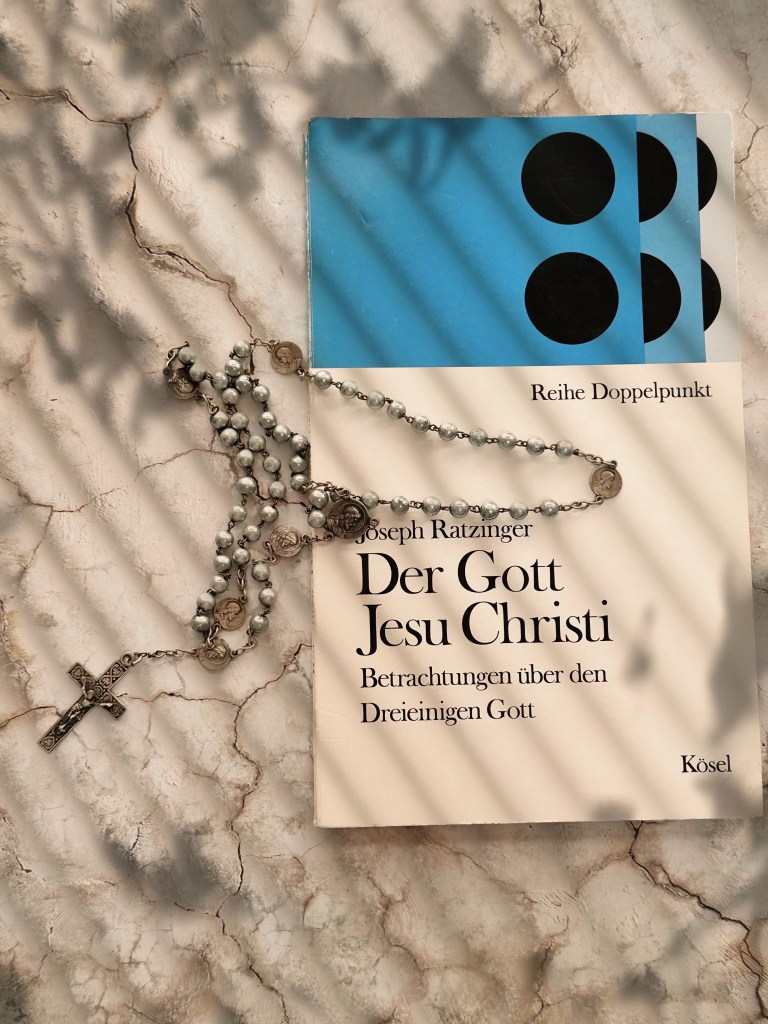
Der Gott Jesu Christi Betrachtungen über den Dreieinigen Gott.

Wieder kann man von hier versuchen, ahnend etwas über Gottes inneres Geheimnis zu sagen: Vater und Sohnsind die Bewegung reinen Schenkens, reiner Übergabe an- einander In dieser Bewegung sind sie fruchtbar, und ihre Fruchtbarkeit ist ihre Einheit, ihr völliges Einssein, ohne daß sie dabei selbst zurückgenommen und ineinander aufgelöst werden. Für uns Menschen heißt Schenken, Sichselbergeben, immer auch Kreuz.(Das trinitarische Ge- heimnis übersetzt sich in der Welt in ein Kreuzesgeheim- nis: Dort ist die Fruchtbarkeit, aus der der Heilige Geist kommt.

English translation:Once again, we can attempt to glimpse something of God’s inner mystery from this point: the Father and the Son are the movement of pure giving, pure surrender to one another. In this movement, they are fruitful, and their fruitfulness is their unity, their complete oneness, without being absorbed or dissolved into each other.For us human beings, giving of the self always entails the cross. (The mystery of the Trinity is translated into the world as the mystery of the cross: It is from this fruitfulness that the Holy Spirit emerges.)

Characteristics of the text

The text mentions ‘God’s inner mystery’, the distinctive parts of which contain mainly religious-philosophical elements.

「Vater und Sohn sind die Bewegung reinen Schenkens, reiner Übergabe aneinander.」:it contains philosophical discussions and analyses of individual words and concepts. The images of parent-child relationships and mutual gifts presented here represent ideas about the existence and nature of God.

・ 「In dieser Bewegung sind sie fruchtbar, und ihre Fruchtbarkeit ist ihre Einheit, ihr völliges Einssein, ohne daß sie dabei selbst zurückgenommen und ineinander aufgelöst werden.」:this statement illustrates the argument about the triune nature of God. It says that God’s existence is expressed as fullness and that this fullness is related to the unity of the Trinity.

・「Für uns Menschen bedeutet Hingabe, Selbsthingabe, immer auch Kreuz (Das trinitarische Geheimnis übersetzt sich in der Welt in ein Kreuzesgeheimnis: Dort ist die Fruchtbarkeit, aus dem der Heilige Geist kommt).」:In the interpretation of the Trinity of God in human experience and faith, the image of the cross and the concept of the Holy Spirit are themes often discussed in religious philosophy and theology and are also illustrated here.

As is characteristic of Benedict XVI’s writings, his texts are highly philosophical and show deep thought. He deals with religious themes and expresses mystical concepts. His writing is concise but dense, and each sentence is full of meaning. His style is rigorous and is used to convey certain concepts clearly. Benedict XVI sometimes uses a dialogical style, explaining his ideas in a supposed dialogue with his readers. This dialogue format may represent the one-dimensional personality of the one and only distant ‘Pope’. His writings show a fusion of rational argument and philosophy of faith. In particular, he uses ethical arguments to show that ‘faith’ and ‘reason’ are compatible. He seems to focus on communicating complex theological concepts in a way that is accessible to the general reader.

Summary

An attempt is made by Benedict XVI to understand the ‘secret of the Trinity’ together with the reader. The Father and the Son are described as engaged in a pure act of giving, in a work of ‘total devotion’ to each other. This work results in their fruitfulness, which is described as their perfect unity and oneness. However, it is also clarified that this process does not lead to their annihilation or merging into each other. It is further asserted that for human beings, giving and self-giving are always associated with the Cross. The secret of the Trinity is seen as manifesting in the world as the secret of the Cross. The explanation offered is that through the Holy Spirit, the Cross holds within it the potential for fruitfulness and abundance.

The difference between philosophical writing and everyday writing.

A philosophical text can be described as a multifaceted yet concise exploration of topics related to deep thinking and philosophical concepts. The term philosophia, coined by Socrates, encompasses the love of knowledge, also known as philosophy. These writings often employ logical reasoning. Both the current Pope, Pope Francis, and his predecessor, Pope Benedict XVI, can be seen as having philosophical elements in their teachings. They delve into concepts such as reflections on existence and religion, including faith, eternal life, the Last Judgement, the law of love, and the relationship with God. However, it is also necessary to provide more specific and succinct explanations using everyday language. For example, ‘Hingabe’ and ‘Selbsthingabe’ are German words meaning ‘devotion’ or ‘devotion to self’. To better comprehend their meanings, specific examples or situations can be used to explain them.

「Für uns Menschen bedeutet Hingabe, Selbsthingabe, immer auch Kreuz (Das trinitarische Geheimnis übersetzt sich in der Welt in ein Kreuzesgeheimnis: Dort ist die Fruchtbarkeit, aus dem der Heilige Geist kommt).」If the original text of the following were to be shown in more everyday terms,

「In unserem menschlichen Verständnis bedeutet Hingabe immer auch Opfer (Das Geheimnis der Dreifaltigkeit offenbart sich in der Welt als das Geheimnis des Kreuzes: Hier liegt die Fruchtbarkeit, aus der der Heilige Geist entspringt)」In our human understanding, devotion always implies sacrifice as well. (The mystery of the Trinity is meant to be unveiled to the world as the mystery of the Cross.)

「In unserem menschlichen Verständnis bedeutet Hingabe immer auch Opfer」The translation is more of an everyday expression than a philosophical reflection on ‘what it means to give of oneself’, in line with the idea that true human commitment always needs to involve some sacrifice (e.g. time, comfort).

Finally, to return to the original again.

Für uns Menschen heißt Schenken, Sichselbergeben, immer auch Kreuz.(Das trinitarische Ge- heimnis übersetzt sich in der Welt in ein Kreuzesgeheim- nis: Dort ist die Fruchtbarkeit, aus der der Heilige Geist kommt.

“The reason why there are two instances of ‘der der’ is that the first one, ‘aus der’, translates directly as ‘from’, indicating that something is coming out of ‘der Fruchtbarkeit’ (abundance). In this context, it signifies the coming out of ‘der Heilige Geist’ (the Holy Spirit) from abundance. The second ‘der Heilige Geist kommt’ consists of the definite article ‘der’ and the noun ‘Heilige Geist’, signifying the arrival of the Holy Spirit. These elements represent the mysteries of the Trinity, which are of different natures yet closely intertwined.

If we were to write this without ‘der der’, for example,…”

Für uns Menschen bedeutet Hingabe, Selbsthingabe, immer auch Kreuz (Das trinitarische Geheimnis übersetzt sich in der Welt in ein Kreuzesgeheimnis: Dort ist die Fruchtbarkeit, aus dem der Heilige Geist kommt.(* Changing ‘Schenken’ and ‘Sichselbergeben’ to ‘Hingabe’ and ‘Selbsthingabe’ maintains consistency in context.)

“This is a trial translation and we would be grateful for any comments.

Following on from the previous edition, we have decided to include a memo-like section called “Cahier.”

Japanese

Cahier(15 November 2023). English

Introduction.

Starting this month, I will post “just a short analysis” of a text I like. The title will be Cahier (date).

I will also continue to update my previous critiques.

La pesanteur et la grâce 1

Today it is Simone Weil.

Ce n’est pas la faute qui constitue le péché mortel, mais le degré de lumière qui est dans l’âme quand la faute, quelle qu’elle soit, est accomplie. La pureté est le pouvoir de contempler la souillure.L’extrême pureté peut contempler et le pur et l’impur ; l’impureté ne peut ni l’un ni l’autre : le premier lui fait peur, le second l’absorbe. Il lui faut un mélange. —L’attention et la volonté 

In terms of gravity and grace (La pesanteur et la grâce), this is what is described in “L’attention et la volonté” (Attention and will).

Simone Weil was a 20th century philosopher, so the French language itself is not ancient. Simone Weil’s original text (in French).

The characteristic feature is a literary melody, and this quotation does not rhyme, but some words and ideas are repeated, so there is a sense of rhythm,The choice of words and phrases are thought-provoking and complex in a short text.

 Translation: It is not the fault that constitutes mortal sin, but the level of enlightenment present in the soul at the time of the transgression, regardless of its nature. Purity is the ability to contemplate impurity. Extreme purity can contemplate both the pure and the impure; impurity can do neither: the former frightens it, the latter engulfs it. It requires a mixture.

・The term “mortal sin” or “sin unto death”, although not a direct reference, is found in the New Translation of the Bible, 1 Romans 6:23: “For the wages of sin is death. But the free gift of God is eternal life in Christ Jesus our Lord. ”, etc., may also derive from Christian doctrine. Le péché mortel (‘the sin that leads to death’)

is translated as ‘mortal sin’.

Contempler (plural: contemple)’ is used, usually in the context of ‘to look at, introspection’, which is deeper than observation(look). The usual meaning is ‘regarder la souillure’, which means ‘to look at the dirt’.

Summary: This text is a short summary of the exploration of sin and purity. It states that sinning is not in itself a fatal sin, but the degree of light in the soul is what matters.

It states. It is because we are very pure beings that we have the power to see what is pure and what is impure. An impure thing is something that has been mixed with the impure thing.

So in terms of mixing, it is necessary to look not only at the pure but also at the impure.

Sacred and Secular phenomenology.

Why is it beautiful?
While I keep on chasing it,
My heart knows better than I do. Where to go for it.

A Sacred and B Secular. Chris Kyogetu
  1. 1Artwork with a phenomenological gaze.
  2. 2The Death of the Author
  3. 3Sacred and Secular Phenomenology
  4. Last ständig vorangent

1Artwork with a phenomenological gaze.

Have you ever thought about sketching a building on a street you pass every day, just once? It is a building you should see every day. You may be able to describe the features of the building, but you cannot spontaneously say how many windows it has. If you were to draw it, you would start by counting them.

It is difficult to find a place for sensitivity to live. Sensitivity cannot be used as a simple form of communication: living in the 20th-21st century, we are exposed to works of ‘expressionism’ and ‘artistic supremacy’, we are taught that we have ‘freedom’ (freedom by breaking away from religion) in our hands. We will see famous works of art as if they had been chosen by the freedom and good will of man.

But on the contrary, many questions will arise in front of the painting as to why a single painting is so expensive. Few people can explain why this one painting is worth so much, and its magical survival strategy as a business strategy. Apart from the fact that the Church commissioned the painting, there are many lies about how the demand for it was created. We accept the world vaguely, without subdividing it, like a building that does not know how many windows it has, but always exists.

A building has a role to play. But when I, as an outsider, try to sketch it, when I try to mix the external time of the building with the mental image of the building, when I start to count the windows, I have an inner world of my own.

When religions chose paintings, the criteria were simple. All that had to be painted was a saint, even if there was no understanding on the part of the church. Once people were painted, the subjects became endless. It is not known how many people have synaesthesia, so why are they chosen? How can one person’s ‘dream’ cost hundreds of millions of dollars? Some people can choose one or the other: manifestation through recognition by others, or manifestation of a value that only they know. Some people cannot choose. I am one who could not choose. The reason is that it is not as simple as the dichotomy between the sacred and the secular.

That is why we can no longer distinguish between them and the ‘sacred’. That is why the first thing to be baptised, as a sublimation from sensitivity to sensibility, is to learn ‘interdit’ in the body. 

A misunderstanding of Bataille’s ‘transgression’ by many irreligious people is that they assume that transgression into prohibition is the abolition or removal of the ‘sacred’, thereby confusing it with evolution – freedom. (Erotisme coll 10/18, p. 68,69) 

The eroticism of Bataille and Baudelaire, the fetishism of Roland Barthes, are not new discoveries. They were philosophies of the original state of nature that broke taboos. They understood Catholic sanctity and were oppressed by it, but did not seek to abolish it. We must not think of them only and by the authority of religion.

Interdit is the French word for Catholic prohibition…Because Bataille is French.

The Death of the Author

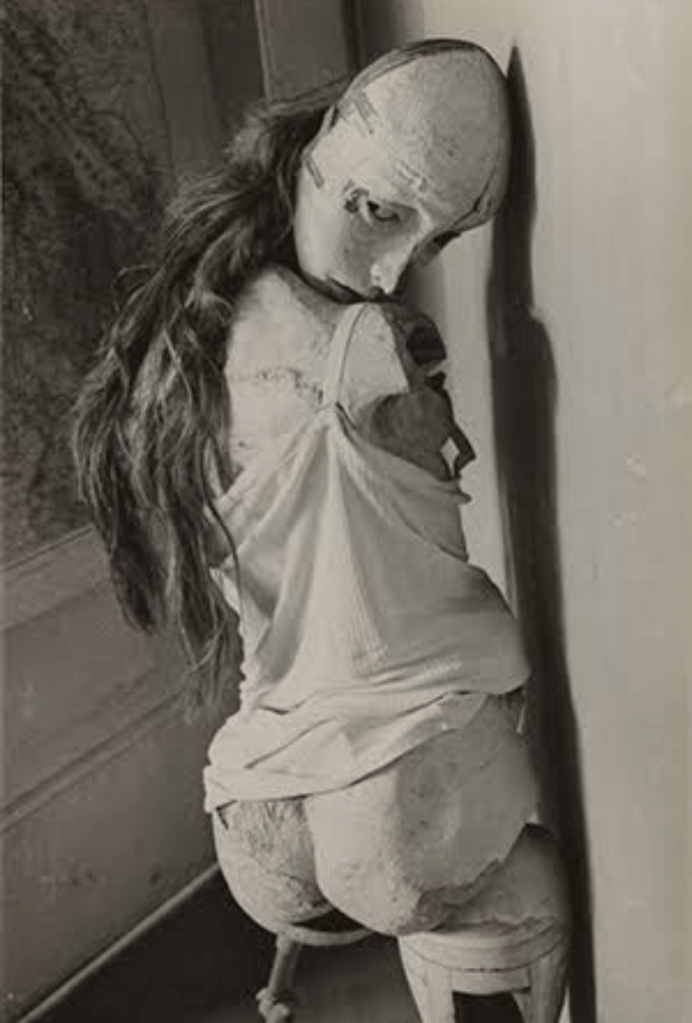
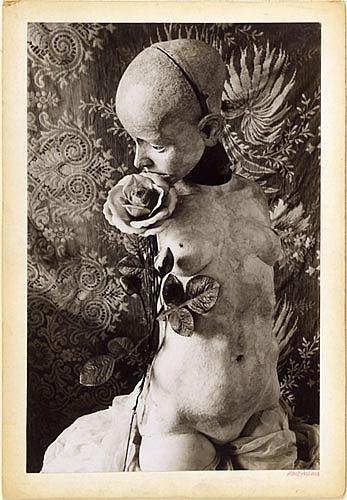
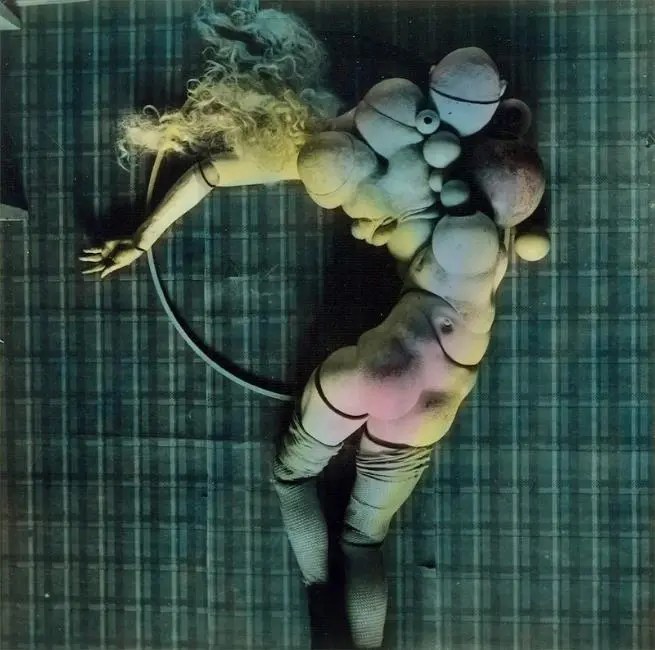
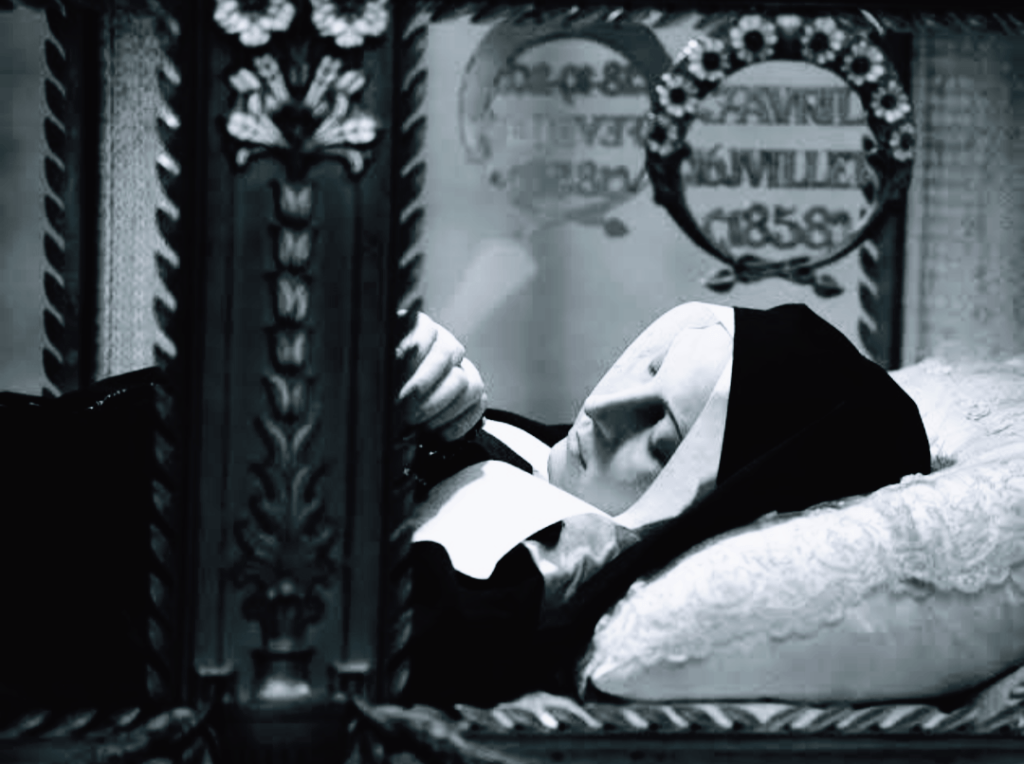
There are differences between the production processes of spherical-joint dolls and statues of the Virgin Mary. The statue of the Virgin Mary is dug out of a regular rectangle and does not show her nakedness (the skeleton and the flesh are conscious at the sculpting stage), but the spherically articulated doll is made out of material and is conscious of its nakedness.By associating the exposed genitals with the naked body and the mutilated corpse, it is even more related to the sexuality and death of the Battle philosophy.What is the entity confronting the spherically articulated doll? The answer is saints. Remember that St Bernadette is beautifully preserved as a mummy. She became not only a corpse, but a transcendent being, but does the doll qualify?

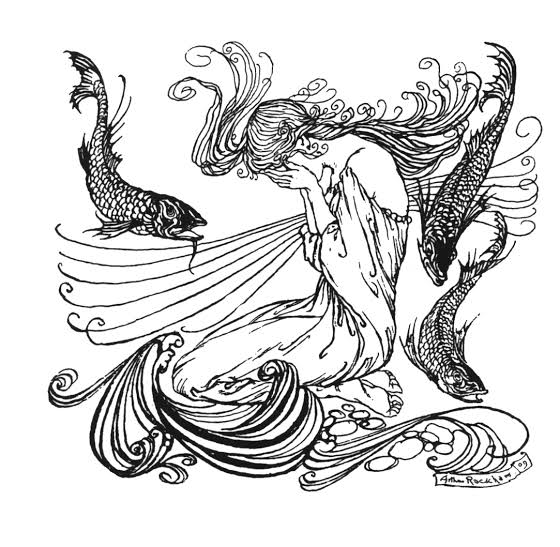
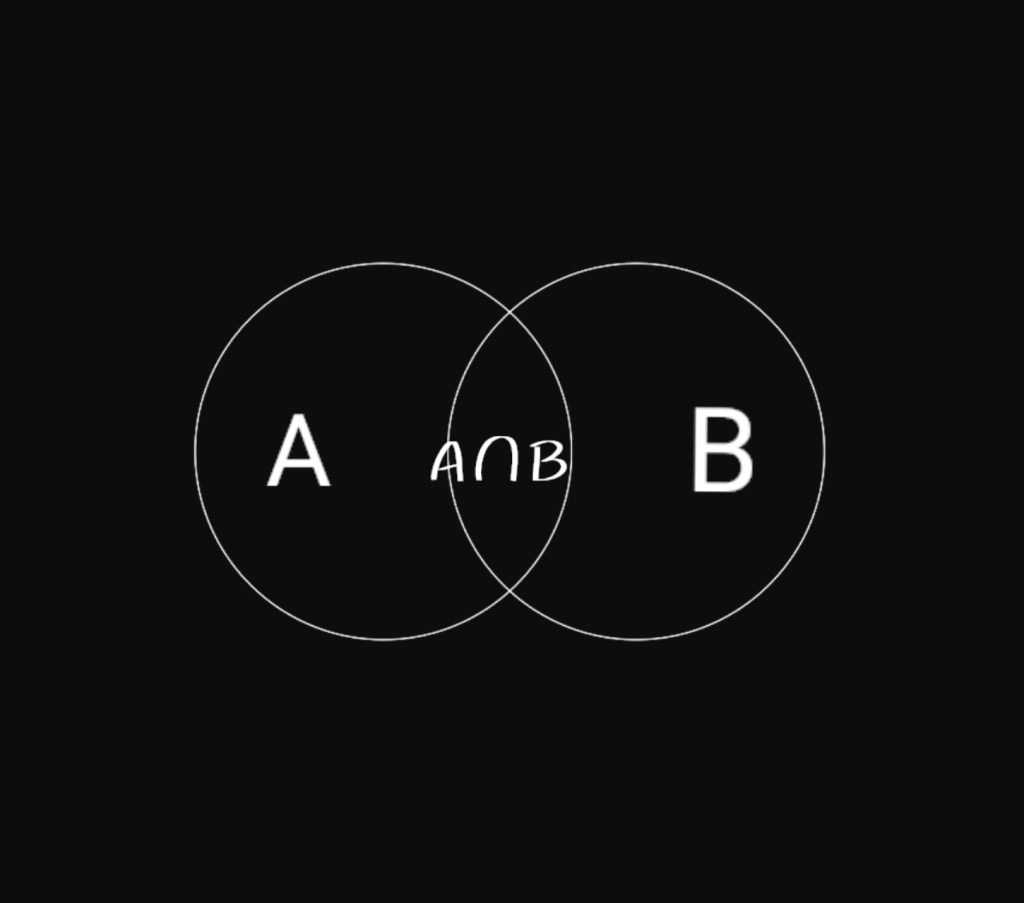
  At the intersection of the sacred and the profane in an A∩ B relationship lies the sacred part of art-humanity. Art in the Christian world is often like this. In literature, even in ‘Undine’, a Catholic priest creates the necessary conditions for the water nymph to become human.

But she dies because of human folly. What was the most beautiful thing in this story? It was the ‘love’ of the water nymph, who tried to approach the ‘human image’ defined by priests and Christian values. The tragedy of Undine having to kill the man who broke the contract is more love. Again, we can speak of a Bataillean transgression and interdit.

St Bernadette
Friedrich de la Motte Fouqué:Undine 
by Arthur Rackham

Hans Bellmeer’s doll is said to have left traces of secrets. It has a spherical belly, an artificial daughter, and it does not tell the story of its life. Dolls were toys, but this doll plays with the human psyche. Abstract works are often not judged by visual information alone and require a thesis from the painter, as in the case of Malevich. Nevertheless, what is always required is a work of sensitivity towards the reader or viewer. Whatever the author’s background, he or she emerges as a signifier. This is exactly what can be said of Roland Barthes’s ‘The Death of the Author’: the work and the author are two different ‘Ones’, and the work is not a manifestation of the author. However, an intuitive (synaesthetic) viewer may find fragments of the author. It is impossible to say when the effect of the symbols will be felt after a long period of time, but the role of symbolisation is to give form to ‘pain’ which is often overlooked in the world of war, racial oppression, ideas and writing.

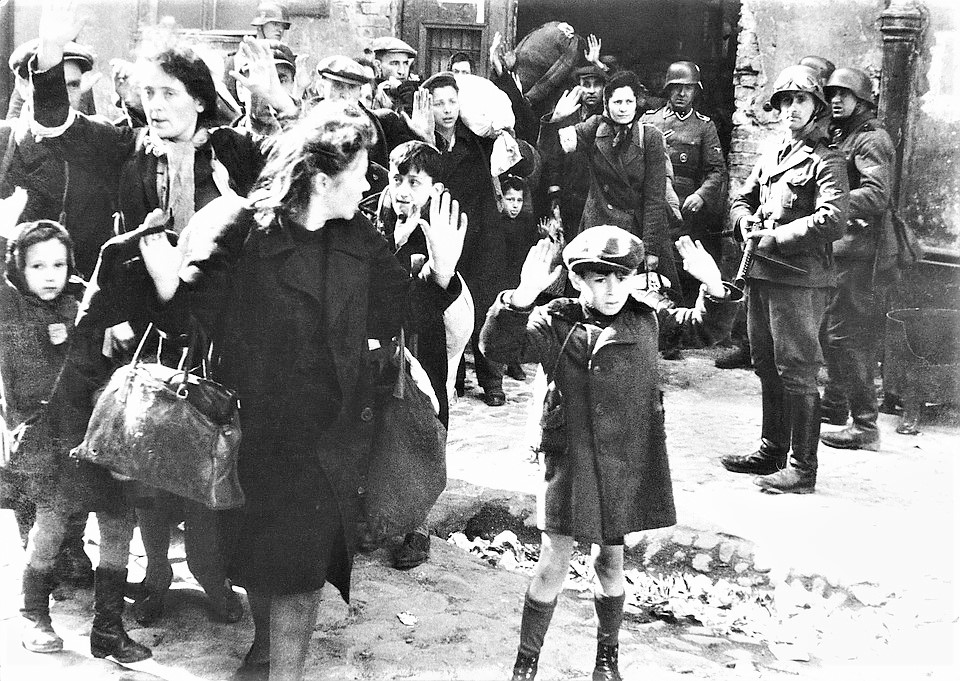
One of the things that has left a painful legacy is the cross-holes left in the Auschwitz camps, but it is impossible for us to experience the same pain. So is a place like Auschwitz enough to document the ‘tragedy’? War cannot be documented in many other ways. In times of catastrophe, we revisit the catastrophic past. But puppets can be applied to war and other contemporary tragedies. Artworks are prepared to be applied to many different positions.

In a sketch, the external value of existence is like counting the number of windows. You don’t need to know the number to have everyday problems. But when you start counting, it shows your humanity.

…… For example, you are a teacher. When you ask your students to draw, they all draw different pictures.

Is this pure work the same as an unjust or immoral mind? Unfortunately, as human functions, they are the same. If we were to assign superiority or inferiority to them, it would depend on the moral ethics of the time. As proof of this, we remember that Gauguin’s paintings were treated as pornography in modern times.

3Sacred and Secular Phenomenology

What should be Epoché (phenomenological suspension) regarding the sacred and the profane is ‘happiness’. Today, happiness is divided into happiness that can be communicated to others and happiness as the value of one’s own existence. People always live in search of happiness and do not want their happiness to be violated. If they are uncomfortable with religious talk, it is because their own sense of the value of happiness is shaken. Therefore, you must suspend the urge to be happy. Phenomena are not driven solely by happiness. We must recognise that reality. Are you under the impression that works of art make you happy? Well, that is a mistake to begin with. One’s own sense of happiness interferes with the perception of the sacred. This is also true for religious people, whose awareness of true happiness can become a word unto itself and lead to unaccountable injustice.

It is not to denigrate faith that phenomenology is concerned with phenomena. Religion has also become an obstacle for those who associate philosophy with happiness, but that is exactly what must be done to Epoché. It is tantamount to not even understanding actual existence. For they have stopped thinking about where in the world they have been dropped by the values of happiness: ‘I could be happy with philosophy without religion.’ Today, just as the poet Baudelaire defined God and the secular not as a dualism but as a vertically equal position from the human point of view, I see the relationship between the sacred and the secular not as a dualism but as a set theory, like A∩B. As a world event, the sacred does not ‘attachment’ but ‘includes’.

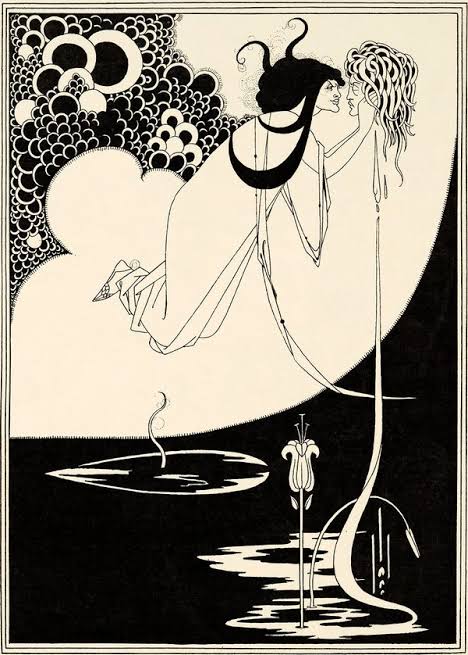
Oscar Wilde’s Salome example will be the last. John the Baptist, who was executed, was located at A-B. Oscar Wilde was an adaptation of the Bible but understood it well. Had he not attempted to convert to Catholicism, he would not have turned his attention to this ‘Interdit’.(prohibition)

Oscar Wilde’s Salome is not a simple indulgence. If he had chosen to tell an unregulated story, using only his imagination, he could have come up with an ending in which Jokanaan was not executed and Salome was not killed. He was well versed in freedom and law (Interdit) as to why Salome had to be killed. The evidence for this is that Oscar Wilde converted to Catholicism in his later years.

Jesus Christ crossed over to the people with his own feet, but Joan the Baptist (Jokanaan) obstinately refused to forgive King Herod’s unfaithfulness. In the Bible, Salome’s original book, John appeared to testify to the light (Gospel according to John, chapter 1) and to say that Jesus was the Son of God. John the Baptist was so righteous that he even advised against religious leaders. (Matthew 3:7-12)

I don’t know why Wilde understood this, however, it was biblically correct for him not to answer Salome’s love. Jesus can move from justice to love. It also makes sense to explain the Holy Spirit’s involvement in the events of this world that the Trinity has its own persona and that the Holy Spirit comes and goes.

Oscar Wilde: ‘Salome’.
Painting by Aubrey Beardsley.

The creator of a work of art dies, but we make a mistake if we see this death as just ‘death’. We must not forget that this ‘death’ is typical of Jesus. John the Baptist did not come back to life, Lazarus was a reanimation. Nor did Jesus’ resurrection give him another life, as in reincarnation. Even Mary, weeping at the tomb, did not recognise Jesus after the resurrection. Hans Bellmeer and other writers have also not been analysed and resurrected. They have only assumed their Creator, whom we have analysed from their writings and works.

It is banal for the transformation of the artist to be an observation only in the museum (and books). If it is to be a phenomenological reduction, it is to try to make the transformation everyday. Phenomenology is the philosophy of the everyday.

Last ständig vorangent

Jesus Christ, the number corresponding to the Hebrew letters, adds up to (Jesus 888 + Christ 1480 = 2368) These three together are a golden ratio of 3:5:8, but the Hans Bellmer doll is not St Bernadette, but the woman who modelled it lived while hiding the fact that she was a Jew There was a woman.

The golden section is already calculated and present before we recognise it. What you do for others, you will do for yourself, is the golden ratio in modern biblical interpretation (Matthew: 7, Luke: 6). What you do for others will come back to you, so much so that it’s even been written about in business books, and we don’t need the noun Christian to hold this idea in our hands. It is an undeniable fact that events are not driven by happiness alone, but if you are looking for happiness yourself, it is a wonder that you are attracted to ‘work’, even if you do not know the Golden Rule. People pray to the miracle of the saint, to the presence of Bernadette, but not to this doll that represents pain. What it imitates is the love of the artist. Because of love, there was anger in the world. And it represented the liberation of the soul. That is the meaning of free creation.

If you begin to look at the mystery of being, why you ‘exist’, rather than the glory of being recognised in life, you will experience communion with the sacred and the profane. Jesus Christ found the pain and sickness of the people. For this age, these were things that the world had rejected. Is there a difference between this act and the reflections and mere observations of philosophy?

Like Jesus, who was aware of his poor existence. It’s banal that a life ends just before someone’s authority is spread throughout the world. During the war, when it was common to see corpses lying around, there were artists who made dolls of the women they loved. Waiting for the war to end is the time of the mundane. The passage of time makes cities without the scars of war. It is a sacred time to look at the reality that hides the pain so that there is no pain, and to look at what is hidden.

In the original title of this article, ‘Sacred and Secular’, M. Eliade says that sacred time is time that can be repeated many times. The two types of time experienced by religious people and the phenomenological time scale are very similar. Chronos (outer time) or Kairos (inner time). Inner time has its own time axis. When the sacred and the religious (sacramental) come close together, it is a different story because it requires ‘faith’. Consciousness is at the door of faith. When we are in front of it this time, we are happy. Belief and faith are two different things, I will not go any further.

Faith and susceptibility are closely connected. It has euphoria and tragedy, as if it were a soul. To be a creator and to want to ‘manifest’, whether this is a mere performance of the brain or a gift from God, becomes from here an inseparable belief in philosophy, but I wish to be given new ‘eyes’ on the ‘happiness’ that I have kept hidden until now.

This article is a series of articles. It and a recounting of Salome and Undine, which I dealt with in my book Iconograph.
The Phenomenology of the Bird’s Nest, which is also my theme.
I drew inspiration from Simone Weil’s philosophy lectures, On Between Instinct and Function.

Birds form nests out of parts of their lives.
Is it the Word of God, as in Matthew 13, or inorganic parts?

Man’s Search for Meaning (English)

All of us in the camps knew and told each other that there was no happiness on earth that could compensate us for our troubles.

…trotzdem Ja zum Leben sagen:Ein Psychologe erlebt das Konzentrationslager
Viktor Emil Frankl

  1. First
  2. Second
  3. Third
  4. Fourth
  5. Fifth
  6. Last

First

Room 18 in the basement of the Auschwitz camp was the prison where Father Kolbe was held. Why is there a small window there? What did the sunshine mean? It was such a space, a mediocre room that a painter could paint rest in a poor hut, if analogy could be made. It smelled like dust and rust on my nose, and I don’t remember what the temperature was that day. Painful seems to rob me of a sense of the four seasons. I continue to listen to the color of my skin floating in the dark space and the description not in my native language, and I only pay attention to the words of my phase. Cruel places where many people have died, in fact, are neither special nor exist in Japan. For example, the station where the sarin gas attack on the underground took place. I passed there many times when I was a student. Sometimes it is hard to describe the weight of the souls that were cruelly taken away from us.

Not only that, but the Auschwitz camp was also a place where God and Jesus Christ did not come to save. Evidence of this can be seen everywhere in the other prisons, where crosses were dug into the ground with nails. They would have begged and pleaded, but salvation never came. It signals the despair of the invisible soul.

Second

In the concentration camps prepared by Nazi-Deutschland, it was not only people who died in gas chambers or from poison. Others died of suicide, starvation and disease. Deaths in the facilities, all of which are lumped together in the death toll of the camps, make concentration camps the root of evil. There were other dictatorships in other countries, but it seems to be a chosen place that has been so clearly narrated and left behind. We cannot easily ask locals about dictatorships in other countries. Comparatively speaking, the camps in Poland, which can be visited like Auschwitz, are an asset.

Why would something that was a democracy produce such a tragedy, I will not go into the details of German history this time. However, the birth of Nazi Germany was also a democracy for its time. In the case of Japan, the first thing that comes to mind is national review. How effective the national review is (Article 79 of the Constitution of Japan) is not clear to most people, although we know how it works, because none of the judges have yet been dismissed from the national review.

Realizations always spring up ‘after the fact’. There is a delusion about ‘democracy’ and democratic politics, but if there is cruelty, it is now hidden in the micro rather than the macro. Emotions from personal experience are not a problem, but the emotions of incidents happening on the other side of the world are just ‘excitement’ when you get right down to it. For example, If a celebrity commits suicide, you have feelings about it as if it were your own family. but Today, that would be a nuisance to the bereaved family.

Even if the bereaved family cries for understanding in a TV broadcast, if viewers sympathies with them and post it on social media, they are sued for defamation. For the victims, they make a fuss about being told by others without their knowledge. Only equivalent celebrities have the right to sympathy for the people on the other side of the television. That has become the modern age. More and more we are being meta and not exposed to the phenomenon.

Thus, in contemporary discourse, the view that it is not the fault of a single building, such as a camp, becomes natural. medical malpractice, or the problems in the schools, about what happened in that one space. It was suicide, so it was self-inflicted – it was starvation, so it had nothing to do with it – the cause of death was illness. ‘They didn’t all die the same way in the same space. So there is no scientific basis for it’ That is the modern world.

The ‘counter-existence’ is formed by what is given by the ‘counter-other’. One, if it is called ‘death without evidence’, its existence is determined. How do we accept the gaze that determines it? Do we take on that gaze honestly, or do we have a subjective self as a ‘counter-self’ in the Sartre sense? The difference between the objective gaze and the subjective self is ‘freedom’. V. E. Frankl in Man’s Search for Meaning also held on to ‘hope’ in Auschwitz, against the positioned decision. This is not a particularly unusual story, as it has been a guiding principle since the time of the Epictetus regarding servitude and freedom.

Third

I was shown the Gulf War on television when I was in primary school. Classes were interrupted and we kept watching the bulletins, which showed people lying under the rubble. Night vision technology was a hot topic at the time, and we were shown how easy it was to hit the target, even in an operation to set fire to an oil field on the Iraqi side to spread smoke. After saying that they would have been killed, the comment was made that it was probably a mother and son. Whether it was a US soldier, my memory is not clear. It was so disheartening that I wondered if people had really died at this moment. The homeroom teacher at the time explained that if there is a war now, it will not be like Grave of the Fireflies, and that weapons have evolved like night vision devices.

Grave of the Fireflies

As well as not doubting that all human beings are equal, we vaguely believed (as a certainty) that we had peace with Article 9 of the Constitution. Nevertheless, having children write about their thoughts on peace was as if to say that they can only write about it when they are children. Why do adults make children write, and why do adults stop saying it? Why do parents and homeroom teachers end up ‘teaching’ children? Why are people who talk about peace guests? Teachers and people close to them do not talk about what they know. People whose personal lives are not affected go home talking about their war experiences.

Eventually, as they grow up, some of their friends wake up and realis that what they have received was a left-wing education. Why is Article 9 supposedly admired around the world, but the world does not emulate it? Other countries have armies as normal. When ‘we’ raise questions about it, the world accuses us of leaning to the right. Yet the world calls that awakening ‘evil’. But that is only a fragment of the world. We don’t know the essence of the world. Article 9 of the Constitution is only a corner of it. The country of Japan is not as ‘known’ as it should be. But this is just another world I have walked through. The world is a wide place. The right answer is probably just as complex and wide.

It is not certain that even the Gulf War images seen at that time were real. The only reliable fact that can be traced back is “Stock price”. Stock price records seem to be the universal language. Analysis is subject to interpretation, but the figures do not lie: after Iraq invaded Kuwait on 2 August 1990, stock prices fell vertically. This is followed by a slump in October and November, but a slight rebound in December.17 January 1991, the Gulf War begins with the bombing of Iraq by Multinational Force Iraq.

Afterwards, it recovers to the same level as before the invasion of Kuwait. What was the tragedy we saw in the classroom then, and did the parents and children really die then? As an adult, I look at stock prices and other prices as if to overcome my childhood fears. When the contingency of war is also a certainty, the market raises expectations. Stocks recover as if the feeling of fear is ignorance.

Fourth

I had a strong sense of existentialism when I went back to my memory. Probably the generation that saw the Gulf War as children tended towards existential philosophy. (Strictly, with the ideal that existentialism could change the frustration that builds up) And those who educated us were inclined towards structuralism. Even John Paul II praised the structuralist Lévi-Strauss as a good philosopher.

Sartre and Husserl phenomenology were overshadowed, but the more they were hidden, the more I followed my ‘uncertain certainties’, because there was no being close at hand to answer the experiences I felt. Is what you see reflected in my mind something that is connected to the world? Yet it exists, even outside of consciousness. Even while we are asleep, the real world is stirring outside our consciousness. News of war is only part of reality. Of course, it is difficult to make a clear distinction between structure or existence as to why I felt the way I did about what is handed to me by the world. In all of them there is something to sympathies with and feel. 

Our generation was educated by those who did not benefit from the bursting of the Economic bubble, so the world was seen as ironic. At the same time, we were given a lot of dreams that never existed, such as ‘people are equal’. And even after a crisis like 911 in 2001, the economy always recovered: a 10% fall followed by a quick rebound. In fact, it was the Enron collapse in December 2001 and the WorldCom accounting fraud in June 2001 that caused the big drop. War would end the world, and it was only natural that this perception would fade.

Fifth

What do you think of Auschwitz? When asked that question, existence itself is a wall away for those of us who don’t think of everyday life in terms of war. What mattered was the world of peacetime. Man’s Search for Meaning were reinterpreted for 911 in a new translation in 2003. While the brutal images from the camps in the old translation have been erased, we have seen only the fireworks of peace slogans in the reality of the Iraq war. We bemoan the youth who don’t know human pain, but when we were children, we compensated for it with our imagination. But it didn’t mean anything when we understood it. The metadata personality of ‘not knowing human pain’ was formed that way even after the war. That would be an undeniable fact. 

Hannah Arendt warned that people imprisoned at Auschwitz would be forgotten over time. She referred to the tortured deaths of those held at Auschwitz, and the deaths forgotten with the passage of time, as a double death. This would be the Auschwitz camp I visited. The records as historical are not imbued with the space. In Room 18, where Father Kolbe was, there was just an empty space inside. He lived his life without thinking in terms of contingencies, and that is a testimony. What would this place look like if you came here with no prior information and an English translation for tourists? Events do not speak beyond information. Existence precedes essence “We mean that man first of all exists” It is an endlessly silent, somehow felt suppression. The meaning of the building’s existence continues to be expressed by human beings. The marks of the cross engraved with nails do not name the scribe. The proof that God did not come is still only despair. They say that it was futile to pray, or that Sartre was an atheist, but Frankl, who was imprisoned in Auschwitz, as a psychologist, left ‘hope’ behind.

In Auschwitz, a place where there is no creative freedom, he remained strong that only his inner life would not be taken away from him. There would naturally be a hidden escape. Those who believed they would be liberated by Christmas committed suicide on Christmas Day with the current of the iron bars. That is why Frankl feared easy hope. In the camps, some people gave alms to others even though they were suffering, while others became mad demons. In the absence of any soul-operating experience, he said that only the value of attitude would not be taken away, even in a place where it was not known whether God would come or not. It includes ‘prayer’.

When Man’s Search for Meaning was published(new translation)in 2003, it was introduced that those of us who had not experienced anything as bad as Auschwitz should naturally have ‘hope’. I thought at the time that was a little different. I thought about the meaning of why Frankl wrote about ‘hope’, which he portrayed in the midst of cruelty, rather than the ‘cruelty’ of Auschwitz.

The historical fact of Auschwitz comes in different forms. That is because human misery is inevitable. I think, even in retrospect, that I was a Sartre ‘condemned to be free’. We have always been forced to feel happy because we are at peace. But in fact, this is not the case. Only those who have known misery can realis this. Even if there is no war, everyone has misfortune, like Hisako Nakamura, who lost both arms. Hisako, who lost both arms due to illness, was brought up strictly by her mother. Like her, everyone falls into a situation where the ‘home’ itself is like a prison camp. Hisako, who was missing both arms, was given a sewing kit by her mother. Without arms, sewing means using the mouth. Naturally, saliva would get on it, but her mother did not allow it. When Hisako learned to sew, she showed the audience how she sewed as the ‘Daruma Maiden’ at a freak show, still holding a grudge against her mother.

Hisako Nakamura

Nevertheless, Hisako forgave her mother and was grateful. While this was based on her Jodo Shinshu teachings, she did not take what she was taught for granted. She realized that it was because of her mother’s strictness that she was able to become independent. But even today in Japan, although this idea is a beautiful story, the mother’s position is that of ‘abuse’. Society must provide ‘comprehensive’ support through welfare and other means to prevent this from happening. Frankl quoted Nietzsche on the most painful human suffering. ‘Suffering itself is not the problem. It is the lack of an answer to the cry ‘what is the cause of suffering’ that is the problem.”

This idea is a ‘freedom’ held by subjectivity, objecting to a given ‘being’. Frankl was also given the ‘fate’ of a dying Jew. But he held out hope. It is freedom but suffering. How freedom is a responsibility, and how heavy it is. Hisako is no different. From her position of being without both arms, she achieved a feat that was almost impossible. It is suffering, and it is ‘freedom’ that tried to overcome her position. All they are integrated into life as untold history. Auschwitz has become a metonymized entity: in Room 18, Father Kolbe took over the dying fate of other Jews. The world does not speak of them. It is ‘man’ who records them to the world. And yet, how many years can one leave behind? Why is it that the faces of anguish in paintings from centuries ago are still recognizable today? For example, Will Shakespeare still be around a hundred years from now? Why is it that what Father Kolbe did is still great today? It is man who makes sure that records are kept, but who creates the destiny that allows them to be kept?

Last

Sartre, who was a genius, missed his prediction before the Second World War when he said that Germany would not go to war. How did a dictatorship arise in Germany, which was supposed to be a democracy? The question can still be asked today. However, there is inevitably no end to speech and violence. This is because there is a ‘will’ in people. The will cannot be unified: the Covid19 epidemic has not subsided, the war between Russia and Ukraine, and in Japan the controversy continues after the assassination of former Prime Minister Shinzo Abe on 8 July 2022. I cannot recall a word from my childhood when I could so easily reject these conflicts. Children today may be cleverer, but a child’s words are not allowed to cross the world. Maybe that is why it is children who can go to the Kingdom of Heaven. (Matthew 19:13-15) 

Our pursuit of human goodness is not always beautiful. We move away from heaven little by little as we defile our souls, as we defile ourselves, as we struggle. We cannot abandon it because we must live with ‘will’. Even if we put an end to today’s challenges, is it something that will dissolve into history and be forgotten, or is it something that will be imprinted on individual souls?

Keeping silent, like the adults of the past, certainly seems like a bad thing. But what if we cannot protect our precious beings if we do not answer the demands of fate? If adults fight, children lose their place in the world. If teachers have made deviant statements, children feel insecure. Maybe that’s why they kept quiet back then. Was it adult self-deception? Or was  ‘consideration’? It is not possible in heaven to know the complexity of human beings. Is that not the will to struggle to live? If the dead sleep-in peace, the living must awaken. It will come, even in silence. 

We must have experienced hardships and cruelty in each of our growing up years. We should not compare our misfortunes with others. Invariably, there is some trivial love left in people. The driving force behind Frankl’s books can be said to be Agape. Faith in human goodness would be to remember that. Even if, in any future situation.

Weeds were beautiful in Auschwitz.

――Like Mary at the feet of Jesus.

Simone Weil-For laborer English

Simone Weil in Marseilles, early 1940s
・People who are considered 'invisible' need beauty and poetry.

・Laborers need beauty and poetry more than bread.

・Poets create beauty by giving attention to the real. Love acts the same way.

・It is only by chance that the most precious things in the world start to be called progress, or 'the genius that makes a statement through the ages'. It is unbearable to imagine that even the most precious things in this world are left to chance.

・Unbearably absent God. In this sense the world is God itself.

Simone Weil.


First

Simone Weil went to Germany in 1932-1933, a year before she entered the factory, to understand the foundations of fascism. She reported that the Nazis were not only taking advantage of the petty bourgeoisie, but also many unemployed and other vulnerable groups.

Weil wrote a letter to Father Perrin during her stay of a little more than two months. The contents of the letter were: She wrote to Father Perrin without hiding her own over-influence on collectivity, “If everyone sings Nazis songs, then I’ll sing them too, which is my weakness, but this is the way I exist.” and it did not hide the fact that it could be influenced by the negative impacts of negative influence. She was saving German exiles and raising her own questions about labor, unemployment and collectivity. At the end of 1934, Simone Weil left her teaching job to work in a factory as a pressman and decided to face the ‘monde réel’(Real)Before she joined the factory, she was obsessed with writing to ‘masterpieces’ and ‘posthumous works’. However, the idea was feel some delicacy about the real world. ‘I began to think that the interchangeable parts were laborer. Parts have more civil rights than people’, she said as she walked through the gate, showing her ID card with the number on her chest,

Simone Weil wrote a core called ‘Beauty and Poetry for laborer’.

I have long remained unsure of this vital nucleus. She quoted a poem by Homerosu at the beginning of her ‘Factory Diary’ (Reflections on Labor and Life). She had many reflections on classical literature, but at the same time she knew that poetry was meaningless to the laborer. She had experienced first-hand the mental and physical exhaustion of hard laborer and was thus troubled by the pointlessness of trying to be philosophical through the Bible. This is reflected in her own record of almost jumping into the Seine in disgust with factory life.

Her writings are characterized by a large number of disconnected chapters, as they were not formally prepared for publication in book form. It seems to be an inclusion structure, a structure in which statements implying contradictions make sense inclusively and mutually, as in the words of Qohelet(Ecclesiastes) in the Old Testament. For example, she knew that art meant nothing in labor. At the same time, she talks about clocks and artists. She held that a made clock can work without love, but created art cannot work without love. Why did she define such a thing as ‘what the laborer needs more than bread is beauty and poetry’?  Even if we were to write out an outgrowth of this as a logic as a definition, it would be difficult to delve into the labor of the time and write it out. One commentary on ‘labor’ explained it in Hayao Miyazaki’s ‘Spirited Away’, but if that is to be used as an analogy, it fails to convey the suffering and weight of labor. Indeed, even if the protagonist who lost his name in that worldview, the dragon god having lost his memory, and the otherworldly beings who follow him obediently represent the structure of labor, nevertheless, labor is completely meaningless in allegory and structural understanding. You cannot catch up with Weil’s philosophy unless you are actually exhausted by labor and conscious of death by labor. The cartoon analogy is a poor outgrowth for the students who are the target of this lecture because they cannot understand the suffering of labor, so they have little outgrowth to formulate logic. As a result, students try to end up with a ‘mind set‘ about labor. Most believe that happiness as a laborer is poetry and beauty, depending on how you ‘mind set’. As a result, It is just an empty theory on the table and something else entirely. To know Weil is to know that hard labor means that poetry, beauty or even faith becomes utterly meaningless. One must strike this reality into one’s heart and suffer that one is wasting one’s time. In modern times, these still seem to make sense through ‘peace of mind’. That would be the explanation of this animation. The students are satisfied with the idea that labor makes sense if they change the way they look at the outside world and the other world and use philosophical terms to describe them. If you can live well enough to go to university in modern Japan, it is unlikely that you will experience the labor Weil describes. As barriers to understanding Simone Weil, one is the suffering of labor, the second is suffering with limitations, and the third is suffering through faith, is important. Without knowing these three things, one may perceive something in Weil’s poetic sentiment and follow it later with logic. I was one of them, and that may be what she calls an overlap of coincidences. That is why, by the time I was over the age of Weil’s death, I left for a time because it even seemed to me that these philosophies were only heading towards death, just as she was heading towards guest death.

Second

Even if one decides that “it is beautiful”, poetry and beauty ask for emotion and heart, and it is difficult to express them and to appeal to them with logic. The same applies to pain and unhappiness. Unhappiness is a great mystery in life. One cannot accept the idea of this misfortune, of abandoning the imagination that you are at the center of the world, of acknowledging that the real center is outside the world, that we are a ‘point’. Descartes’ ‘I think, therefore I am’ should not be left behind in everyday life. Sartre refuted it, but it is still incomplete. So much so that the I and consciousness must not be separated. Clerics such as Father Perrin, with whom she interacted, make sense of such misfortunes. Because that is their job, They seldom look back on whether or not Jesus really felt unhappy. Jesus was the Son of God, but as a man he studied the Old Testament. Before his execution, the Son of God cried out “My God, my God, why have you forsaken me?”, Psalm 22. If Jesus was God, he would not have originally suffered. Jesus suffered as a human being. Suffering and misery are enigmatic for people, just as Jesus’ suffering is a beautiful story. Even today, people’s unhappiness is swelling day by day, although the world is full of measures and words that could solve their misery.

Many people still think today that Weil is not a philosopher, but for those who understand theology and faith, it was philosophical. Why is that, because she phenomenologically Epoché what people of faith cannot always erase or stop, ‘pray thinking there is no God‘ She did not flirt with religious people in the Caillet.

Religious people admonish Jesus to bear the suffering of labor, but Weil did not. Keeping philosophical questions and answers to religious understandings impoverishes the human mind to the extreme. From a religious perspective, there is even a saying, “Be a fisherman rather than a philosopher”. Wisdom is a condition for becoming poor. 【Proverbs28:11】If the saint’s condition is to perform miracles, the philosopher expects miracles but excludes them himself. That is the purification of knowledge. That purification may be the only way to realize one’s true nature. However, we do not know if that essence is something that can cross over into the world. In fact, she died because she refused treatment. Although contemporary ethics cannot touch on it, Weil’s focus on the ‘labor’ can be said to be neighborly love. She was in the same position as the poor, as was Jesus. She did not ridicule the poor laborer.

In 1937, Simone Weil, who had also become a poet enough to have Paul Valéry write a review of her books, also wrote about art. She loved Jesus so much that she was never unaware that he had descended into Hades. She descended as in ‘Gravity and Grace’.

Simone Weil used the example of Andromaque to show that tragedy is what people will not listen to unless it is represented by a creation, but she did leave a written record of her labor. If she had not died at the young age of 34, I don’t know if this fact would have been created, but that ‘Coincidence’ record of her labor is something that has to be experienced to be understood, just as there are deaths from overwork and suicides even today. Few students or professors are aware of the cruelty of her record. I was one of them. We can only be vaguely aware of the toil. I immediately play it on the basis of my own faith and experience. Not so much that it is a ‘sin’, but while I am unaware of labor, even that seems like beautiful poetry. For the sick, there were nightingales, but for the laborer, every artist makes a beautiful story. That is just raising people who can read books, but only such people try to be the voice of people’s labor.

Yet, she was still waiting for a miracle for the weak. As a seeker, she would read the Bible into her mind.She wrote like a philosophical thinker, organizing the mysteries in philosophical reflections and thinkers. about it I often asked myself what she kept doing it for.  She also became ill and poor again in her later years. Despairing too, she understood her gifts. She was estranged from her destiny and was constantly fighting against it. Maybe she waited for a miracle to figure out what she could write. For example, as manifested in her interpretation of Prometheus and Grimm’s fairy tales, she did not touch the deus ex machina – the mechanical god. That is not the same as Aristotle, who was in denial. She was choosing a god or destiny to reach out to suffering. She was informing despair so that miracles would happen to the laborer and so that the artist would invoke the god of mechanical contraptions. Despair is the stripping away of all hope. Despair is not something that comes. Sometimes others feel differently from you. Hopelessness is the stripping away of expectations in order to fall into despair yourself. St Cassilda was carrying food for the Christians, who were heretics at the time, when she was stopped by her vassals and the king and told to show them the food she had hidden. If the food was found, the death penalty awaited her, but God turned the food into roses. Simone Weil’s miracle for the laborer in waiting, in my opinion, is this. She epokayed(epokhế) God as a philosophy, but she assumed the world was God.

Like Casilda’s stripped cloak, after all hopes and expectations were stripped away, the prayer was indeed pure.

Last

Jesus was the closest to the Father, and misfortune came to him. Those who understand know that to be close to the Mystery is most unfortunate. Whether it is just inorganic unhappiness or unhappiness due to the Mystery. When I was a seeker, I believed that the unhappiness at the time was due to the mystery. Not by hope. My faith began with misfortune. I had a desire to believe and a doubt whether souls are really equal. Unspeakable and difficult-to-surface thoughts were stirring me. The objections of the world were constant: the feeble believe in mysteries.

Light enters the eye with a single blink of an eye. Nevertheless, there are days when it does not illuminate the heart. Those who write with words begin by struggling with words they cannot communicate to express the light that transcends wisdom. Just as a musician cannot separate himself from sound, what he expresses in words cannot separate himself from words. Just as music is said to be incomprehensible, words cannot be understood, they need to be understood in the heart. How to call upon the heart is always a struggle as well. From such despair we must write down real miracles, so that light may shine on the mysteries of misery.

I think she has managed to turn it into a teaching guide so that we can get there.

Will she be a philosopher, a thinker or a seeker? She is treated as rootless by an undefined reputation. So, We have forgotten. That she was a teacher.

She was the ‘teacher’.

I could find her as a real person, a ‘teacher’. As an‟poètes”

Jesus’ Gospel walk is full of unnamed poor people. The labor she experienced is the embodiment of these unnamed people. Jesus stands in suffering outside the church.

Jesus was a laborer.

____________________

The overview will be updated in due course.→ 

https://en.wikipedia.org/wiki/Simone_Weil

Next Work Ⅰ (English)

Nagi Tukika

The doctor said to me, “Gradually it will become possible to see. The light moved without being able to decide where to stay, and tried to create space, but the shapes were dreaming too much in my heart, and I was afraid of waking up. Outside is a nightmare, or is it possible to wake up?

 The emotional conflict inside of the shadows and the light seemed to overwhelm me.

Outline

I am left with the memory that I was blind. When I say, ” touching the world,” it’ s not a metaphor. It is a recurring memory of the day I was blind and could see for the first time. And yet, the emotion of “that day” when I could see has faded, and this memory is like a stranger.

I wonder if I’ve come back to life or am I a stranger.

On a summer’s day the painter contemplated death, and on a winter’s day the writer found the body of a musician. Fleeing footprints were burst shot by the photographer.

By the way, where you were “that day”?

From the Author.

As for my own experience, there was a six-year period when I couldn’t write since my last publication (2016). Then I structured the novel in seven chapters based on the seven days of Creation in Genesis.

Publication schedule: Winter 2022 – Spring 2023

Language: Japanese and English

English version may be requested from a translator.

I adapted this photograph to show the protagonist, who experienced a past of blindness, repeating his/her memories. “The emotional conflict inside of the shadows and the light seemed to overwhelm me“

Photo by

WordPress.com でブログを始める.

ページ先頭へ ↑