The Beauty and Poetry of Labour(2) Simone Weil /English


Continued from the previous article

  1. Ⅶ. The Labourer and Poetry: Jesus Christ, ed
  2. Ⅷ. Reflections 


Ⅶ. The Labourer and Poetry: Jesus Christ, ed

In this context, it seems reasonable to conclude that Weil is referring to the Catholic Eucharist, or Eucharistia hostia. This is, of course, an intuitive conjecture, yet it remains plausible to suggest that Weil maintained a critical perspective towards the monotonous and arduous nature of factory labour. Moreover, she implies that the hostia has been reduced to a mere habit—an observation aligned with her critique of the increasing materialism and secularisation of the Church. I argue that this insight emerged from her personal experience as a labourer, leading her to realise that the act of consuming food and drink, devoid of the accompanying physical effort, could be seen as a more materialistic pursuit.

My preference for Weil, over many other philosophers and theologians, lies in her focused exploration of the condition of the ‘labourer’. Furthermore, her spiritual ‘turns’, which many find challenging to interpret, are consistently anchored in the figure of Jesus Christ. The issue of poverty tied to labour remains a pervasive and universal challenge, even in modern contexts. It is also worth noting that Jesus himself had a profound connection to labour, given that Joseph, his foster father, was a carpenter.

***

・Travail manuel. Pourquoi n’y a-t-il jamais eu un mystique ouvrier ou paysan qui ait écrit sur l’usage du dégoût du travail ? La pesanteur et la grâce

・(Manual labour. Why has there never been a labourer or peasant mystic who wrote about the experience of disgust towards work?

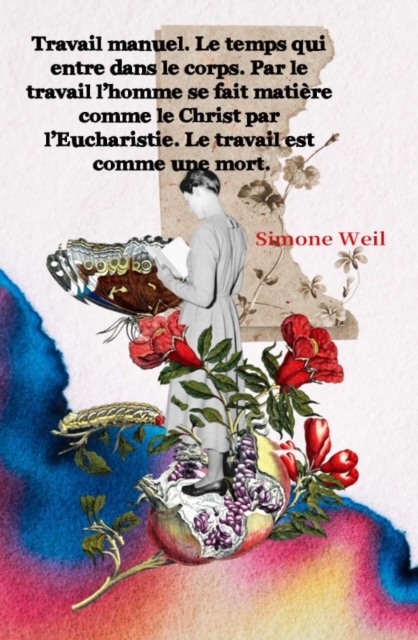
Travail manuel. Le temps qui entre dans le corps. Par le travail l’homme se fait matière comme le Christ par l’Eucharistie. Le travail est comme une mort.

***

This assertion appears in Gravity and Grace (La pesanteur et la grâce), where Weil reflects on the mystery of labour, drawing a parallel between work and the transformation that Christ undergoes in the Eucharist. This connection evokes Christ’s anguished cry from the cross: “My God, my God, why hast thou forsaken me?”—an expression of divine abandonment. Christ suffered fully as a human being, and conveying the meaning behind these beliefs can be profoundly challenging. Faith is often deeply intuitive and internal, making it difficult to articulate through rational discourse alone. From a Catholic perspective, reflecting on why one might embrace Catholicism involves recognising the inherent contradictions within the institution, which may serve as part of its appeal.

In early Christianity, the teachings of Jesus were transmitted orally and through personal encounters, embodying a distinctly spiritual and individual approach to faith. As the Church’s influence expanded within the Roman Empire, however, faith became increasingly institutionalised, with doctrines and rituals formalised over time. This evolution established faith as an entity rooted in institutional authority, often intertwined with political power. Catholicism continues to value mystery and intuition, yet these elements have also been absorbed into its institutional framework. Although Weil’s exact reasons for embracing Catholicism remain unknown, I believe it was the very contradictions within the faith that captivated her. Amidst the materialism and corruption that taints some members of the clergy, she found solace in her connection with the humanitarian Fr Perrin. When I challenged Fr Perrin on the Church’s practice of excommunication, he replied in writing, comparing it to an act of weeping. Regrettably, this letter never reached Weil.

Weil recounts three significant encounters with Catholicism following her factory experience. The first occurred in a small Portuguese village, where she witnessed fishermen’s wives singing sorrowful hymns. This encounter led her to perceive Christianity as a “religion of slaves,” realising that those who suffer need faith for solace—and that she, too, was one of these “slaves.” The second encounter took place in Assisi in 1937, where, for the first time, she knelt in a small chapel associated with St Francis, experiencing a profound reverence for God. She also immersed herself in the liturgy at Solesmes, enduring severe headaches but finding comfort in the beauty of the hymns and words. These experiences offered her a glimpse into the possibility of understanding divine love beyond human suffering, etching the Passion of Christ deeply into her spiritual consciousness.

For her third encounter, Weil committed to reciting the Lord’s Prayer (Pater) in Greek each morning with complete focus. During these prayers, she often experienced a profound silence, sometimes feeling as though her thoughts transcended her physical body, enabling her to sense the loving presence of Christ. This practice of prayer became a vital means of direct contact with the divine for her. Her engagement with Catholicism left a significant imprint on her thoughts and beliefs.

The term “Catholicism” in this context encompasses the formal doctrines, rituals, and institutions of the Catholic Church, along with its social and cultural impact. The Pope is viewed as the supreme authority, and Catholicism emphasises the institutional and public dimensions of tradition-based education and social action. It can be described as an “outward-looking” phenomenon, centred on the officially recognised doctrines and institutions of the Roman Catholic Church. Although personal “intuition” remains vital for practising Catholics, it is noteworthy that Weil—despite her deep involvement—never received baptism, or passed away before she could do so, suggesting that her spirituality transcended institutional boundaries.

Weil’s factory experience allowed her to empathise with the suffering of others and to recognise herself as a “slave.” This realisation profoundly shaped her spirit, leading her to see herself as an anonymous figure within society, much like Christ, who bore the weight of human suffering.

The Psalms of the Old Testament offer a poetic connection between God and humanity, expressing a spectrum of emotions through praise, prayer, and lament. Other biblical texts, such as the Song of Solomon, Job, Proverbs, Lamentations, and sections of Jeremiah and Isaiah, also contain poetic elements. However, the New Testament does not portray Jesus Christ in poetic form.

Why, then, is Jesus not praised through poetry? This absence may reflect the early Christian focus on spreading the faith and establishing communities within the material world. The practical need to communicate teachings clearly and accessibly took precedence over poetic expression, leaving any poetic sentiment about Jesus to the reader’s interpretation. The narrative structure and instructive parables used in the Gospels were essential for conveying the message to diverse audiences across different cultures and languages.

In this context, Weil’s concept of the ‘labourer’ serves as a symbolic connection to Jesus. It is not merely physical sustenance that labourers require, but rather the nourishment of the soul and imagination.

Even today, the issues surrounding poverty and labour are not easily categorised as either social problems or matters of personal responsibility; they remain deeply intertwined, presenting challenges without clear solutions. Viewing poetry solely as an act of creative expression reflects a subjective perspective, reminiscent of Plato’s theories. However, my focus has been on Weil’s engagement with Catholicism, despite her not being baptised.

Can we view labourers not as mere material beings but as individuals who share in Christ’s suffering?

While the hostia, representing Christ’s flesh, may exist within sacred rituals, it is undeniable that institutional corruption often reduces it to mere bread. Labourers need more than this—they require a poetic sentiment capable of inspiring and enriching their lives. Historically, poetry has expressed devotion and reverence towards God, articulating moral and ethical ideals. To what extent, though, can humanity embrace such ideals today?

Weil does not deny the necessity of bread in addressing physical hunger; rather, she distinguishes between this and the spiritual nourishment she seeks. Her writings call for a deeper exploration of suffering and the human experience, frequently referencing Jesus Christ as a guiding figure. In doing so, she reveals a profound religious intuition that underpins her perspectives on contradiction and transformation.

Ⅷ. Reflections 

Perhaps you may glimpse poetic sentiment in the theme of ‘light and shadow.’ I wonder what thoughts stir within you as you observe the shadows cast by trees and the way light dances upon an outdoor wall. The delicate interplay between light and shadow conjures countless associations. Shadows, it could be said, are ephemeral—born from the presence of light, yet perpetually shifting and fleeting. If we draw upon Plato’s allegory of the cave, we might surmise that what we perceive as reality is but a shadow of the true essence, a projection on the wall that we mistake for the real. This enchanting scene offers only a fragment of truth, revealing but a glimpse of a larger whole.

In Japanese thought, this interplay evokes the concept of mujo—impermanence—capturing the transient meeting and parting of light and shadow. In Japanese literature, cherishing such seemingly insignificant moments is, in itself, a literary act. Gaston Bachelard, for his part, refrained from naming such experiences, instead drawing profound meaning from the essence of the fleeting moment.

While some may interpret this view as offering solace to labourers, my perspective has been shaped by Christian evangelism. Light and shadow, deeply symbolic throughout tradition, reveal beauty wherever the heart is open to see it. Yet if we are to embrace the full scope of Weil’s reflections on ‘labour,’ we must look beyond the mere interplay of light and shadow. We are called to confront the very symbol of ‘labour’ itself, not in its economic sense, but as a representation of poverty. Symbols, which merge the tangible with the abstract, demand both conceptual understanding and authentic engagement with reality.

One might say that while poetic sentiment grants us a certain freedom, we must also tread the path of poverty that Jesus embodies.

In Matthew 25:40, Jesus offers a parable that illuminates his royal worthiness: “Whatever you did for one of the least of my brethren, you did for me.” Conversely, he warns, “What you did not do for one of these least, you did not do for me.” These words convey that service to the most vulnerable is, in essence, service to Jesus himself. Yet bound within this message are daunting challenges, tangled with complexity, leading us away from the realm of poetry and heartfelt inspiration.

Indeed, those who place their faith in Jesus Christ may encounter moments of profound intuition, a deep sense of spiritual insight. Yet to articulate the poverty that Jesus embraced, and to share its meaning with others, is no easy task. The human heart, it seems, is caught in tension—yearning to draw nearer to the divine mystery, while fearing to lose itself within it. In recognising my own impermanence, I discover within myself a compassion tinged with humility—a challenge that mirrors my understanding of Jesus. This reflection becomes the essence of my redemption: not a pursuit of abstract beauty, but of a beauty that longs to take tangible form.

Amid the complexities of doctrine and the mysteries of faith, I have anchored my thoughts in the figure of the ‘labourer.’ Honouring Joseph, the earthly father of Jesus, I pay tribute to Simone Weil, whose words resonate with this enduring theme. Through her eloquence, Jesus walks the landscape of the heart, emerging as a poetic sentiment. Though the New Testament does not portray Jesus in the language of poetry, it was perhaps Weil who most profoundly conveyed that the journey to discover this poetic truth lies within us.

Lastly, I have chosen to translate “Work” consistently as “Labour.” In English, “Labour” encompasses not only work but also the pains of childbirth, whereas French distinguishes between these meanings with different words. For Weil, however, the shared Latin root may have embodied a deeper connection. She left us with these poignant words in her notebooks: “Writing is akin to childbirth. One cannot help but strive to the point of feeling limits.” This is an experience familiar to anyone who has engaged deeply in writing, regardless of their grasp of Latin. Yet knowing Weil, it is likely she uncovered within this act a profound mystery.

In this light, perhaps she was indeed a ‘teacher’ in the truest and most profound sense.

Comments:

*Although this work does not engage with Kantian thought, it is possible to reflect elements of Kant’s philosophy.

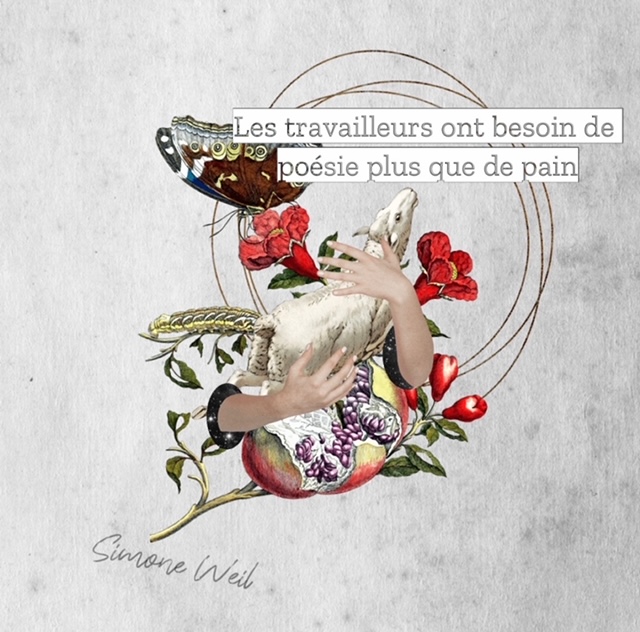
Les travailleurs ont besoin de poésie plus que de pain is part of the “Workers and Mysteries” chapter in Gravity and Grace, and it continues with Seule la religion peut être la source de cette poésie. (Only religion can be the source of this poetry).

*I hope you will accept this critique, even though it references literature. While it does not mention Kantian thought, it can reflect it as well.

Les travailleurs ont besoin de poésie plus que de pain appears in the “Workers and Mysteries” chapter of Gravity and Grace, followed by Seule la religion peut être la source de cette poésie. (Only religion can be the source of this poetry).

References:

• Simone Weil 『La pesanteur et la grâce』『La Condition ouvrière』『Attente de Dieu』『La pesanteur et la grâce』

• Tome VI, volume 2, Cahiers 2 (septembre 1941- février 1942), Paris, Gallimard, 1997.

• George G. Humphreys, Taylorism in France, 1904-1920: The Impact of Scientific Management on Factory Relations and Society

• Plato / Allen, R. (TRN), 『The Republic』

暗い時代の三人の女性, 晃洋書房

シモーヌヴェイユ アンソロジー, 河出出版

Please note that, as of now, this paper does not provide references to literature specifically addressing Catholic sacraments. The relevant details will be submitted at a later date.

The Beauty and Poetry of Labour(1) Simone Weil /English

Les travailleurs ont besoin de poésie plus que de pain.
La pesanteur et la grâce Simone Weil

  1. Ⅰ.Introduction
  2. Ⅱ.Premonition
  3. Ⅲ .Turning Points and Contradictions
  4. Ⅳ ouvrière and ouvrier
  5. Ⅴ The labourer and Poetry’ (1) Plato, ed. 
  6. Continued in ‘Labour and Poetry (2): The Christ Edition.

Ⅰ.Introduction

Simone Weil’s life and philosophy were characterised by numerous intricate twists, as reflected in her writings, which offer a breadth of interpretations that often elude certainty as to whether she herself foresaw them. Her notebooks comprise a collection of fragmented reflections, which, after her death, were organised, edited, and published by her friends and fellow believers. Among her works, the celebrated Gravity and Grace (La pesanteur et la grâce) stands as a masterpiece, owing in no small part to the editorial contributions of Gustave Thibon.

The recurrent themes of ‘turning points’ and ‘contradictions’ in her philosophy, I argue, demonstrate a persistent consistency throughout Weil’s thought, especially in relation to her spiritual quest and profound engagement with Jesus Christ. Weil’s exploration of Jesus Christ led her to confront numerous religious and philosophical questions, which, I believe, served as a central axis that imparted coherence to her seemingly disparate transformations. Her efforts to reconcile faith with reason, and to deepen her understanding of life’s inherent suffering, demand thoughtful reflection, no matter how often one revisits them.

For me, engaging with her work remains an enduring source of profound joy.

Ⅱ.Premonition

In 1932–1933, a year before beginning her work in a factory, Simone Weil travelled to Germany to gain deeper insight into the foundations of fascism. In a letter dated 20 August, she observed that the Nazi Party had garnered support not only from the petit bourgeoisie but also from a significant number of unemployed individuals and other vulnerable groups. Although her stay in Berlin lasted just over two months, she retained vivid impressions of the city’s atmosphere. Former engineers struggled to obtain even a cold meal, yet no military personnel were visible on the streets.

At that time, Germany was grappling with widespread unemployment and severe hardship. In 1942, Weil confided in a letter to Father Perrin, with whom she shared a close relationship, expressing an inner conflict: “I know that if twenty German youths were to sing a Nazi song in unison before me at this moment, a part of my soul would instantly resonate with that of the Nazis. This is my profound vulnerability, yet it is how I exist.”

Upon her return from Germany, her analysis of the country encountered criticism from orthodox Marxists. Nevertheless, she endeavoured to support German exiles to the fullest extent possible.

Ⅲ .Turning Points and Contradictions

In his book Strength to Love, Martin Luther King Jr. draws on a quote attributed to a French philosopher, asserting that “a person who lacks a clear and prominent antithesis in their character is not strong.” However, the identity of the philosopher in question remains uncertain. King frequently invoked philosophical concepts in his speeches and writings, often referring to thinkers like Hegel to emphasise the necessity of balancing opposing forces to achieve harmony and progress. Hegel’s notion that truth emerges through the synthesis of thesis and antithesis aligns with King’s message of deriving strength and understanding through the reconciliation of differences and unity. Moreover, King observed that Jesus also preached about the fusion of opposites, as seen in his admonition: “I am sending you out like sheep among wolves,” and the instruction to “be wise as serpents and innocent as doves.” Although this teaching is undoubtedly demanding, it reflects the expectations that Jesus placed on his followers.

That said, Hegel was a German philosopher, which raises the question: which French philosopher might King have been referencing? Given the period, Gaston Bachelard is a plausible candidate. However, I argue that Simone Weil is equally likely. In late 1934, having resigned from her teaching post, Weil began working as a press operator in a factory, driven by a determination to confront the demands of the “real world.” Before embarking on this factory work, she had been preoccupied with the idea of creating “masterpieces” and “posthumous works.” Yet, the ideals she cherished proved difficult to sustain in the face of the harsh realities of factory life. She reflected on these experiences, recording: “I can’t help but think that interchangeable parts are like labourers. The parts seem to have more citizenship than we do,” as she entered the factory gate, displaying her numbered ID.

Simone Weil left behind a pivotal statement that encapsulates her philosophy: “What labourers need is not bread, but poetry.” During her time in Germany, she observed the plight of the unemployed and expressed her feelings of inadequacy to Father Perrin. The contradictions she grappled with in her philosophical and theological inquiries reflect the inherent complexity of human existence. Indeed, the notion that human essence is fundamentally complex has been explored by philosophers long before the advent of psychology. Plato’s tripartite conception of the soul and Aristotle’s examination of human nature in relation to logical virtues laid the foundation for this discourse. The exploration of human reason, emotion, and self-awareness evolved through the works of philosophers such as Descartes, Kant, and Hegel during the Middle Ages and Renaissance, expanding our understanding of the human mind. In the modern era, Freud’s scientific approach marked a critical turning point in this tradition.

Returning to Simone Weil, her assertion that “What labourers need is not bread, but poetry.” might appear paradoxical when juxtaposed with the brutal conditions of factory work. In such an environment, uncovering beauty and poetry presents a profound challenge. This tension echoes Hegel’s dialectic of thesis and antithesis. However, Weil’s philosophy, I contend, offers a distinctive perspective that requires deeper engagement with the complexities of the human spirit and psyche.

Weil also recognised that poetry could seem irrelevant to labourers, given the harshness of their daily struggles. She herself experienced the exhaustion and disillusionment intrinsic to physically demanding labour. Her philosophical explorations, particularly those rooted in biblical engagement, reflected the inner turmoil she faced. She even recorded that her distress in the factory was so overwhelming that she contemplated suicide by throwing herself into the River Seine.

Weil’s intellectual transitions and fragmented thoughts seem to form an inclusio structure, wherein statements that appear contradictory—much like the reflections of Koheleth in the Old Testament—gain coherence when examined in relation to one another. While Weil acknowledged that artistic expression had little relevance in the context of labour, she also explored the interplay between timepieces and artistry. She remarked that a clock, even when crafted with precision, functions without love, whereas a work of art requires love to resonate meaningfully. One may wonder why Weil insisted that “What labourers need is not bread, but poetry.” Even if we were to systematically outline the logical implications of her statement, conveying the mental state induced by labour at that time remains an arduous task.

I intend to unravel this challenge in my own way.

Ⅳ ouvrière and ouvrier

The direct translation of Simone Weil’s La Condition ouvrière is The Condition of the Labourer. The term ouvrière refers to female labourers, and in this work, Weil distinguishes between ouvrière and ouvrier, using the former to denote female labourers, including herself, and the latter to refer to male labourers. This distinction follows standard French grammatical conventions.

I am close to concluding that the salvation of a labourer’s soul depends primarily on their physical constitution.” While this idea is subjective, her use of ouvrier reflects an awareness of the collective and universal role of labourers. This distinction thus signifies both the importance of individual existence and a broader, societal perspective.

“mais jusqu’à quel point tout cela résisterait-il à la longue ? – Je ne suis pas loin de conclure que le salut de l’âme d’un ouvrier dépend d’abord de sa constitution physique. Je ne vois pas comment ceux qui ne sont pas costauds peuvent éviter de tomber dans une forme quelconque de désespoir – soûlerie, ou vagabondage, ou crime, ou débauche, ou simplement, et bien plus souvent, abrutissement – (et la religion ?). La révolte est impossible, sauf par éclairs (je veux dire même à titre de sentiment). D’abord, contre quoi ?” On est seul avec son travail, on ne pourrait se révolter que contre lui –La Condition ouvrière Simone Weil

Next, we turn to:

“But to what extent would all this endure over time? I am close to concluding that the salvation of a worker’s soul depends primarily on their physical constitution. I cannot see how those who are not robust can avoid falling into some form of despair—whether it be drunkenness, vagrancy, crime, debauchery, or simply, and far more often, stupefaction—and what of religion? Revolt is impossible, except in fleeting moments (even as a feeling). First, against what? One is alone with their work; one could only rebel against it.”

Weil’s expressive power is paradoxically revealed through her encounter with the flower of evil, exemplified by her exposure to the Bessarabo Affair (l’affaire Bessarabo) in 1920, when a man was murdered by his wife, and his body transported by train. This incident reflects the human longing for goodness, even in the midst of moral decay. Weil argues that the concept of sainthood—particularly of a female saint—is ultimately flawed. She possessed the strength to maintain opposition to idealised moral righteousness. Furthermore, her factory experience gave her first-hand insight into the lives of individuals lacking the resilience she had cultivated.

By ‘individuals lacking resilience,’ Weil refers to those without the physical and psychological endurance necessary to withstand harsh conditions. In this context, the physiological and psychological composition of the individual becomes critical in resisting social and economic pressures. For those with limited physical capacities, the risk of succumbing to despair in difficult environments increases substantially, often manifesting in addiction, social deviance, delinquency, or emotional paralysis. Moreover, their rebellions are typically reduced to brief emotional outbursts; without a clear target of opposition, the potential for meaningful change remains blocked.

映画:「渇水」

(Drought -渇水)

This tension is also evident in the increasingly complex nature of contemporary poverty. The film Drought (渇水) portrays the struggles of a municipal water department worker tasked with visiting households and businesses in arrears on their water bills. When payment cannot be collected, he must carry out water shut-offs, cutting off access to water. During a summer heatwave, the residents affected by these shut-offs do not always present sympathetic cases. Some have fallen into despair, losing any sense of priority or financial planning. Others appear selfish, failing to pay their bills due to gambling addictions. In some cases, mothers in arrears prioritise their smartphones over their families’ essential needs.

In this context, the term labourers primarily refers to the water department employees. These workers often bear the brunt of public frustration, facing insults such as, “You’re just working for taxpayer money.” This conflict illustrates the tension between institutional policy and individual responsibility. Water shut-offs are implemented based on public policy, which must be applied uniformly to all users to maintain fairness and sustainability. However, these workers, despite being agents of the system, are human and must enforce these policies while facing resentment from those unable to pay. This dynamic extends to vulnerable groups, including single mothers, some of whom depend on men who leave them financially and emotionally stranded. In such cases, financial survival—not mere pleasure—drives their behaviour. Even under these circumstances, the water department employee may assist by helping families store water before shutting off their supply.

(Social Support and Institutional Constraints)

Support systems within institutions and society must continuously evolve to accommodate the needs of the vulnerable. Conversely, decisions to withdraw support on a personal level become necessary to safeguard mental health and the sustainability of shared resources. As individuals do not possess infinite emotional or material resources, boundaries must sometimes be established to preserve long-term relationships. In practice, however, people rarely have the clarity to assess these considerations when overwhelmed by hardship. This may partly explain why society often seems indifferent to individual tragedies.

Weil’s writings highlight how institutional inadequacies and injustices—such as precarious employment and insufficient social security—constrain individuals and perpetuate cycles of poverty. However, her reflections transcend the conflict between institutions and individuals by focusing on human fragility. Her philosophical inquiries explore what individuals can do and what emotions ought to be nurtured between people. Yet, the boundaries of these inquiries remain ambiguous. Weil’s search for meaning unfolds through the ‘hypothetical truths’ she articulated in her factory diaries. It is here that her concepts of ‘turns’ and ‘contradictions’ demand both lived experience and abstract understanding.

Ⅴ The labourer and Poetry’ (1) Plato, ed. 

In the secondary literature surrounding Simone Weil’s renowned work “Poetry for the Labourer,” many interpretations suggest that labourers may find salvation by cultivating sensitivity and mystical richness through engaging with poetry. However, I find that this reading does not align with my understanding of her text.

First and foremost, poetry revolves around ‘intuition,’ a concept that both the author and the reader must grasp. Yet, articulating such a concept within an academic or self-help framework is exceedingly difficult. Intuition resides in a realm that language may only partially express, never fully resolving it. While language is a powerful medium for conveying human experience and emotion, it remains inherently limited.

Spiritual fulfilment and cultural experiences often transcend the boundaries of language, relying on intuitive understanding and sensitivity. This realm encompasses complexities, depth, and contradictory emotions that resist verbal expression, manifesting instead as inner transformations and profound realisations. Weil herself noted that persuading others is challenging when relying solely on impressions without concrete evidence, yet she asserted that human misery could only be expressed through impressions: “Misery is constituted solely of impressions.” Through her writing, she captures the nuanced layers of human experience that extend beyond words.

In early 20th-century France, Taylorism—a system of scientific management developed by Frederick Winslow Taylor in the United States—was widely criticised. Taylorism divided labour into smaller tasks to maximise productivity, clarifying the roles of individual workers. However, the outbreak of World War I forced France to adopt Taylorist principles to facilitate the mass production of munitions. The need for efficiency and large-scale output led to the application of task specialisation and standardisation, improving productivity but rendering the work more monotonous and exhausting. Labourers faced faster-paced tasks with reduced autonomy, and both women and children entered the workforce. After the war, France pursued economic reconstruction and industrialisation, often under difficult conditions. Many factories operated with lax safety standards, subjecting workers to long hours and constant risks of injury. Wages were low, leaving working-class families in crowded, dilapidated housing, barely able to meet their basic needs. In this environment, Weil encountered the dehumanising aspects of factory work and observed the suppression of labourers’ potential.

Despite its limitations, recognising the value of language remains essential for fostering empathy and holistic understanding. Beauty, sensitivity, and intuition play crucial roles in bridging the gaps left by verbal expression. At the age of 16 in 1925, Weil demonstrated an early appreciation for the symbolic nature of wisdom, observing that “Plato’s thought is most beautiful when revealed through myths.” Although she frequently referenced Plato, her interpretations of Books VI and VII of The Republic were uniquely her own.

Weil engages with Plato’s metaphor of the ‘gigantic animal’ (θηρίον μέγα) in Book VI of The Republic, in which the state and society are likened to a vast and ferocious creature. This creature possesses distinct likes and dislikes, controlled by a ‘keeper’ who knows its tendencies well. What the creature favours is deemed “good,” and what it rejects is labelled “evil.” The key insight of this metaphor is that moral judgments are dictated by the preferences of the masses, symbolised by the animal. Plato warned of the dangers posed by societies governed by such relative and arbitrary standards. Weil aligns with this critique, emphasising that social morality is merely the reflection of collective preferences—nothing more than the likes and dislikes of a gigantic animal. She contended that morality, governed by social necessity, is inherently relative and can only be transcended through divine intervention. True goodness, in her view, must be directly revealed by God to the human soul.

Weil extends her engagement with Plato by reinterpreting Book VII of The Republic through the lens of love and ethics. Using the famous allegory of the cave, she argues that “humans must turn towards the good and love beyond themselves,” advocating for ethical growth grounded in a relationship with God rather than in intellectual achievements alone. Her interpretation moves beyond Plato’s educational theories, emphasising the moral and religious dimensions of human development. In Plato’s original text, the allegory of the cave depicts the gradual progression from ignorance to knowledge. While the focus is not on love, Weil reinterprets the allegory as a meditation on the capacity to love and the impossibility of self-love, comparing the eye’s inability to see itself directly with the limits of self-love.

Even in modern times, based on my own experience, when I worked part-time as a newspaper collector in 2013, I had to visit households to collect payments. The area I was assigned to mainly consisted of elderly people living in poverty. As solicitation and collection were handled by different personnel, I often received complaints about discrepancies between what had been promised and what was delivered. When payments could not be collected, I had to visit the same households two or three times. In practice, several elderly individuals were locked into auto-renewed newspaper subscriptions, unable to read what they purchased or withdraw cash due to physical infirmities. In some instances, I found elderly women wearing adult nappies, unable to dress themselves, calling out for help. Despite their circumstances, collectors could only leave notifications of unsuccessful payment attempts. Rooms were often filled with neglect and strong odours, a testament to the overwhelming difficulties these individuals faced.

Collectors lacked the authority to cancel contracts, even when it was clear that the other party could not fulfil their obligations. Without an explicit request to cancel, I had no power to advise them otherwise. These experiences revealed the limitations of personal enlightenment and sensitivity in addressing poverty and incapacity.

Collection work, while straightforward, does not cultivate transferable skills or essential competencies. It is a task that even children could perform, offering those without experience or qualifications an opportunity to earn a modest income. However, it requires patience and a significant degree of inner resolve. In stark contrast, proficiency in my primary occupation, details of which I will withhold, directly correlates with skill development through the completion of tasks. Skills gained from collection work, however, rarely translate into other career opportunities.

It is important to acknowledge that the situations I witnessed in these homes could one day become my own reality. Life viewed through a strictly materialistic lens suggests that a severe brain injury could render me incapable of sustaining my current lifestyle. If existence is reduced to mere materiality, the erosion of human dignity becomes an ever-present risk.

It may be argued that Simone Weil’s exploration of love and God was profoundly influenced by Platonic thought, particularly by reflections on the absurdity of Socrates’ execution, which deeply affected Plato himself. Articulating such abstract concepts is no small feat, requiring the translation of intuitive insights into verbal expression. Yet, for Simone Weil, this task was indispensable.

Following the Platonic tradition, Weil believed that liberation from the tyranny of society’s ‘great beast’ could only be achieved by transcending egocentric perspectives and locating one’s value in a relationship with God. For Weil, the inherent human capacity for love manifests in turning one’s attention beyond the material world, discovering true goodness through divine connection. This pursuit, for her, embodied the Platonic “Idea.” Plato’s exploration of ideal societies and true beauty rested on the notion that material existence is transient, with real value residing in the intangible. This resonates with Weil’s yearning for spiritual depth, symbolised by her emphasis on “poetry.”


Continued in ‘Labour and Poetry (2): The Christ Edition.

Cahier2024/01/22 English

Simone Weil, ‘Illusions’ (Gravity and Grace).La pesanteur et la grâce

・On se porte vers une chose parce qu’on croit qu’elle est bonne, et on y reste enchaîné parce qu’elle est devenue nécessaire.

・Les choses sensibles sont réelles en tant que choses sensibles, mais irréelles en tant que biens.

・L’apparence a la plénitude de la réalité, mais en tant qu’apparence. En tant qu’autre chose qu’apparence, elle est erreur.

L’illusion concernant les choses de ce monde ne concerne pas leur existence, mais leur valeur.

L’image de la caverne se rapporte à la valeur. Nous ne possédons que des ombres d’imitations de biens. C’est aussi par rapport au bien que nous sommes captifs, enchaînés (attachement). Nous acceptons les fausses valeurs qui nous apparaissent, et quand nous croyons agir, nous sommes en réalité immobiles, car nous restons dans le même système de valeurs.

ceux qui ont nourri et vêtu le Christ ne savaient pas que c’était le Christ.

English

・We are drawn to something because we believe it is good, and we remain attached to it because it has become necessary.

・Sensible things exist as sensible things, but are unreal as goods. Images possess the fullness of reality, but only as images.

・The illusion regarding the things of this world pertains not to their existence, but to their value.

・The illusion concerning the things of this world does not concern their existence, but their value. The image of the cave is related to value. We only possess shadowy imitations of goods. It is also in relation to goodness that we are captives, bound (through attachment). We accept false values that appear to us, and when we believe we are acting, we are actually immobile, as we remain within the same system of values.

・Those who fed and clothed Christ did not know that it was Christ.

1L’apparence

L’apparence means ‘appearance’ in French, but in legal philosophy and sometimes in psychology it is translated as ‘provisional image’. While a virtuality has the integrity of reality, it can also be misleading, not only with regard to the appearance of reality, but also with regard to other objects. This may be a feeling that is not common in Japanese concepts. Although Husserl distinguished between ‘imaginative action’ and ‘fantasy’, in phenomenology Husserl provided an approach to the idea of the provisional and value. The distinction between phenomena (physical sensation) and value (provisional representation) is also mentioned in Weil’s quotation.

ceux qui ont nourri et vêtu le Christ ne savaient pas que c’était le Christ.

・Phonological beauty: in this sentence there is a balance between vowels and consonants and a sense of rhythm. For example, the phrase ‘nourri et vêtu’ feels beautiful because the sounds are delicate and echo each other.

2 ’provisional image’ versus ‘conjectural’.

Provisional image refers to an image in the mind of an object or event that has not been directly experienced in the real world, based on imagination or speculation. Assumption is an unquestioning perception distorted by subjectivity with concepts that are different from provisional images. In essence, provisional images are realistic and contain misperceptions, but they are also correctable. Assumptions, on the other hand, are often not correctable. For example, in advertising and marketing, provisional images are used to attract people and make them stick to a product or service. We need to make sure that we do not miss the real value and benefit behind individual products and services. In the area of self-development and relationships, it is also important to focus on one’s own true needs and wellbeing, rather than getting caught up in the provisional images and expectations of others.

3 ’Good’ and ‘justice’.

Weil’s declamations seem to have philosophy at their heart, even though they are poetic in nature. This quotation, for example, may be based on the ‘good’ and ‘justice’ of ‘Platonic’ philosophy. In Plato’s ‘Republic justice is attributed to the soul. I think that the image of a ‘cave’ here is undoubtedly an analogy for the cave in Plato’s ‘Republic’.

The parable describes a situation in which people are trapped in a cave and live by seeing shadows projected on the walls by a fire at the back of the cave. They believed the shadows to be real and never left the cave. However, when a person escapes from the cave and sees the outside world, he or she discovers true reality for the first time. There were concepts and things that were different from the shadows he saw in the cave, such as light, colour and shape. This person discovered new knowledge and truths and tried to communicate their existence to the others in the cave, but they were convinced of the shadow world and refused to accept the truths of the outside world. This parable represents Plato’s ideas about the acquisition of knowledge and truth. The cave symbolises the material world and sensory experience, while the shadow represents knowledge through perception. On the other hand, the world outside, as seen by the person leaving the cave, would refer to the world of ideas and metaphysical truths. Plato’s parable of the cave is a metaphor for the fact that we can only see things in their provisional image or shadow form, not in their real form. The people in the cave only see shadows projected on the walls and cannot know the true reality, so although there are ‘provisional images’ in the cave, they cannot be said to be the true existence or reality. It suggests that the world we perceive is part of reality and that there is a truth or essence beyond it. It emphasises that ‘provisional images’ exist in some sense, but that they are not a complete picture of truth or reality.

This is also an example of the fact that truth and knowledge must be obtained through reason, and that true understanding is impossible as long as we are trapped in the material world and sense experience.

In Plato’s Republic, the desire to know the truth about justice interacts with the idea of the good, which is also characteristic of the French word Nous ne possédons que des ombres d’imitations de biens. C’est aussi par rapport au bien que nous sommes captifs, enchaînés. In Bient in, it can mean ‘good’, but it can also mean ‘possession’.

For example, what does it mean when translated as ‘property’?

We are trapped in a cave whose walls reflect the shadows of our possessions. But these shadows are not real possessions, they are only imitations. Because we are trapped in these shadows, we cannot know true ownership and luxury. If we could come out of the cave, we would experience true possessions and true wealth.

Even as ‘property’ he points to our obsession with material possessions and our missing out on true happiness and abundance.

So what if we think in terms of the good, which is the correct translation?

Trapped in a cave, what we see is not the real world but shadows, which are imitations or representations of reality. Shadows reflect true reality, but are themselves incomplete, and we cannot know true reality accurately. Goodness’ becomes the knowledge and rational understanding of true reality. By going outside the cave and seeing true reality directly, we can understand and accept true goodness. However, trapped in the cave, we cannot have knowledge of the true good and remain trapped in the shadow of mere imitation.

This parable is consistent with Plato’s advocacy of an ideal state and his insistence that philosophers should play a role in pursuing the true good and communicating it to others. It also suggests that in order to gain knowledge of the true good, we need to go outside the cave and engage in self-knowledge and self-transcendence.

Continuing the section, Weil adds a passage from the biblical Gospel of Matthew, chapter 26, verse 37, where he gives him food and clothing without recognising him as Jesus. This shows the difficulty of understanding Christ’s presence and the need to open people’s spiritual eyes. By treating this account in a provisional image, Weil may have been trying to express the universal theme of people’s contact with Christ (or a divine being) but their inability to understand his presence and truth, as well as the difficulty of mystical experience.

The biblical position on ‘property’ (in money),


Matthew : 6 : 19 – 21

Do not choose to store up for yourselves treasures on earth: where rust and moth consume, and where thieves break in and steal. Instead, store up for yourselves treasures in heaven: where neither rust nor moth consumes, and where thieves do not break in and steal. For where your treasure is, there also is your heart. 

This is not just a denial of material possessions, but a question of where the heart is. Those who gave food and clothing without knowing Jesus may have earthly possessions, heavenly treasures and ‘heart’. This is also related to Platonic ‘goodness’ and ‘justice’. As Plato wrote in the Republic, biblical ‘goodness’ and ‘justice’ do not just enrich the inner life of an individual. He believed that an individual’s goodness and justice is made up of a collection of individual goodness and justice. He taught that through the pursuit and practice of goodness and justice by individual souls, the nation as a whole can also realise goodness and justice. Reality, however, exists alongside provisional images and is difficult to put into practice. Provisional images’ are questions for the philosopher.

*This is not an explanation.

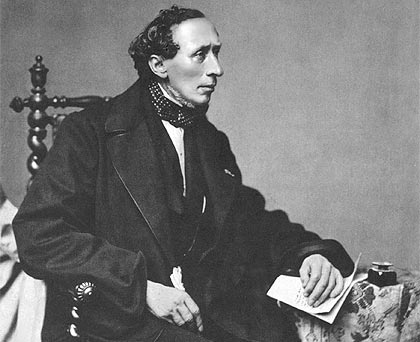
Hans Christian Andersen, ‘Skyggen’.

Calm down, listen till the end. I was in the right place. I have had sight of all the truth that is in sight.

Hans Christian Andersen, 'Skyggen'.
  1. First
  2. Ⅰ Personality and personas
  3. Ⅱ  Plato and the ‘shadow’.
  4. Ⅲ ’Uniqueness’ and monads.
  5. Last Lazarus of Bethany

First

“Sooner or later, you will die.” When the shadow uttered these words, the scholar must have taken them as a reference to some distant point in time, unaware that death was, in fact, looming near.

During his travels to the sweltering countries, the people he encountered acquired a complexion like mahogany. Mahogany, perhaps not the easiest colour to picture, is a rich, deep reddish-brown, often seen in finely crafted furniture.

The scholars dedicated their studies to the pursuit of ‘truth, goodness, and beauty.’ Those scholars, along with their shadows, found it impossible to endure the oppressive heat of the day and would wait for the relief of nightfall to stretch out and rest. One evening, the scholar fell hopelessly in love with a woman on a nearby balcony, where beautiful flowers bloomed, and music seemed to take root in the air.

As his shadow stretched over to the edge of the woman’s balcony, he playfully instructed it, “Go on, slip into her room and keep her company.” Bowing slightly, the scholar directed the shadow toward the woman’s chamber, adding with a sly smile, “Even you, shadow, should make yourself useful now and then.” To his surprise, the shadow obeyed—and vanished altogether.

The scholar grew restless in the absence of his shadow, but he continued his work on his manuscript. Strangely, it seemed there were precedents in this fictional world where shadows disappeared, with similar tales existing even in colder climates.

Then, one day, a knock came at his door. Standing before him was a well-dressed gentleman. The scholar stared, utterly puzzled, unable to place the man’s face.

The man smiled and spoke: “I am the one who used to be your shadow.”

Ⅰ Personality and personas

Andersen’s era preceded the development of Jungian and Freudian psychology, yet the concept of persona bears similarities to those later theories. While the word ‘persona’ is sometimes associated with divine aspects—such as roles within the Christian Trinity—it also refers to the human self, which is unified as one.

The term persona originates from the Latin word meaning ‘mask,’ which itself derives from a Greek word for ‘face.’ In its earliest usage, it referred to the masks worn by actors on stage. Over time, however, it came to denote not the physical mask but the role the actor played. In this way, it is easy to see parallels between the idea of the Christian Trinity—Father, Son, and Holy Spirit—as three distinct roles that ultimately unite as one.

For Jung, the shadow represents repressed aspects of the psyche and takes an Aristotelian form. By contrast, Plato projected the concept outward, focusing on the ideal form of truth. Jung’s framework, in which the unconscious represents unachieved aspects of the self, offers an interesting lens through which to view Andersen’s tale. As a work of art, the story endows the scholar with an externalised, autonomous shadow, representing not merely an unconscious element but a fully embodied being.

In Andersen’s time, scholars were enraptured by the pursuit of the good, the beautiful, and the true. Yet the shadow in this story is not an unconscious reflection of the scholar’s mind—it is a conscious, embodied presence. To better understand this, one might consider Andersen’s own youthful ambition to become an opera singer. He longed to remain on the stage, if only his voice would transform to meet the demands of the role. This raises a curious question: is a role merely another facet of the self?

persona typically returns to unity as a single identity when not performing. However, a role demands more—it requires the actor to use their entire body and presence to become someone entirely different. On stage, identities shift with names, yet the performer remains inseparably linked to their true self. Even if one plays the role of a ‘scholar,’ that character is inherently fused with the actor’s underlying personality.

In The Shadow, one figure must always play the subject, while the other takes on the role of the shadow. As a ‘thinking entity’ that extends the human psyche, the shadow assumes multiple meanings. However, the shadow-actor in this story achieves happiness in a way the original form—the scholar—cannot. This suggests that the shadow’s identity transcends individual judgement, belonging more to the collective consciousness.

Indeed, the shadow belongs to society far more than the scholar does. It is the shadow that finds fulfilment by engaging with the group, suggesting that individuality must, at times, give way to collective identity.

Ⅱ  Plato and the ‘shadow’.

What exactly was the shadow to the scholar? The way in which the shadow detached itself and operated independently recalls Plato’s Allegory of the Cave. In this allegory, prisoners are confined within a cave, unable to see the fire burning behind them. All they perceive are the shadows of puppets, projected by the fire onto the walls before them. However, one prisoner manages to escape the cave and discovers that the world outside—illuminated by the sun—is the true reality. Upon returning to the cave to share his discovery, the other prisoners refuse to believe him, mistaking the shadows for the only truth they know.

Similarly, in Andersen’s tale, the scholar’s shadow takes on a life of its own, leaving the scholar’s side and venturing into the world. The departure of the shadow raises questions: was it truly a distinct being, or merely an alter ego of the scholar? Andersen deliberately obscures the connection between the two, leaving room for ambiguity. Upon the scholar’s return to the cold lands of his homeland, he discovers that a new shadow has emerged to replace the old one. Meanwhile, the original shadow, now freed from its former master, has pursued ‘outer truth’ and transformed into something magnificent.

In this altered state, the shadow presents itself to the scholar, appearing in splendid attire. Despite the transformation, the scholar warmly welcomes the shadow as though it were an entirely new personality. The reader may initially assume that the scholar and the shadow share a dual identity, but Andersen offers no such resolution. Instead, it becomes clear that the shadow has evolved into a completely independent entity, no longer tethered to the scholar.

“The most beautiful thing in the world is poetry,” the shadow declares, speaking of the woman the scholar had fallen in love with during his travels in the hot country. Through his connection with the woman, the shadow’s own sense of self is awakened. He begins to desire material comforts—shoes, clothes, and the kindness of others—and people take pity on him, offering him aid. Having enjoyed these indulgences, the shadow resumes its journey, continuing to explore the world on its own terms.

Plato’s philosophy, particularly in his dialogue Philebus, equates the concept of the Good with that of the One. He states: “It would do more harm than good if, having all other knowledge, one lacked knowledge of the highest Good.” The scholar represents an individual in pursuit of such ideals—truth, goodness, and beauty. However, in Andersen’s narrative, the shadow evolves into a separate existence entirely. It becomes a being that embodies these ideals not through intellectual pursuit, but through experience and interaction with the world.

Ⅲ ’Uniqueness’ and monads.

The shadow eventually returned to the scholar, who continued to write stories about ‘truth, goodness, and beauty.’ However, despite his efforts, the scholar made little progress in his career. At this stage, the shadow remained amicable and even suggested that they travel together. Yet, there was one condition: “You will be my shadow.” The scholar, unwilling to submit to such terms, flatly refused, saying, “I don’t want to do that.” He declined, even though the shadow offered to cover the travel expenses.

The ideals the scholar pursued—truth, goodness, and beauty—were, to most people, as meaningless as giving a rose to a cow. This sense of futility weighed heavily on the scholar, and he soon fell ill. When the shadow repeated his offer, proposing again that the scholar travel with him and become his shadow, the scholar—now weakened—reluctantly agreed.

At first, they got along well. However, their relationship shifted when the shadow raised the question of how they should address one another. The shadow insisted on addressing the scholar informally as ‘you’. This provoked the scholar, who retorted, “This is absurd.” His irritation grew: “It’s ridiculous that I must say ‘buggerlugs’ while he calls me ‘old bean’.”

This linguistic tension is particularly challenging to translate. In Danish, it is expressed as: “Det er dog vel galt,” tænkte han, “at jeg må sige De og han sige du, men nu måtte han holde ud.”

In this sentence, ‘De’ is a formal, respectful pronoun, while ‘du’ is a more familiar, personal one. The protagonist resents being addressed with the informal du—not merely because it implies familiarity, but because it reflects a shift in authority. The once-masterful scholar feels humiliated, now reduced to a subordinate role. This wordplay recalls the whimsical language of Lewis Carroll, but here it underscores the scholar’s existential crisis: the loss of his autonomy.

For someone devoted to the ideals of the Platonic school—where eidos (form) must remain within one’s grasp—the notion that a shadow could surpass him in influence is intolerable. In philosophy, where perception and understanding are traditionally the purview of the self, it is the self that ventures outside Plato’s cave to gain knowledge. Yet in Andersen’s tale, the scholar, despite his intellectual pursuits, is eclipsed by his shadow, who succeeds while he struggles even to complete his writing.

What, then, has the shadow taken from the scholar? Or perhaps the scholar, without realising it, has relinquished something vital to the shadow—an exchange that Andersen deliberately leaves unresolved.

At a resort, they encounter a beautiful princess afflicted with an unusual condition: she “sees things too clearly.” Intrigued by the shadow’s charm, she falls in love with him as they dance together. The shadow introduces the scholar as “the shadow who knows everything.” When the princess is told, “When you ask him questions, treat him like a human being,” she complies and poses many questions to the scholar. Impressed by the depth of the shadow, the princess decides to marry him, admiring the extraordinary qualities his ‘shadow’ (the scholar) possesses.

Despite this arrangement, the shadow turns to the scholar and says, “From now on, you will be my shadow.” Once more, the scholar refuses. However, on the day of the wedding, the scholar meets his tragic end, killed without fanfare or resistance.

Leibniz’s principle of sufficient reason asserts that every event must have a reason for occurring. The idea also implies that the existence of something—ratio in Latin—relies on clear cause and effect. Leibniz’s concept of the monad, representing unity, hinges on the presence of self-consciousness. To possess uniqueness, an individual must first be aware of themselves as a distinct entity. Perhaps Leibniz’s obsession with uniqueness stemmed from his scientific mind—after all, the observer and the object observed must both be understood with certainty. Where duality arises, certainty vanishes. Only by existing as both the observer and the observed can one claim true singularity.

This tension plays out in Andersen’s story: why could the scholar and the shadow not live as separate beings? Modern psychology might interpret the shadow as a manifestation of repressed aspects of the self. However, Andersen obscures the connection between the two characters, suggesting that the shadow transcends the scholar’s consciousness. Over time, the shadow integrates with the surrounding world—melding with the scholar’s cognition, soul, and persona. Notably, this transformation culminates in the marriage to the princess, a union symbolising monogamy, as prescribed by Christian tradition.

A similar theme appears in Andersen’s “The Goloshes of Fortune” (Lykkens Kalosker). In this tale, the story moves between cold and hot countries, explicitly named as Switzerland and Italy. The characters include a young servant called ‘Happiness’ and an old fairy named ‘Sorrow.’ Happiness, a servant to the goddess, carries joy wherever she goes. Sorrow, by contrast, works alone. On her birthday, Happiness receives a pair of magical boots, which grant any wish to their wearer. However, Sorrow warns that these boots may bring misfortune instead of joy.

The boots pass through several hands—a legal adviser, a night watchman, and a scribe—bringing each of them unexpected tragedy despite granting their wishes. Finally, the boots fall into the possession of a seminarian, who wishes to travel from the cold climate of Switzerland to the warmth of Italy. However, after some time, he tires of travel and blames his physical body for his fatigue. In a desperate wish, he asks to be freed from his body—and dies.

Two figures appear in the room where the seminarian lies. The Fairy of Sorrow turns to the Servant of Happiness and asks, “What happiness have you given him?” Happiness responds, “I believe I granted him eternal happiness, for he now sleeps peacefully.” Sorrow, however, disagrees: “He died by his own will, so he was not summoned.”

Sorrow then offers the seminarian grace. She removes the boots, and the young man is revived. At the same moment, the Fairy of Sorrow disappears, taking the boots with her. In the end, the boots—intended to bring happiness—belong to Sorrow.

The scholar’s death in The Shadow parallels the seminarian’s near-fatal journey. Both characters fail to recognise their true gifts—those destined for them by fate. Andersen’s story is ultimately about missed opportunities and the consequences of not understanding oneself. However, unlike The Goloshes of FortuneThe Shadow refrains from explicitly addressing human experiences such as sorrow or happiness. Instead, the shadow’s meaning remains ambiguous, open to multiple interpretations.

Leibniz argued that not everything possible is realised—possibilities remain unrealised, existing merely as potential. Reality emerges from countless unrealised possibilities. Drawing on Leibniz’s ideas of reason and chance, the scholar’s death in The Shadow might be seen as a tragic accident born of ignorance. This echoes the Greek concept of tyche (luck)—a force beyond human control.

While Leibniz and Plato shared an interest in the nature of ideas, Leibniz’s philosophy diverged from Descartes’ by asserting that ideas are not merely subjective but inherently representational. The scholar’s pursuit of truth, goodness, and beauty reflects his belief in these ideals. Yet, like Leibniz, the scholar fails to reach the ultimate realisation of these truths in his lifetime. His failure lies not in his intellectual pursuits but in neglecting to recognise the shadow as part of himself—a unique, indivisible being.

Andersen’s story leaves us with a tantalising question: Was the shadow truly the ‘opposite of good,’ or something more nuanced? This ambiguity draws us closer to later psychological interpretations of shadows and personas, leaving us to ponder the elusive nature of selfhood.

Last Lazarus of Bethany

The shadow, like a prisoner released from Plato’s cave, ventured into the world and uncovered many truths. It must have been a journey towards becoming whole, to achieve oneness without being recognised. In this tale, the shadow represents yet another persona—an extension of the author’s reflections on themes such as marriage, a recurring motif in Andersen’s fairy tales. Here, the coexistence of two beings—scholar and shadow—becomes impossible, as they cannot remain united within a singular form, an Eidos. The shadow believed this was his moment of triumph, but the scholars could not bring themselves to accept it.

Andersen’s personal longing for the stage runs through this story. Yet, from an actor’s perspective, we might wonder: was there ever truly a ‘shadow’? Could it be that the scholar played every role, not through a split personality but simply as a man in search of meaning, travelling endlessly to understand the world? This would explain his failure to complete the manuscript on truth, goodness, and beauty. He was too preoccupied with his journey to attend to his work. The room remained empty, the manuscript neglected. Perhaps, like an empty tomb, there was no princess, no wedding—only absence.

And yet, in Andersen’s world, death cannot be a void. Death must be present, for the actor must bow at the end of the play and return to unity—the One. After enduring life’s cruelty, which version of the self takes the final bow before the curtain falls?

In The Goloshes of Fortune, the seminarian, guided by the Fairy of Sorrow (Sorgen), is given a second chance at life. The scholar, however, has no such guide. Why did the scholar lack a companion like Sorrow? What meaning lies within this omission? Could it reflect Andersen’s own fear—not just of death, but of a life without mourning, without sorrow to give meaning to loss? Perhaps the one who did not mourn the scholar’s death was, unmistakably, the scholar himself.

Andersen’s stories frequently contemplate the deaths of the poor. His sensitivity to death was deeply personal, permeating his narratives. The seminarians in The Goloshes of Fortune reflect both Andersen’s hopes and his fears—hence, their resurrection. In contrast, the death of the scholar in The Shadow seems to signal acceptance, as though Andersen were embracing death’s inevitability.

What makes The Shadow a profoundly melancholic tale is that it offers no miracles, no divine intervention. Jesus wept at the death of Lazarus, but here, there are no such tears—no prayers to resurrect the fallen. Yet, those who read Andersen’s fairy tales may recognise his hidden persona: a voice suggesting that happiness can only be found in death. Perhaps the scholar’s tragedy lies in the many things he neglected while still alive. And in the end, faced with life’s cruelties, Andersen might have hoped that his readers, like Jesus, would feel righteous indignation, that they too would mourn such losses with tears.

It is here, in this sorrow, that we find the thread of sanctity running through Andersen’s work—the sense that life, even in its frailty, holds profound meaning. I cannot help but imagine that this is how the author himself appears when he has fulfilled his role: a persona complete in its purpose.

Remember, Jesus always mourns your death. Whenever you feel your worth slipping away, whenever you believe your death would make no difference, know that there is someone who loves you enough to grieve your loss.

When he heard this, Jesus said, “This sickness will not end in death. No, it is for God’s glory, so that God’s Son may be glorified through it.” – John 11:4

When my persona can no longer return to unity,

I pray that, as the curtain falls, I may return to this heart.

*The English translations of the quotations are original.

Lykkens Kalosker       http://wayback-01.kb.dk/wayback/20101108104438/http://www2.kb.dk/elib/lit/dan/andersen/eventyr.dsl/hcaev021.htm

WordPress.com でブログを始める.

ページ先頭へ ↑