Die Aufzeichnungen des Malte Laurids Brigge / by Rainer Maria Rilke
Original text
①Und ich war es in der Tat. Ich war beschäftigt, ihn mir vorzustellen, ich unternahm die Arbeit, ihn einzubilden, und der Schweiß trat mir aus vor Anstrengung. Denn ich mußte ihn machen, wie man einen Toten macht, für den keine Beweise mehr da sind, keine Bestandteile; der ganz und gar innen zu leisten ist. Ich weiß jetzt, daß es mir ein wenig half, an die vielen abgenommenen Christusse aus steifigem Elfenbein zu denken, die bei allen Althändlern herumliegen. Der Gedanke an irgendeine Pietà trat vor und ab –: dies alles wahrscheinlich nur, um eine gewisse Neigung hervorzurufen, in der sein langes Gesicht sich hielt, und den trostlosen Bartnachwuchs im Wangenschatten und die endgültig schmerzvolle Blindheit seines verschlossenen Ausdrucks, der schräg aufwärts gehalten war.
②Ich wußte sofort, daß meine Vorstellung wertlos war. Die durch keine Vorsicht oder Verstellung eingeschränkte Hingegebenheit seines Elends übertraf meine Mittel.
(Zeitungsverkäufer)
③Ich will nur sagen, daß sie an ihm waren wie das Weicheste auf eines Vogels Unterseite. Er selbst hatte keine Lust daran, und wer von allen (ich sah mich um) durfte meinen, dieser Staat wäre um seinetwillen?
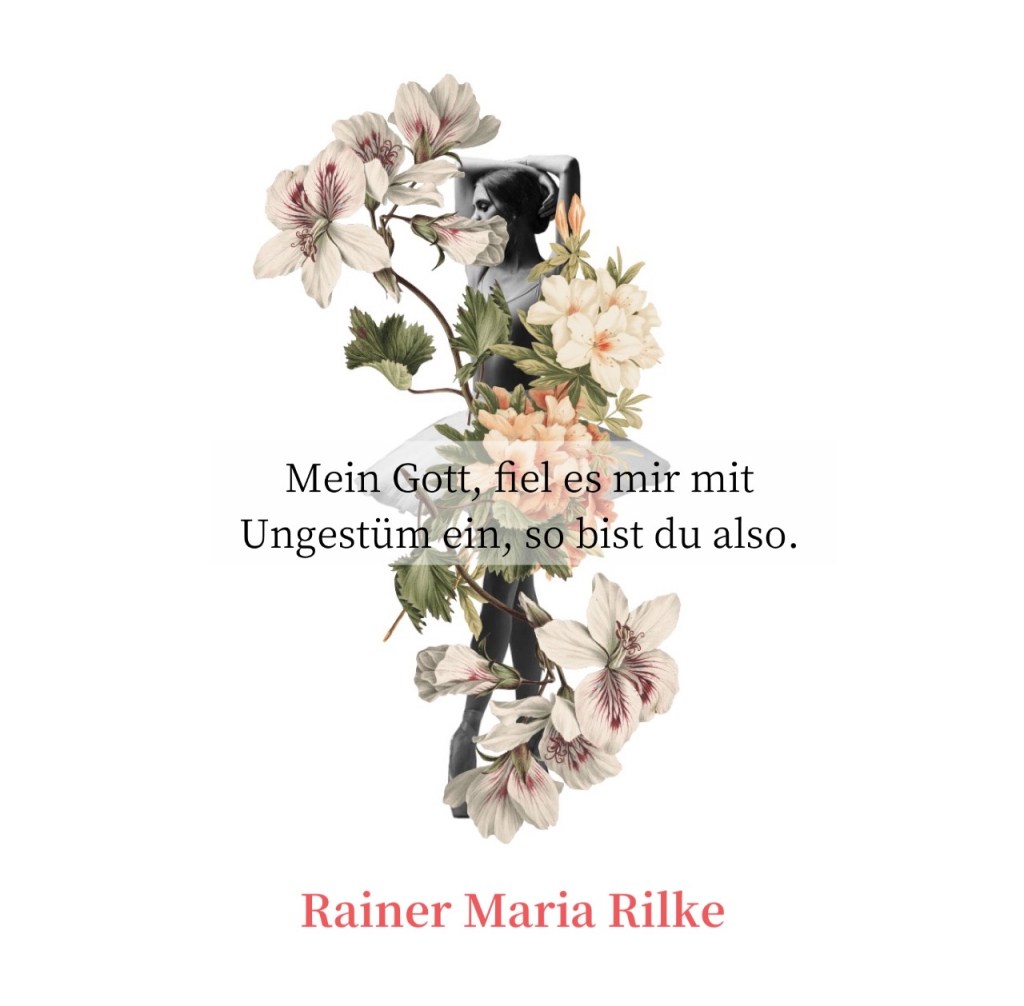
④Mein Gott, fiel es mir mit Ungestüm ein, so bist du also. Es gibt Beweise für deine Existenz. Ich habe sie alle vergessen und habe keinen je verlangt, denn welche ungeheuere Verpflichtung läge in deiner Gewißheit. Und doch, nun wird mir’s gezeigt. Dieses ist dein Geschmack, hier hast du Wohlgefallen. Daß wir doch lernten, vor allem aushalten und nicht urteilen. Welche sind die schweren Dinge? Welche die gnädigen? Du allein weißt es. Wenn es wieder Winter wird und ich muß einen neuen Mantel haben, – gib mir, daß ich ihn so trage, solang er neu ist.
⑤Es ist nicht, daß ich mich von ihnen unterscheiden will, wenn ich in besseren, von Anfang an meinigen Kleidern herumgehe und darauf halte, irgendwo zu wohnen. Ich bin nicht soweit.
English translation
①And indeed it was myself. I was busy imagining him, I undertook the work of imagining him, and sweat broke out on me with exertion. For I had to create him, as one creates a dead man, for whom there is no longer any evidence, no components; to be entirely accomplished within. I now know that it helped me a little to think of the many detached Christs made of stiff ivory lying around at all the antique dealers.The thought of some Pietà came and went -: all this probably only to evoke a certain inclination in which his long face held itself, and the desolate growth of beard in the shadow of his cheeks, and the final painful blindness of his closed expression, held obliquely upwards.
②I knew immediately that my representation was worthless. The unbounded surrender of his misery, unrestricted by caution or pretense, exceeded my capabilities.
③I only want to say that they were on him like the softest thing on a bird’s underside. He himself had no desire for it, and who among all (I looked around) could think that this state was for his sake?
④My God, it occurred to me with impetuosity, so this is how you are. There is evidence of your existence. I have forgotten them all and have never asked for any, for what a tremendous obligation would lie in your certainty.And yet, now it is revealed to me. This is your preference, here you find delight. If only we could learn to endure above all and not judge. What are the burdensome things? What are the merciful ones? You alone know. When winter comes again and I must have a new coat – grant me that I may wear it so long as it is new.
⑤It’s not that I want to differentiate myself from them when I walk around in better clothes that are truly mine from the beginning and insist on settling somewhere. I am not that far yet.
Consideration
If I were to introduce him, I would say that he is not a philosopher or a theologian, but a poet. It wouldn’t be enough to simply say he is a poet from the beginning. It is through these denials that the true value of being a poet emerges. Rainer Maria Rilke, in my opinion, is such a person.
Although I have not yet reached a conclusion, the theological and philosophical inquiries raised by the quotations (1) to (5) remain unanswered.
This is Rilke’s autobiographical work, but it appears as if he is writing “in disguise” as the character Marthe. However, this is also a creative piece with an underlying confessional aspect. He acknowledges that he perceives God (Jesus Christ) in a state of poverty, yet he confesses that he is unprepared for the unimaginable life of a newspaperman. Simultaneously, he raises questions about the Kantian notion of representation, suggesting that it is an essential faculty for comprehending external objects, but also viewing it as an activity of the individual subjective mind rather than an independent existence separate from the object.
Descartes attempted to provide a logical proof for the existence of God, while Kant argued that existence cannot be deduced solely from concepts, emphasizing the significance of “faith” (practical principles). In Christian theology, specifically without aligning to any particular denomination, “Vorstellung” refers to the concrete concepts and images that individuals hold about God, often associated with the concept of “Form.” For instance, in Catholicism, “Form” represents the embodiment or essential qualities of God’s divinity. Additionally, the emphasis lies on the incarnation, sacraments, and the recognition of the unseen mysteries concealed beneath the “visible.” Despite this ambivalence, Rilke acknowledges the limitations of capturing the representations of Christ and Mary in the Pietà as a questioning of existing religions.Rilke, although embracing this dual nature, expressed the poetic sensibility of one dressed in his Sunday best in modest attire, bearing the weight of profound responsibility in confirming the presence of God. (Mein Gott, fiel es mir mit Ungestüm ein, so bist du also )Nevertheless, Rilke personally encountered a sensation of connection between God and the world.
He seeks to explore the existence of God and delve into the experience of limits(Grenze), but this is done as a poet, confessing his fear of becoming impoverished. What were the limits for Rilke?
An antique statue of Christ, Mary of Pietà with historical value, keeping one feeling like wearing a new coat, the expensive clothes of the poor, the life of an unnamed bird?
Rilke does not explicitly define them as “poetry,” but rather portrays them in a sincere manner as the ascent and descent of the “soul,” which cannot be directly described by philosophy and theology.
****
*Grenze, also explored by philosophers such as Kant and Hegel, are also pursued theologically by Bonhoeffer.
*This is a thoughtful note. There are no answers.
If you have any comments on the translation, please write them in the comments section.
Thank you


 Chris Kyogetu