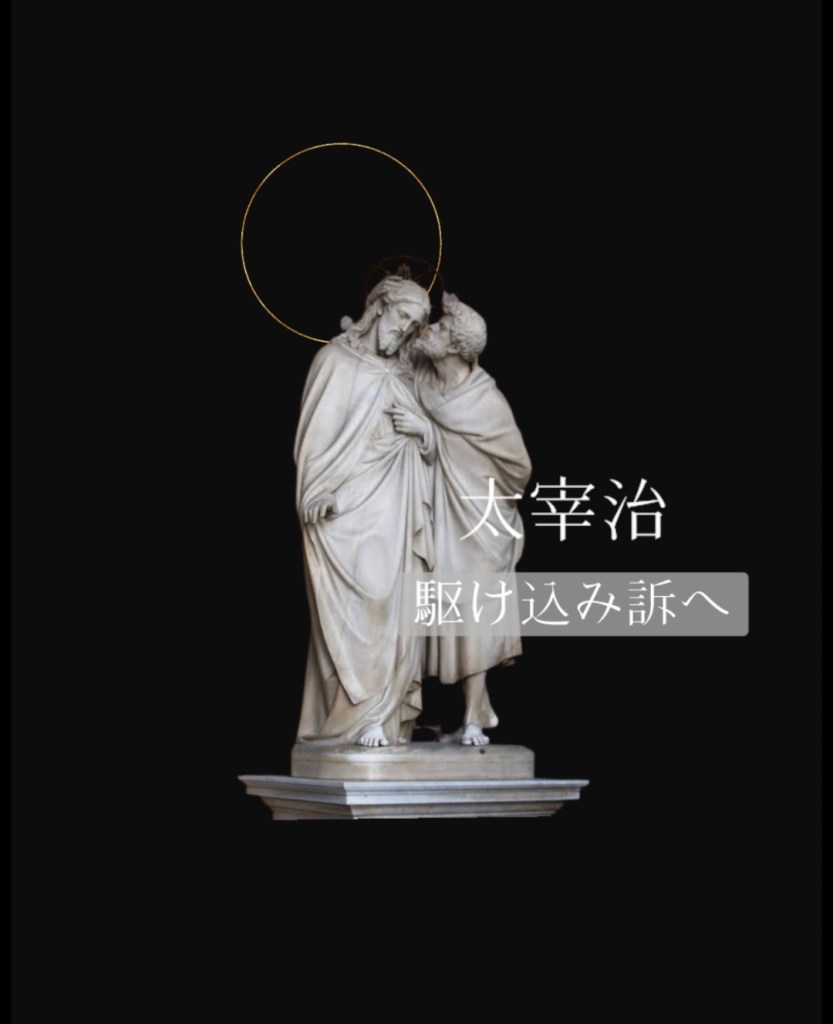
You know, wouldn't it be better if only your sincere father, who is out of sight, understood your loneliness, even if you didn't want others to understand? Don't you think so?
Loneliness is for everyone.
Heed My Plea, Osamu Dazai
- First:Osamu Dazai’s Heed My Plea
- Ⅰ.The Restoration of Leonardo da Vinci’s Last Supper
- Ⅱ.Osamu Dazai’s Heed My Plea and Its Resonance with Other Works
- Ⅲ.Judas in Heed My Plea
- Ⅳ
- Ⅴ
- Last
First:Osamu Dazai’s Heed My Plea
Heed My Plea by Osamu Dazai is an adaptation of Judas Iscariot’s betrayal of Jesus Christ, as told in the New Testament. In this retelling, Judas struggles with the act of selling out his beloved teacher, Jesus. Dazai weaves this story with an ease akin to a spider spinning its thread, drawing from his personal experience, just as Michiko transcribed it for him. Judas’s hesitation and inner turmoil are portrayed as though he were Dazai’s alter ego, reflecting the author’s own instability and ambivalence.
Judas, as a symbol of treachery, serves as the centrepiece of this narrative. Yet Dazai repeatedly reinterpreted his own experiences through the lens of betrayal, altering and refining his works over time, much as one would revisit a painting.
Once, many years ago, when I was engaged in painting, my teacher asked me a simple yet profound question: “When do you consider your work finished?”
This question touches the heart of what it means to complete something—a fundamental dilemma for all art.
What constitutes completion? Is it only for the artist to decide? Or does it require the recognition of others? If the work is created solely for oneself, does it even matter if it is imperfect? What do we ultimately seek—an audience, applause, friends? Or perhaps validation from God? Completion is not easily defined in a single word, but over time I began to understand that it resembles the final moments of Goethe’s Faust.
In the closing of Faust, good and evil both strive to move forward, yet time remains indifferent to their struggle. There is a moment when we awaken from darkness to a sudden glimmer of light. The one who can capture life in all its beauty, through both joy and sorrow, achieves something rare and precious.
“Time, you are beautiful.” These words embody the essence of true perfection.

Mephistopheles.「Eduard von Grutzner 1895年」

Ⅰ.The Restoration of Leonardo da Vinci’s Last Supper
The restoration of Leonardo da Vinci’s Last Supper took place between 1977 and 1999. In earlier depictions of the Last Supper, painted by artists before da Vinci, Judas Iscariot was traditionally seated opposite Jesus. However, da Vinci chose to place Judas at the far end of the table. Why did he make this choice?
In the restored version, it becomes evident that only Judas is shrouded in shadow. Yet, the positioning of the other figures is such that any small movement would cast them into shadow as well. This suggests that da Vinci did not adhere to a simplistic good-versus-evil dualism. Instead, his composition hints at a non-duality reminiscent of Buddhist philosophy, where good and evil are intertwined rather than opposed.
Da Vinci’s worldview aligns, in some respects, with the values of Machiavelli and Bacon, whose works emerged during the waning of Renaissance philosophy in the 16th century. A similar nuance can be found in the teachings of St Bernardino of Siena, a 15th-century Franciscan preacher. Bernardino condemned usury as morally wrong, yet acknowledged the essential role of bankers in economic development. This kind of moral ambiguity, where necessity coexists with sin, permeates much of the intellectual thought of the period.
Goethe’s Faust—inspired by the Book of Job—shares a similar complexity. Completed in the 16th century, the character of Satan in Faust diverges from the biblical depiction in Job. Rather than inflicting immediate suffering, Satan in Faust tempts Dr Faust subtly, offering him youth and pleasure instead of misery. This reflects the philosophical shift of the time, moving away from mystical German traditions towards a more rational, human-centred approach to philosophy.
Art, too, reflected this duality. Commissioning artworks served both spiritual and worldly purposes. On the one hand, patronage promised eternal salvation; on the other, it satisfied the vanity of the wealthy, who used their collections to display their status and refined taste.
Ⅱ.Osamu Dazai’s Heed My Plea and Its Resonance with Other Works
Osamu Dazai’s Heed My Plea reimagines the biblical story of Judas betraying Jesus for thirty pieces of silver. However, within Dazai’s own body of work, there is a strikingly similar story in terms of structure: A Tale of Honourable Poverty. This work, an adaptation of a Qing dynasty ghost story, explores the tension between “worldliness” and “anti-worldliness.” Through it, Dazai reflects on the struggle of being both an artist and a human being, wrestling with the desire to create while also living in the material world.
The story is set in the Edo period (1603–1868), where Sainosuke Mayama, a passionate chrysanthemum grower, takes in Saburo Tohmoto along with his siblings, Kie and her brother. Saburo is a master cultivator of chrysanthemums. He proposes that they sell the flowers to buy essential supplies like rice and salt, but Sainosuke, a man who takes pride in his poverty, protests. For him, selling the flowers for profit would be a disgrace to their beauty and meaning.
Despite Sainosuke’s objections, Kie and her brother go ahead and sell the chrysanthemums. In time, Sainosuke marries Kie, attempting to maintain a life of purity and poverty. However, he soon realises that his poverty is more of a compromise than a virtue. As time passes, his villas become larger and more extravagant. Beneath his disdain for selling the flowers lies jealousy—jealousy that Saburo is far more skilled at growing chrysanthemums than he could ever be.
In the story’s climax, Saburo vanishes like smoke, revealing his true nature as a chrysanthemum spirit. It is only then that Sainosuke realises his deep love for Kie, who, unlike the spirit, has not disappeared.
Heed My Plea and A Tale of Honourable Poverty were both published in 1940, the same year as The Grapes of Wrath. Steinbeck’s novel depicted the monstrous nature of capitalism, though the film adaptation of the story shifted its message to one of resilience: “The people will live on.”
In that same year, Disney released Pinocchio and Fantasia, both of which initially failed to find success in the American market. In Disney’s adaptation of Pinocchio, the fairies grant Pinocchio the gift of “good and evil” before sending him out into the world. Little Jiminy Cricket symbolises good, yet evil is not explicitly mentioned—perhaps because evil is implicit in the world Pinocchio must navigate. Jiminy’s guidance is insufficient to shield Pinocchio from temptation and neglect. In fact, it is evil that reaches out to Pinocchio—not as malicious intent, but as a silent invitation to follow along, unthinking and unchallenged.
In a curious parallel, Dazai’s works resonate with the themes found in these films. Pinocchio’s salvation lies not merely in Jiminy Cricket’s advice but in his spontaneous, unpremeditated actions. It is through this spontaneity that he rescues Geppetto from the belly of the whale. This form of goodness—one rooted in instinctive action rather than calculation—represents an eternal ideal. However, because Pinocchio lacked the glamour of Disney’s previous success, Snow White, it failed to generate enough revenue to keep the company out of financial trouble, even during wartime.
This sequence of events reflects an enduring challenge for humanity: the tension between the ideals of goodness and the harsh realities of survival.
Ⅲ.Judas in Heed My Plea
In Heed My Plea, Judas is cast as a symbol of betrayal in the Western tradition. Although the story draws directly from the Gospels’ account of Judas, it carries a unique tone, as if Judas has somehow possessed Dazai himself. The prose is familiar and unembellished—free from unnecessary words—yet every phrase is charged with tension. The focus of Judas’s obsession is “that man,” Jesus Christ, lending weight to every word he speaks.
A similarly Gospel-inspired work is Oscar Wilde’s Salome. Although Wilde’s Salome is a play, it also portrays the sacred through the lens of human depravity. Wilde reminds us that until we understand the full scope of the sacred, it remains elusive, swallowed by the terse expressions of human desire. As long as we remain blind to its meaning, the sacred can appear merely as self-indulgence or egoism. Yet, indulgence itself is not inherently wrong. Sanctity, as Bataille might argue, can manifest even within moments of sinful abandon. From one perspective, Satan may be dismissed as a mere monster, but what makes him human is the interplay of light and shadow—just as seen in Leonardo da Vinci’s Last Supper.
In painting, shadow sometimes mimics light, and similarly, Salome breaks a Catholic taboo by seeking the kiss of a divine figure. Her love is not boundless or pure; it is sharp and cutting, like a sword. After demanding and receiving the head of John the Baptist, Salome is executed, punished for transgressing sacred law.
Dazai’s Judas, however, is not presented as grand theatre like Salome, but instead takes the form of something akin to rakugo. Unlike plays that delve deeply into the human psyche, many rakugo tales—such as the well-known Manjuu Scary—tend to be light and humorous, focusing less on inner emotional turmoil. While Wilde added Salome’s execution after the death of Jokanaan, Dazai’s Heed My Plea notably avoids including a suicide scene for Judas. This omission is significant, considering Dazai’s own reputation for grappling with suicidal ideation. The fact that Dazai chose not to make Judas take his own life in pursuit of a sacred ideal suggests a deeper psychological insight. Instead, Dazai allows Judas to navigate several unspoken biblical codes, engaging with religious themes in a way that reveals the complexity of his inner struggle.
Dazai’s personal life was no less turbulent. A drug addict, he once sent desperate postcards begging to borrow old issues of Bible Knowledge, a publication that had become scarce. Dazai’s fascination with Christianity surpassed his interest in any other faith. Though he was never baptised, he believed himself to be seen by the Lord, aware that his sins were recorded by the Father. From a young age, he had attempted suicide using sleeping pills such as calmotine, not out of a desire for salvation, but as an act of confronting the defilement within his own heart—measuring himself against the commandments and always falling short.
Often regarded as one of the “three worst writers” in Japan, Dazai showed little awareness of the need to support his family with his earnings, as his wife, Michiko Tsushima, recounts in her memoirs. He was unfaithful to her and neglected responsibilities, even when taking in stray dogs. Yet, it was precisely this dissonance between his actions and emotions that fuelled his writing. At times, he wrote with sincerity; at other times, it seemed as if he were speaking on behalf of someone else entirely.
Psychologists might interpret these fluctuations as symptoms of mental illness, but it is this very instability that made Dazai an artist. Sensitivity—particularly at the level of the so-called “gifted”—cannot afford to wait for life to provide justification or meaning; if it waits, it perishes. Even today, we live in a world where possessing such heightened sensitivity is far from comfortable.
Critics who dislike Dazai’s work dismiss Heed My Plea as shallow. They argue that its contradictions lack depth and that its engagement with religion is superficial at best. Members of the clergy, too, might criticise Dazai’s portrayal of Judas as simplistic. Yet, this simplicity is precisely the point. Judas betrayed Jesus not out of elaborate malice, but through ordinary human weakness. There was no grand plan—just the kind of petty malice that festers quietly within us all.
Ⅳ
In the Gospels, Judas is portrayed in the most negative light in John 6:70: “Have I not chosen you, the Twelve? Yet one of you is a devil.” Although it is primarily in the Gospels of John and Luke that Judas is associated with Satan, each of the four Gospels offers a distinct perspective. Their narratives, while multifaceted, invite readers to seek a deeper understanding by integrating these differing viewpoints.
Dazai’s portrayal of Judas does not depict him as a particularly malevolent or cunning figure, nor as an elevated Satan capable of bargaining with God, as seen in the accounts of Job or Faust. Instead, Dazai’s Judas recognises that Jesus was fully aware of his impending betrayal, and that this betrayal was inevitable. The form of “Satanic” influence captured by Dazai is not a force of grand destruction but one that subtly, gradually sets destiny into motion—reflecting the very contradictions inherent in human nature. Through Judas, Dazai explores the inner duality that resides in every individual.
Dazai often revisited his personal experiences in various forms: through adaptations in his stories, in his wife’s memoirs, in the diary of a lover who suffered a heart attack, and in the writings of his mentor, Masuji Ibushi. Yet, just as Judas defies any singular interpretation, so too do the darker aspects of Dazai’s life resist easy categorisation. His flaws are complex, their meaning shifting depending on who recounts them.
The message conveyed by Dazai’s depiction of Judas is not one of criminal cunning or calculated malice, but rather a warning: that even ordinary human emotions, when left unchecked, can grow into something far greater than intended. This fragility—this awareness that human weakness can spiral—is essential for any religion. It reminds us that spiritual guidance must address not only grand transgressions but also the quiet, everyday contradictions that dwell within us all.
Ⅴ
Heed My Plea” is a quote from Matthew 23:25: “You are clean outside the cup and the plate, but inside you are satisfied with greed and riches.There are many crimes in this world that cannot be punished. In response to this, Dazai’s Judas seemed confused.
He wanted the reward, but he also wanted Jesus’ love. Judas expected great powers from the Messiah. But no.What Jesus does is only good for the poor. Thirty pieces of silver are worth the same as a slave in the Old Testament. A more competent and clever betrayer could have gained even greater riches. But Judas could not. That his little folly remains as a warning at the end of the Gospel is not far from the essence of Dazai’s adaptation. What was Judas’s punishment at the time? Judas had committed no crime according to the law of the time. And yet, He committed suicide. That alone should be enough to know what Jesus was like.
In A Tale of Honourable Poverty, the author’s own resistance to labor is expressed. At the same time, there is a search for a sacredness that cannot be converted into wages. Do people really want to labour? Have you ever thought about that? It is also true that people want to seek the sacred, not just to turn everything into recognition or money. But the Bible is also a book about labour. It is labour that has not progressed far enough to be called history. People have been working since Cain and Abel. That is why people had expectations of the labour of Jesus. Self-empowerment is not easy to achieve. It is man who cannot defy gravity, but what is the possibility of rising above it? This should be the original love. Dazai’s Judas wanted his soul to rise, but he lost that love for a measly sum because he could not defy gravity.
Last
“I just believe in its beauty. There is no one in the world as beautiful as he is. I truly love his beauty. That’s all. I don’t think of any reward.”— Heed My Plea, Osamu Dazai
Every human being is, at heart, well-intentioned. Within each of us lies a soul that weeps for what is truly sacred. I still believe that this is not a fairy tale—that it is the confusion born of our choices and judgments that clouds our vision. Jesus Christ recognised the potential within humanity, yet he also acknowledged the harsh reality: “It would have been better for him if he had not been born” (Matthew 26:24).
I do not need to justify how I interpret these words or why literature takes the shape it does. Writing need not involve seeking the approval of an audience. In the beginning, there was light—as it is written in Genesis, as well as in the opening of John’s Gospel. Yet, Satan has a way of reducing everything to meaninglessness, dragging even the brightest light into the dull weight of reality. It is necessary to reflect on this, but to see ourselves as worthless is to deny the very act of creation. How, then, do we turn towards love—towards a love that encompasses both ourselves and God? How do we find communion with the divine, beyond mere self-love?
The movement of the soul is like gravity: it is always falling. And at times, gravity severs the fragile thread of salvation. For the Christian, repentance and forgiveness are essential, but it is not always easy to see ourselves as we truly are. To grasp our own contradictions without slipping through them is no simple task. For writers, writing becomes an act of confession. Whether or not the events described are factual is irrelevant—the ritual begins the moment the story is told. Once words are set down, the speaker is judged for every utterance, even if the accusations are false or exaggerated.
When the manuscript becomes a confessional, there are no priests to offer absolution. Fate alone stands as witness. Even when we long for someone to understand us, we do not easily find such a partner. Dazai’s life was marked by relationships that ended in tragedy—multiple women chose to die alongside him. The destinies that draw us in cannot always be managed or planned. Confessors are urged to make amends to the world, but for the literary artist, there are two possible paths: Satanism or conversion. Both, however, can become art.
For Dr Faust, who sought knowledge with earnest intensity, his path led to the demonic. Goethe would have understood. Similarly, François Villon—whose name Dazai borrowed for Villon’s Wife—was a scoundrel and a thief, driven by reckless desire. There is something inherently flawed in the pursuit of perfection—when words that ought to be pure are forced into shape, they become tainted. In A Tale of Honourable Poverty, the man who refused to sell chrysanthemums doubted the purity of his own heart.
Having loved Jesus, Judas lost sight of his love and ended up laughing at himself like a clown. If Dazai had written a more coherent portrayal—whether psychologically, philosophically, or through poetic beauty—he might not have become Judas at all. What we do know is that Dazai continued to write, even when his life was steeped in discomfort and turmoil. Had he fully understood himself within his literary confessional, perhaps he would have openly criticised his own failings. In fact, that is exactly what I would do—just as one throws stones.
The reading to Heed My Plea has reached 10,000 views.(three days) The reader is male.

 Chris Kyogetu