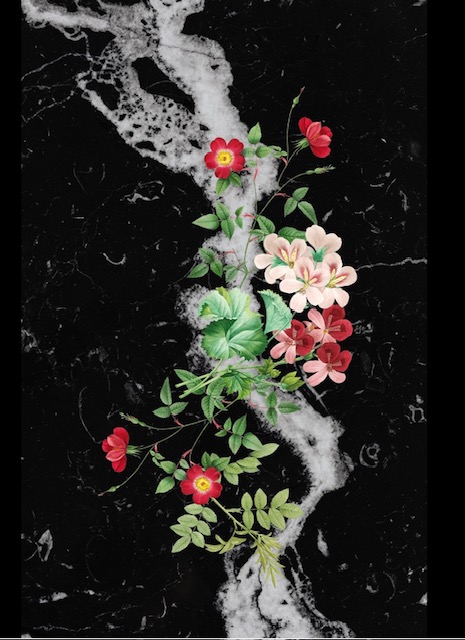
My rosary broke, prompting me to buy a new one.
Seizing this moment, I’ve decided to start sharing my dream diary openly.
Before my father passed away, he recounted to me a story from the “Tale of the Heike.” Following the Heike’s fall in the capital, a nun of the second rank entered the waters with the young Emperor Antoku. The three sacred objects she carried with the infant sank to the depths, and only the replicas of the mirror and sword, excluding the magatama, were passed down to subsequent generations. These sacred objects were meant to remain unseen by the emperor, leaving him uncertain whether the ones still preserved are indeed the legendary items. My father would often remark, ‘It’s better not to talk about the imitations outside.’ For it is political to those of ignoble spirit. To renounce the beauty of illusion is an act more ignoble than witnessing the demise of myth itself. Yet, given the world’s perpetual ignobility, we alone are left to breathe life into these phantasms. My father’s manner of speaking, rich with the suggestion that such matters were best left unsaid beyond our walls, seemed to uniquely encapsulate his character. In its entirety, this became my own Tale of the Heike, a treasured story woven into the fabric of my existence.
This is what I dreamed:I found myself standing in a fine drizzle, feeling as if suspended between worlds. The sodden earth beneath my feet seemed to whisper of days upon days of unending rain. Sheltered under the conifers, uncertain if the rain would relent or intensify, I stumbled upon the imprint of a sheep’s hoof. Though I couldn’t fathom why I attributed it to sheep, there was a certainty within me that a verdant meadow lay just beyond, yet I felt unable to proceed further. The light of day was muted, never yielding to darkness.
“A psalm of David.”
“The Lord is my shepherd; I shall not want.”
“He makes me lie down in green pastures,”
“He leads me beside quiet waters,”
“He restores my soul. For His name’s sake, He guides me in paths of righteousness.”
“Even though I walk through the valley of the shadow of death,”
Who recited that psalm? I was uncertain of the language in which it was spoken, yet it was evident to me that I was among the living, for I recognised it as the 23rd chapter of the Psalms. In the realm beyond, where life relinquishes its grasp, the ego and personality dissolve, and we transcend this passage as beings beyond imagination. Monks have said that in death, we become free of anger and sorrow. Yet, I felt not so privileged; I bore with me the full spectrum of emotions—joy, anger, sadness, and grief. Thus, it dawned upon me that this was all ensconced within a dream. The sound of my heart’s steady beat confirmed it; I was dreaming. I turned and posed a question that lingered in my mind: ‘I understood this psalm to be a trial for those who live, but does its reach extend to the departed as well?’
I asked this and then awoke.
Regarding this 23rd chapter, Augustine states that ‘the Church speaks to Christ.’ Who was it I intended to turn and question, who recited Psalm 23 to me? It was neither light nor shadow. The choice of interpretation seemed to rest solely with me. Boldly, I assert it was both. What lay within my grasp was both a void and a celestial realm, but I could never truly know it, for I couldn’t traverse it further.
This dream appeared to emanate from the mind. Impermanence, elusive to the senses, left me wondering whether the Holy Spirit had reached out and touched me beyond its speculation. The sacred, submerged in the depths of my mind, remains by my side as a discrepancy, a reproduction. Thus, it manifested as a ‘dream’.
The unsaid words and misplaced affections faded into eternity. For me, as a ‘phenomenologist’, the act of ‘bracketing’ (Epoché)these unidentifiable aspects and extracting only the experience from them was what I had been striving for all along.
Perhaps the fact that my father’s funeral adhered to the Jodo Shinshu tradition also played a role, yet I refrained from mentioning Christ altogether while delivering my eulogy before the coffin. I attuned myself to the atmosphere, contemplating what would be most appropriate for that particular moment. Neither did I delve into tales like the Tale of the Heike; rather, I spoke of more mundane matters. This approach brought a certain clarity, yet simultaneously compelled me to ponder my faith: ‘Could it be that the life devoted to emulating Christ is merely a “dream” during our mortal existence?’It might also signify an acceptance of having been defeated in thought. For me, such an entity had simply “vanished.” While dreams are chronicled in the Book of Daniel as a conduit to divinity, they can equally be construed within the human psyche. Innately, I could not assert Christ’s presence as “absolute” in the manner of a sovereign decree. And so, even if these were dreams of a fleeting existence, I found myself replacing a broken rosary.
‘Whose son are you?’
I wish to keep in mind that Jesus Christ, who drew nearest to the mystery of the ‘Father’, was executed. It is said in Revelation 2:17 that there exists a name known only to God and the one who receives it.My reflections often dwell not solely on his resurrection but also on his death. The question arises: what is truly sacred? Does Jesus reside within the rosary? The answer is no, and yet, why did I find myself compelled to repurchase it?
I have resolved to believe that these discrepancies between reality and mystery are what allow us to retain our humanity. More pressing, perhaps, is the question of what we would wish to do if we and our cherished existences were truly to dissolve into ‘nothingness’. Death is the ‘fruit’ that sinks to the ocean floor, prompting those who follow to strive to create substitutes for that which was lost. In the realm of the living, death assumes the guise of a dream, slightly misaligned with the otherworldly. Much like Jesus not residing in the rosary, yet the rosary remains an essential item. Hence, a certain misalignment must exist where this world intersects with the next. There are religious factions that oppose the three sacred artefacts, but the Christ shaped by skewed historical narratives and political ideology diverges from the true Christ. To skew mythologies within a favoured ideology betrays a lack of sincerity towards the sacred.
Some literary figures have remarked that literature often dwells more on death than on love. For me, a myth that stands in contrast to Jesus’ love and death is, for example, Orpheus. While Jesus bequeathed love to the world, Orpheus, overcome by love and awe, looked back despite his covenant with Hades. This fateful glance sent his wife Eurydice back to the realm of the dead, leaving only death in its wake. Even before his crucifixion, Jesus did not waver or look back when faced with betrayal by his disciples, rejection by the people, or the death of John the Baptist; he continued steadfast on his journey.
In narrative terms, both tales embody a form of love that brushes against the valley of the shadow of death, spinning a story that knows no end.Therefore, to accept only the impermanence of things or love alone was something I could never do.
Husserl’s phenomenology calls for fidelity not to the ‘things themselves’ but to phenomena as they manifest in consciousness, thereby implying that all that is seen, felt, or dreamt holds equivalent value to ‘reality’. My truth, as a phenomenon, possessed a surety. This dream may vary from Nebuchadnezzar’s dream, as interpreted by Daniel.
Yet within this, what do we decide to take from the scant items available before death claims us? Concerning this, I choose henceforth to employ the nebulous realm and vocabulary of dreams.
Within this domain, I seem to discover my core essence.
My conviction stands firm that my strength lies in accepting that absence, settled at the ocean’s depths.
As the first night draws to its close, were I to leave something unsaid,
Before the coffin, I longed to say: ‘You were, to me, like Joseph.’

 Chris Kyogetu