
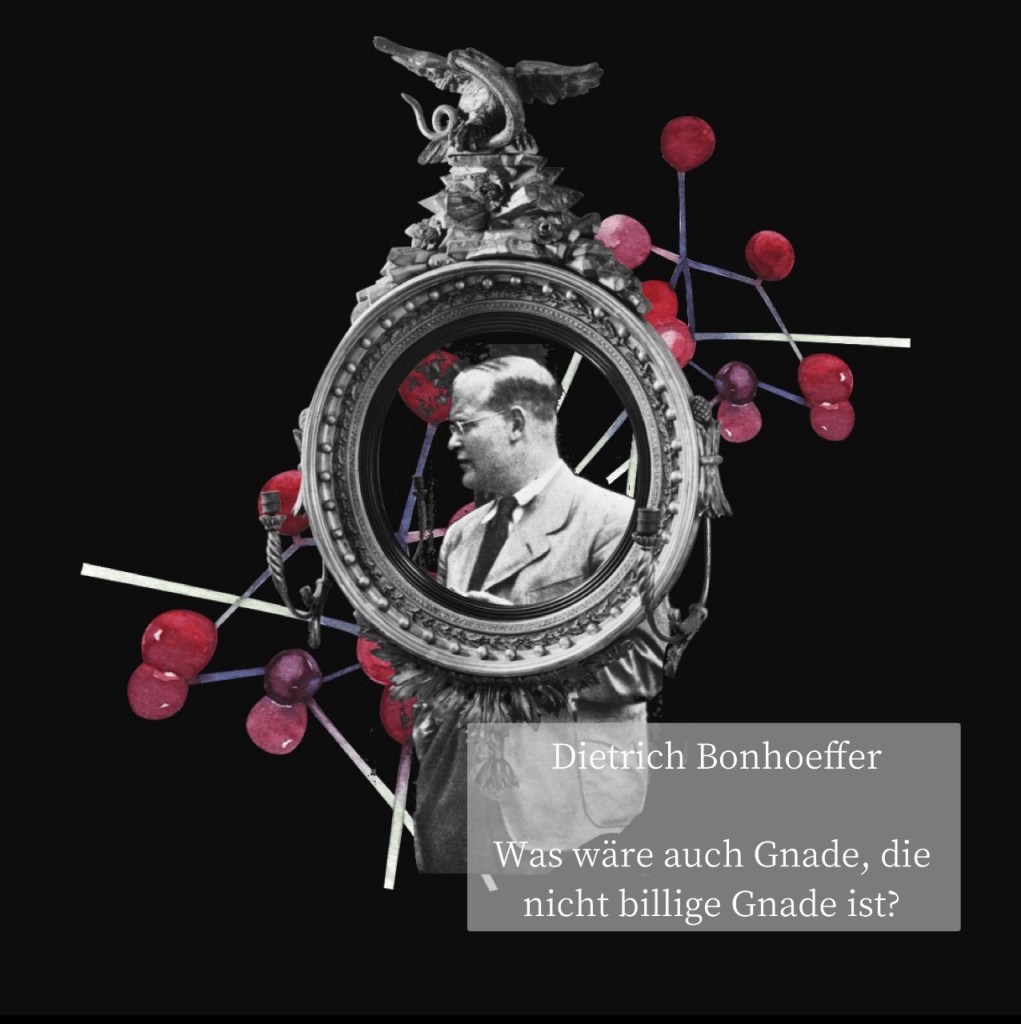
I. Die teure Gnade -Nachfolge
Was wäre auch Gnade, die nicht billige Gnade ist? Billige Gnade heißt Gnade als Lehre, als Prinzip, als System; heißt Sündenver-gebung als allgemeine Wahrheit, heißt Liebe Gottes als christliche Gottesidee. Wer sie bejaht, der hat schon Vergebung seiner Sünden. Die Kirche dieser Gnadenlehre ist durch sie schon der Gnade teilhaftig. In dieser Kirche findet die Welt billige Bedeckung ihrer Sünden, die sie nicht bereut und von denen frei zu werden sie erst recht nicht wünscht. Billige Gnade ist darum Leugnung des lebendigen Wortes Gottes, Leugnung der Menschwerdung des Wortes Gottes.
・・・
Billige Gnade ist Predigt der Vergebung ohne Buße, ist Taufe ohne Gemeindezucht, ist Abend-mahl ohne Bekenntnis der Sünden, ist Absolution ohne persönliche Beichte. Billige Gnade ist Gnade ohne Nachfolge, Gnade ohne Kreuz, Gnade ohne den lebendigen, menschgewordenen Jesus Christus.
Translation
・What is also grace that is not cheap grace? Cheap grace means grace as doctrine, as a principle, as a system; it means forgiveness of sins as a universal truth, it means the love of God as a Christian concept of God. Whoever affirms it has already received forgiveness for their sins.The church that holds to this doctrine of grace is already a partaker of grace through it. In this church, the world finds a cheap cover for its sins, which it does not repent of and from which it certainly does not want to be free. Cheap grace is therefore a denial of the living Word of God, a denial of the incarnation of the Word of God.・・・
・Cheap grace is preaching forgiveness without repentance, baptism without church discipline, communion without confession of sins, absolution without personal confession. Cheap grace is grace without discipleship, grace without the cross, grace without the living, incarnate Jesus Christ.
Dietrich Bonhoeffer(1906年2月4日 – 1945年4月9日)
Dietrich Bonhoeffer, born in 1906, was a Lutheran pastor and theologian. Under the Nazis, most churches collaborated with the Nazi regime, but Bonhoeffer, among others, founded the Confessing Church, which he fiercely and righteously opposed. He was executed in Flossenbürg concentration camp (KZ Flossenbürg) for his part in the assassination of Hitler. The present translation is an extract from I. Die teure Gnade from his early work, Nachfolge.
His writings are not characterized by metaphor or rhetoric, but they are not only theologically profound but also logical, ethical, and moral, and enlightening. Bonhoeffer interpreted “billige Gnade” as a disregard for the word of salvation, accepting it as a mere theory or doctrine without seeking repentance or transformation. According to him, such an acceptance of grace is not authentic grace but a “rejection of the living Word of God” and a denial of the doctrine that “the Word of God appears as a person.” Bonhoeffer argues that authentic grace must be more than a mere theory or doctrine but must have the power to transform the heart and life of the individual. Therefore, authentic grace is seen as going beyond doctrine and theory and should be practiced in the heart and life of the individual so that genuine transformation and conversion can take place. His interpretation of the Sermon on the Mount is particularly noteworthy, but above all, his discernment of what is right in the midst of the distortion of worldly morality and ethics. There are few Christians today who can accompany their practice in the face of the injustices that are happening throughout the Church.
As for accepting the guilt of assassination in a liminal state (Grenzfall) under Hitler’s regime, I would choose my words carefully.His reference to the ‘word of the living God’ (des lebendigen Wortes Gottes) should still be felt today.
*”This is a translation and analysis done in the usual fragmented style of the ‘Cahiers’ journal. I acknowledge that it may be insufficient, but I appreciate your understanding.”

 Chris Kyogetu
コメントを残す