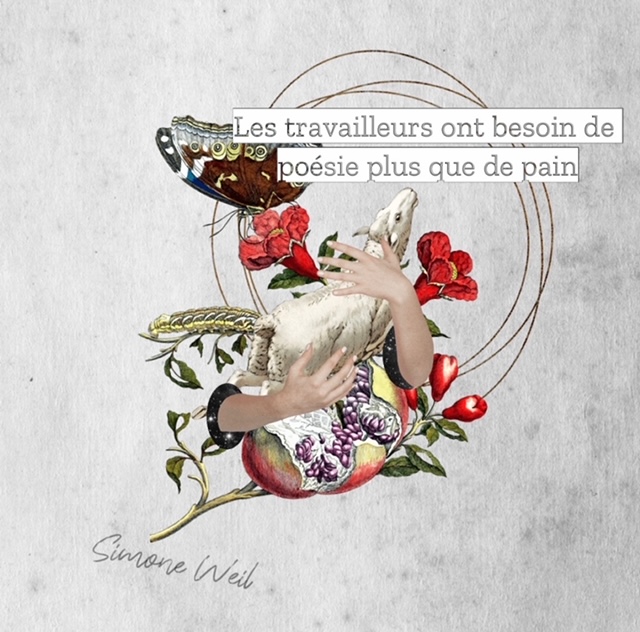
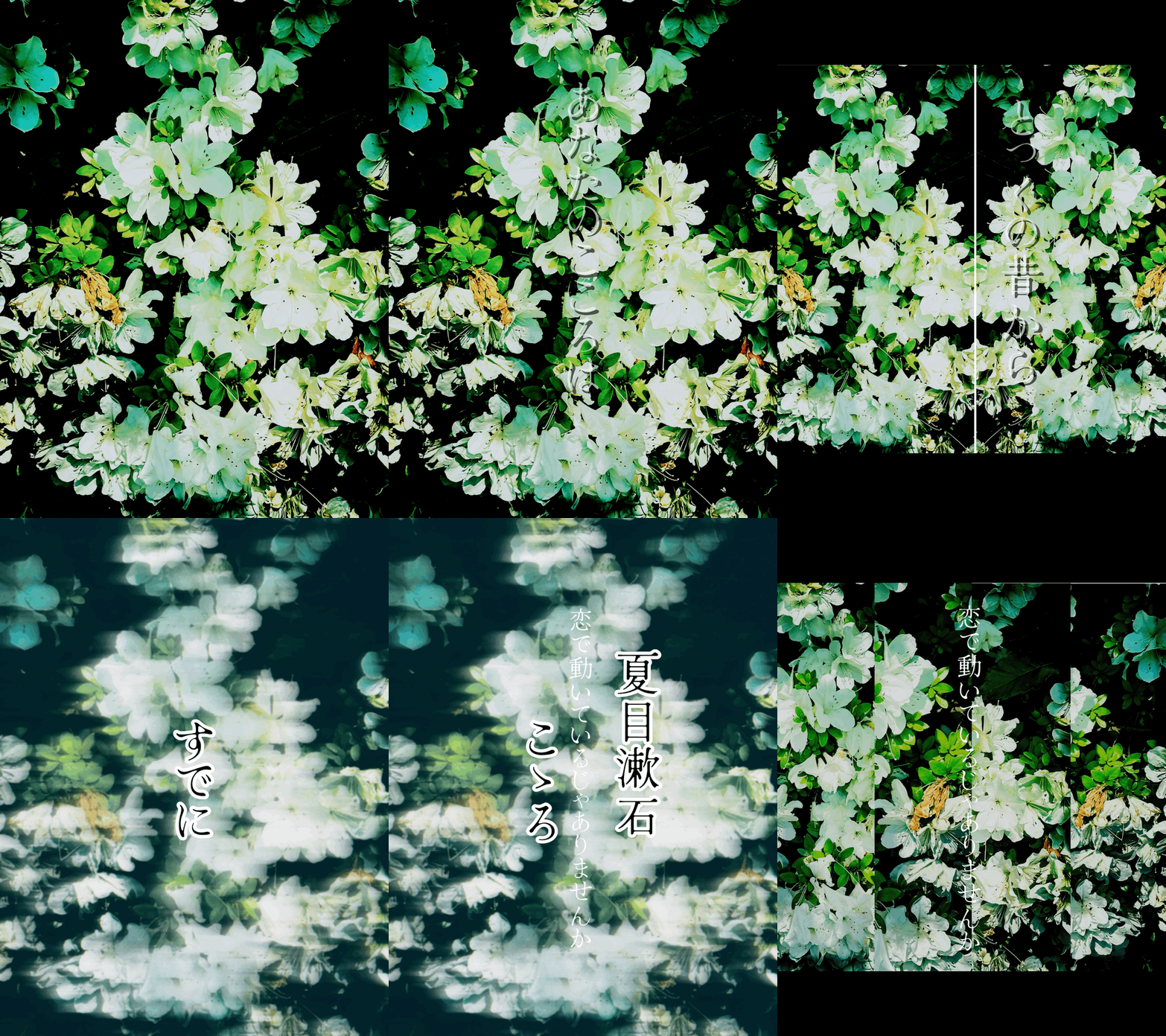
“Every celebration is held on the other side of suffering, as though time had stopped.”
Possession
I have the sense that what we call love is, above all, one of those human undertakings through which we come to know that love is not confined to romance. In this respect, the question of “possession” is particularly interesting.
What first comes to mind is the notion of possession in Bergson’s philosophy. He speaks of reprendre possession de soi. Here, possession does not mean the domination of an object. It means rather the return of the self, which had been taken away by the world, by language, and by external time, to the inner movement of its own life.
Ordinary possession places the object outside oneself and declares: “This is mine.” But Bergsonian possession means something else. It is to return, from the condition of having been carried outside oneself, to the time one lives in truth, and to inhabit it once more from within.
Stendhalian possession, however, is of another order. It is directed toward the “other,” toward the object; the beloved person, the object of admiration, one’s own desire and dream, become crystallized. Perhaps this is what is commonly meant by possession.
As for my grandfather’s “Bible,” it is interesting that it bore both of these movements within it. I speak only from my own point of view, but my grandfather was not a Christian, nor did he, while he was alive, ever show himself to be an assiduous reader of the Bible. He never showed himself praying. Though trained in the sciences, he loved literature.
It was only once that my grandfather let fall, concerning the Bible, something like a fragment of himself.
It was the day of the Flower Festival. At kindergarten, I had taken part in a celebration of the Buddha’s birthday. When I came home, I told my grandfather how I had poured sweet tea over a small statue of Shakyamuni, and how, above all, it had been beautiful and joyful.
My grandfather sometimes had the manner of speaking of someone from a Grimm fairy tale. He did not simply say, “That must have been nice,” or anything of the kind. Instead, he asked me, “Did you pour water over a fairy tale? Or did you pour it over something you believed had truly happened?”
Without thinking, I answered, “A fairy tale.”
My grandfather then said, “So you poured water over a fairy tale?” I became a little stubborn and answered, “It is the same as Cinderella or The Little Mermaid. I know they are not there, but I do not want to throw away the book, because I feel sorry for the princess inside it. When I sleep, I cannot sleep unless I imagine things. So when I poured the water, I did it as if it were truly so.”
“That is a good instinct,” my grandfather said.
Then he began to speak of Moses in the Old Testament of the West. Moses, he said, was a child who, after his birth, had been set adrift upon a river in the midst of conflict. He began to tell me that when a “saving presence” appears, it is often at the very moment when human beings are poorest.
The reason Moses was placed in a basket and sent down the river was that he had been born into an age of violence, when the male children of the Hebrews were being killed. The story of Moses was therefore, at once, the story of “a baby who was protected,” and a story placed, from the very beginning, within conflict, persecution, and the suffering of a people.
The life of the Buddha, too, would become the life of one who looked upon human suffering: old age, sickness, death, attachment, and strife.
“Why do you think,” my grandfather asked, “that celebrations are always held as though time had been stopped, on the other side of such suffering? When you grow older, you should think about it. Other religious people have only disappointed me. But you, I think, have the talent not to disappoint me.”
That was where the conversation ended.
When I asked him, “Should I read the Bible?” he only said, “Do as you like.”
He did not tell me to read it.
Nor did he tell me not to read it.
“You may do whatever you like,” he said, “but become a poet.”
He gave me no guidance, either about the Bible or about poetry. I had only heard, besides this, that when he was poor, my grandfather had once received an English translation of the Bible from either a priest or a pastor, and that he had studied language through it. But he said that he was an atheist.
I had thought that my grandfather lived as though God did not exist. During his lifetime, the books he kept on his desk were books on investment, or other books of a more practical kind. After that day, we never spoke again of the Bible. As I grew older, even that conversation began to seem to me almost like a false memory.
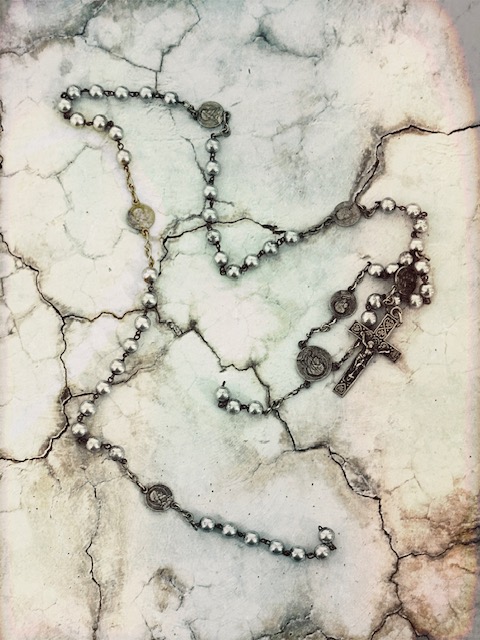
I left Japan, and after I returned, absorbed as I was in my own life and scarcely looking back toward my family, I entered the Catholic Church in 2014 for the sake of marriage. The man and I had found common ground in saying that, among all books, the Bible was the one we loved most. We had even believed that our way of looking at Jesus was something we possessed together, as though it were a crystallization of love. Moreover, it had been he who told me that I ought to be baptized.
I shared with him, in particular, the literature that had some relation to the Bible. Because of this, I looked for a church, and I seized upon the first place that seemed ready to receive me at once.
But then, because of circumstances by which he suddenly declared that he could not enter the Catholic Church, the engagement was broken. Alone, at the baptismal ceremony on the Feast of the Assumption of the Blessed Virgin Mary, I faced and greeted a community I had never desired.
As though there were love in my heart, I performed joy in order to conceal the empty seat. There was, in truth, a part of me that was happy. And yet, whenever I remember the bow I made in greeting at that baptismal ceremony, everything in me seems about to melt away and disappear into tears.
I was baptized.
A week later, my grandfather was dead.
***
In 2025, when I went, after many years, to my grandfather’s house, his study was still there. I was told by my relatives that the completed manuscript from his lifetime had been left upon his desk, and that, since then, the room had scarcely been touched.
When I had last seen it, there should have been, upon the desk of that study, only books of practical use. But I learned that they had been replaced.
The first thing that astonished me was Edgar Allan Poe’s “Annabel Lee.” I myself had translated that poem many times, and had been intoxicated by it; and now I discovered that my grandfather, too, had loved it. In a file entitled “Poetry,” he had translated it again and again: “seventh translation,” “eighth translation,” and so on.
I had bought a newly designed edition of the collected works of Edgar Allan Poe. But I learned that my grandfather had owned the same contents in the former paperback binding.
And then, among the old foreign books, there was, at the centre, one volume alone, sun-browned, its title no longer legible. I took it up without thinking.
It was the Bible.
It was so deteriorated that, had I handled it roughly, its pages seemed ready to crumble and spill out. Already, in an instant, several pages had fallen loose.
And yet it was that Bible — the Bible that had been spoken of in that faint memory.
My grandfather had received a Bible.
The story had truly been true.
What I had almost come to think of as a mistaken memory had been true.
On the inside of the cover, these words were written:
For three years, let this learning be unto me a seed of humility.
***
At some point, with regard to love, the desire to possess had grown thin in me. Little by little, even when I felt something to be dear, I no longer divided things so readily by the word “love.”
To extend a hand had become, rather, a reflex born of experience. Without much thought, I came to feel that if, when it was received, there was even a little warmth, then life had been enriched, and that I had gained something. Beyond that, I ceased to thirst.
And yet, even before my baptism, I had known that love could be both romance and agape. I became unable to free myself from these two poles; and whenever something ended sadly, I would do little more than settle it under the name of agape.
I still wished, in literature, to write of “love.” But it did not go as I wished. With regard to love, there were destinies one could accept, and destinies one could not.
Those who preach what true love is are, after all, not separate from their own view of life; that view merely becomes part of their faith. It does not mean that they have exhausted the truth of love. And yet they try to distinguish between love that leads to Christ and love that does not.
To speak honestly, my love for Christ had also been, between a man and a woman, a romance. “We possessed the same thing.” That had seemed to me something very special.
But, on the other hand, when I stood before the true deaths of friends, of my grandfather, and of my father, a presence like the god of death surrounded me, and I wondered whether the Bible, too, might have been only a dream-tale of the living.
And yet, as though in the continuation of a dream, the figure of Jesus remained within my inward landscape, refusing to disappear. Time passed, while I could not say in what way it was certain.
***
Takehiko Fukunaga regarded “possession” in this way: passion contains within itself a movement toward acquisition, and love, too, appears as a desire for possession. Just as the desire for fame or the desire for money seeks to possess status or property, so, in love, there arises the desire to possess one particular object entirely.
Yet, unlike status or property, the object of love is a human being. For that reason, possession can never be perfectly accomplished. One may hold the other’s body, but one cannot possess the whole of the other’s soul or consciousness. There, perhaps, lie both the intoxication and the impossibility of love.
He distinguished rather clearly between the possession of the body and the possession of the soul. Even if one possesses the body, this is no more than a temporary satisfaction; desire soon moves beyond it. If one then comes to wish to possess even the soul of the other, there arises the danger of trying to subordinate the other’s personhood to oneself. But this is not the completion of love. It is, rather, something like placing the other in a state of servitude.
Thus, in love, “possession” is born almost inevitably as desire; and yet, if one tries to bring it to perfect fulfilment, one wounds love itself. This is the tension at its heart.
Fukunaga, in the end, left the question in this form: if, in the process of trying to possess another soul, one gradually turns the other’s consciousness toward oneself, and presses desire so far that the other can no longer think of anything but oneself, does that mean one has seized the other’s soul?
Even if one occupies the consciousness of the other, this does not mean that one has truly possessed the soul. To deprive someone of consciousness is not the same thing as to possess the soul.
In the possession proper to love, there remains something almost unattainable.
My story is not, strictly speaking, a story of love between a man and a woman. And yet Edgar Allan Poe’s “Annabel Lee” was such a story.
The tale said to have given rise to that poem was one in which a sailor and a girl of noble birth loved each other, were opposed by those around them, and met secretly in the graveyard. The girl, in time, died; and still the sailor continued to visit her grave.
The image of Annabel Lee in the sepulchre there by the sea — and the love between a man and a woman — makes everything that has been chosen, what was intended and also what was not intended, into a crystallization in the Stendhalian sense.And if one tries to imagine the form of such love, it can become something that passes even beyond the relation of love between the two persons themselves, something sacred. It gives the sense not only of love, but of a soul that seems to bear upon itself all original sin, and all tenderness.
My grandfather, who had been intoxicated by “Annabel Lee” and had translated it again and again, wrote in his diary that there is a great difference between a life capable of leaving behind such a poem and a life incapable of doing so. For that, he wrote, one needed “passion”; and he wrote that this was what he lacked.
After his death, I would come to find this together with the Bible.
Only then did I begin to understand that, for my grandfather, the words “become a poet” may have contained all of this. What was being sought there was not, as in magical realism, a “curse,” nor was it the perfect form of love. In the words that told me to become something, there was freedom.
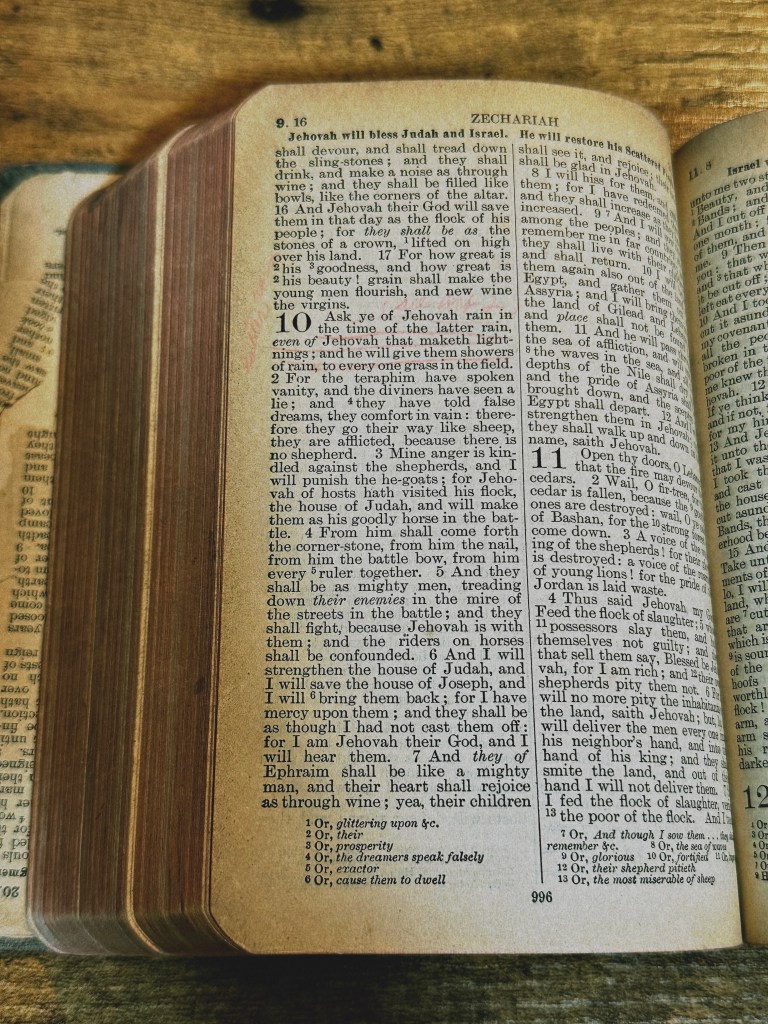
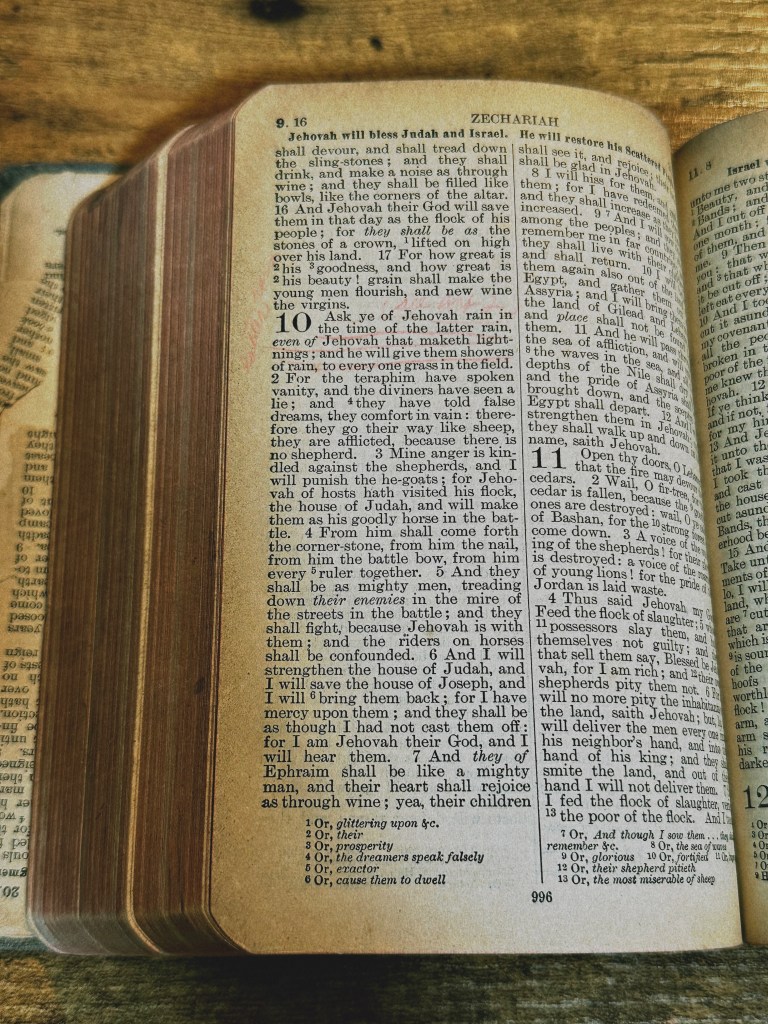
In my grandfather’s Bible, there was a passage that had been underlined.
“Ask ye of Jehovah rain in the time of the latter rain,
even of Jehovah that maketh lightnings;
and he will give them showers of rain,
to every one grass in the field.”
(Zechariah 10:1)
Because it was an older English translation, the divine name appeared as Jehovah. And by appearing as a name, God was not a nameless god, but a God who could be called by name.
Ask. Desire. Ask for rain.
A seed cannot grow by its own power.
“Ask ye of Jehovah.” Ask the Lord for rain.
And rain does not fall only upon the chosen. It falls also elsewhere: “to every one grass in the field.”Perhaps a Bible becomes one’s possession simply because someone has drawn a line beneath it.
And I, ever since I was baptized, had believed that I was the one who had been sowing seeds. But when I held this Bible in my hands, something very far from impermanence came over me. For a time, the god of death withdrew from my heart. As though light had entered there, I wanted once more to believe that I, too, was God’s “possession.”
I had taken up the pen for my grandfather because I had heard that, after he was told how little time remained to him, he had fled from the hospital.
How was I to leave behind the trace of a man who had lived? How was I to leave behind what he had feared, and to say that it was not mere impermanence?
Which of the two is the true story, and which is the fairy tale — that has not yet been decided.
But I came to know that I, too, had been a seed that was sown.
***
Author’s Note
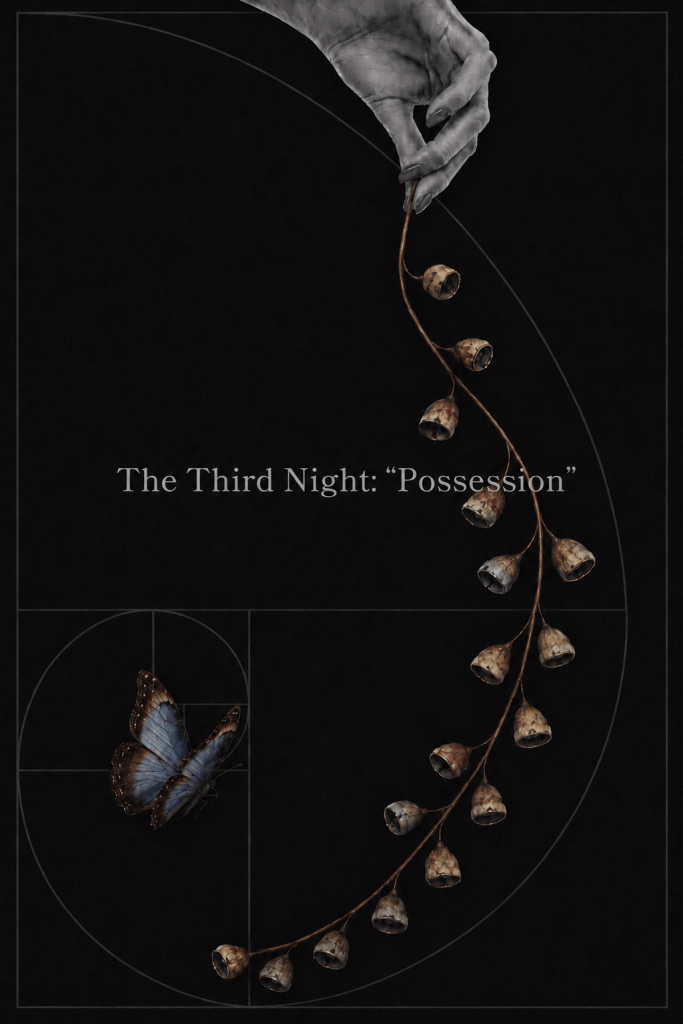
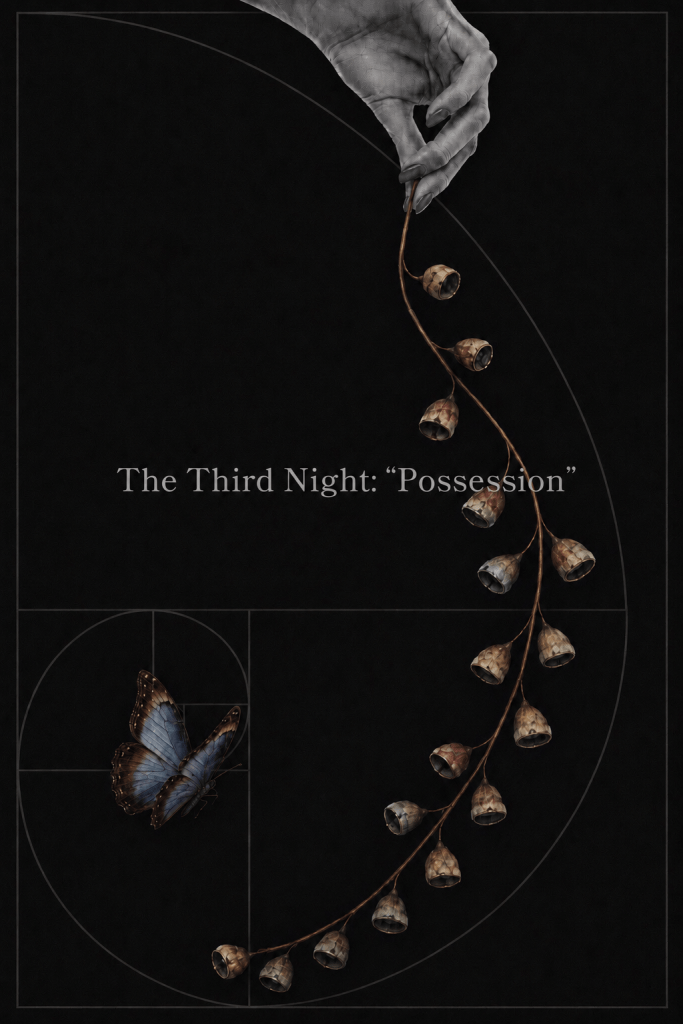
This series began in homage to Takehiko Fukunaga’s Ai no Kokoromi (An Attempt at Love). Yet homage, if it is truly alive, does not remain imitation. It becomes a response. Taking up Fukunaga’s structure of twenty-three pieces, I recast each piece as a “night.” In this form, the questions of love, memory, faith, death, and possession pass into the landscape of my own life. The Third Night: “Possession” is one such variation. The question of “possession” in love passes through my grandfather’s Bible, baptism, and the memory of the dead, until it is transformed into the question of being God’s “possession,” and into the discovery that I, too, may have been a seed that was sown.
・Agir librement, c’est reprendre possession de soi, c’est se replacer dans la pure durée.
“To act freely is to take back possession of oneself; it is to place oneself once more within pure duration.”
This is a passage from Bergson’s Essay on the Immediate Data of Consciousness, commonly known in English as Time and Free Will.
・The Japanese word 片鱗 may ordinarily be translated as a glimpse. Here, however, I rendered it more poetically as a fragmentary sign or a trace.
・The word “curse” in relation to magical realism may seem somewhat sudden here. It is used in anticipation of the next work, whose themes will be magical realism and poetry.
・And I, ever since I was baptized, had believed that I was the one who had been sowing seeds.:In 2016, I published a work that took Matthew 13 as its motif. My grandfather did not know this.