
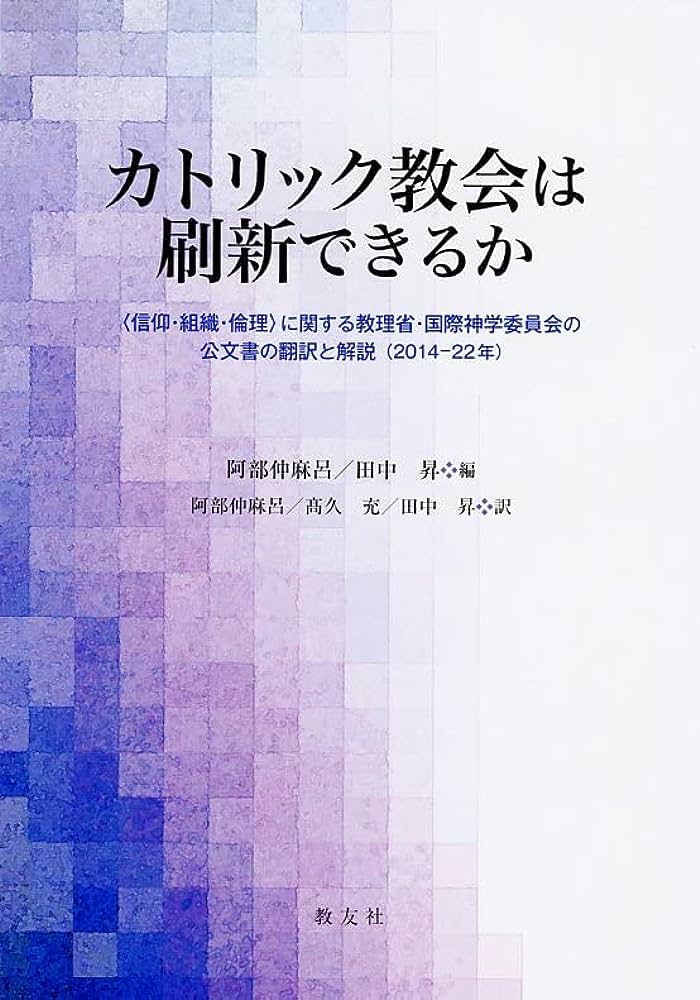
'If the Catholic Church needs to constantly “renovate” itself, then it needs to continue to strive to increase its own holiness.'   「カトリック教会は刷新できるか」
阿部仲麻呂/田中昇 編
教友社
First
For example, if you do not have a good impression of the Catholic Church, that is a very reasonable opinion and you are right. However, I would like to say, if I could say it here, that some clergy and lay people are trying to deal with various issues in a ‘realistic’ way. The book is developed in technical terms, but it not only stays within a religious framework, but it is written by priests in office who do not hide what is already in the news and the problems that people away from the Church have. But few have the strength to recognise the problem. I hope that as many people as possible will use this article as an opportunity to find out. I would also like people studying religion in philosophy and other subjects to pick up this book as a realistic religion.
Second
The book begins by looking at the current situation of the Church, examining its reality and the quality of faith, and developing a timeline of proof and verification from traditional biblical interpretation to synod and synodality, based on the ‘sensus fidei’ (sense of faith) that the Pontifical International Theological Commission claims to emphasise. Sense of faith’ is a familiar and easily found term in Catechism No. 92, which refers to the supernatural understanding of faith (sensus fidei) when it indicates universal agreement in matters of faith and morals, from the bishops to the faithful. At the Angelus Domini, Pope Francis quoted the story of a humble woman he once met. Without the Lord’s forgiveness, this world could not exist,” the Pope said, marvelling that “this is the wisdom that the Holy Spirit gives us”.
Surely this was a statement that combined faith and morality and promoted true wisdom. I was particularly reminded of ‘speaking in tongues’ in chapter 12 of his first letter to the Corinthians. Paul preached to the Corinthian believers who were preoccupied with tongues that they were ‘love’ and that their words contained ‘love’ (agape/caritas). (p.95 Catholics derive their ‘sense of faith’ and ‘love’). What can be done to ‘RENOVATE’ the present state of the Catholic Church? The book attempts to develop a ‘sense of faith’ in response to the question ‘What is the sense of faith?’, but it allows the vague religious beliefs of the faithful to be organised together with Catholic doctrine. This attempt is similar to that of the philosopher Heidegger. He too traced the question of ‘existence’, which had long been questioned in philosophy, back to Greek philosophy and other etymological analyses, and tried to overcome the forgetfulness of existence by means of “Daseinanalyse” (a form of psychopathology). This not only revises the sensus fidei, sensus fidelium, but also deepens the relationship between the Bishops and the Synod, and this too is certainly an attempt to overcome the forgetfulness caused by the illness of the whole organisation. Above all, it should be noted that the current situation continues to think of the development of the Church only in terms of what “renewal” means. The Catholic Church cannot develop without leaving its problems behind, and “RENOVATE” means, as a first step, that each of us becomes aware of our “sensus fidei“.And as the ‘religiosity of the masses’, people have a self-generated ‘religiosity’. Explained in dichotomous terms, the sensus fidei and the religiosity of the masses appear to be in opposition, but they are closely related. It is a mistake to distinguish between the sensus fidei and public or majority opinion, and we must bear in mind that the experience of the Church is not only the efforts of theologians and the teachings of the majority of bishops, but that the “truth of the faith” is defended in the hearts of the faithful. The principle of discernment is linked to popular religiosity and the evangelical instinct for the sensus fidei. By not separating it from the religiosity of the masses, we have to look at the shortcomings of Catholicism. There are many judgments that are wrong as sensus fidei. (Illegal clergy)The contents of the book should be used more in conferences, etc, To be judged by the Vatican as being interested in such matters by Japanese Catholics,Invenescit Ecclesia with, …… That it is not a “fideis mortua”but a living faith. And above all, that the image that remains after a long textual experience should strive to become the Holy Family, a compass for many faiths. Jesus replied: “That you believe in him whom God has sent, that is the work of God’s Opus Dei”. May we remember this and may our senses be sharpened with the possibility of a waking.
*Why did they translate it as Renovate? : To look at the various problems of the Catholic Church. Instead of ‘developing’ and leaving the defects behind, it is necessary to try to defect and repair them, because they need to be reformed while preserving their traditions. –Invenescit Ecclesia

 Chris Kyogetu