And that [same] day Jesus went out from the house and sat down by the sea.

 And great crowds were gathered together to him, so that going on board ship himself he sat down, and the whole crowd stood on the shore.

 And he spoke to them many things in parables, saying, Behold, the sower went out to sow:

 and as he sowed, some [grains] fell along the way, and the birds came and devoured them;

 and others fell upon the rocky places where they had not much earth, and immediately they sprang up out of [the ground] because of not having [any] depth of earth,

 but when the sun rose they were burned up, and because of not having [any] root were dried up;

and others fell upon the thorns, and the thorns grew up and choked them;

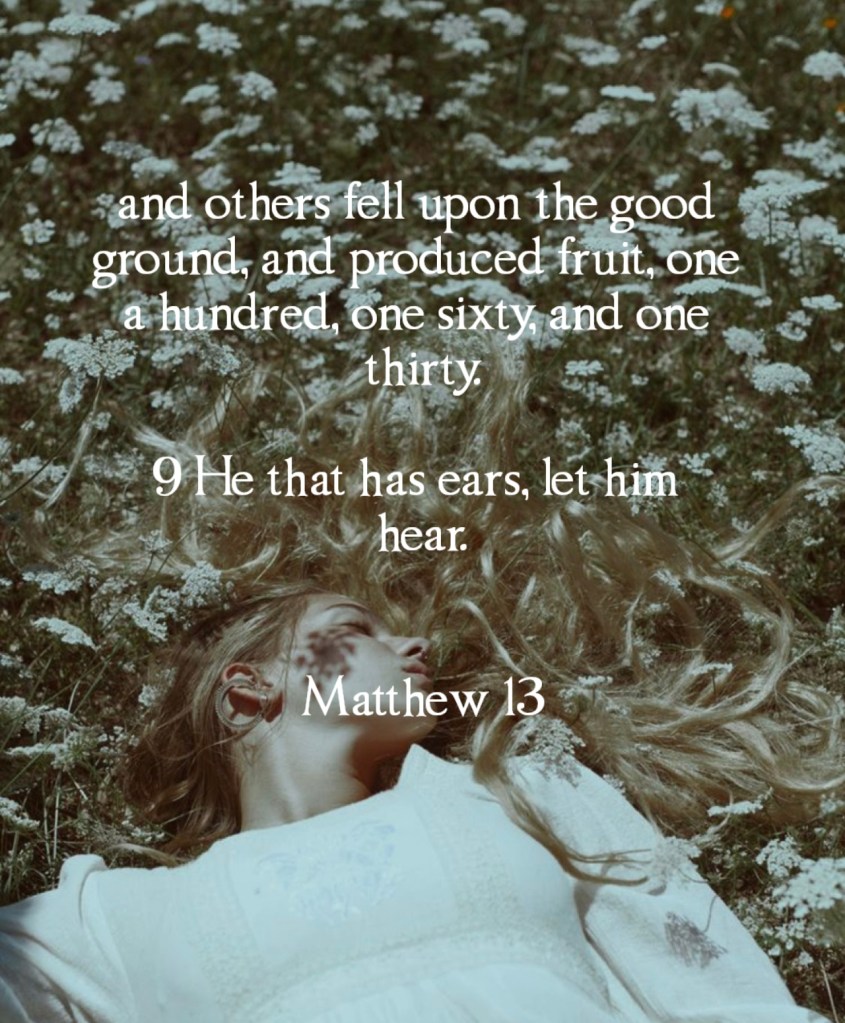
and others fell upon the good ground, and produced fruit, one a hundred, one sixty, and one thirty.

He that has ears, let him hear.

Matthew 13:1~9
1
Western philosophy and Greek mythology had the sea as ‘Mother Sea’, but also the opposite, as something which drowns and is unsuccessful. No land seed can grow on the sea, but I thought it made sense that Jesus was talking about seeds on the boat. Seeds are the possibility of a person’s faith in Jesus, but seeds that are scattered and falling, do not choose the place, the good earth or the bad land: Birds come and eat it, it germinates where the ground is not deep, but withers, or if it falls down a thorny path, it is blocked. We don’t know where the land is where the seed will grow and It must know that it can wither along the way. This passage became the heart of my Christian transmission because it was the lecture when I attended my first church mass.
2
In the Old Testament, there are stories of Joseph, who receives revelations in dreams, and Daniel the interpretation of dreams, and in the Old Testament, dreams were also revelations from God. I visited the church for the first time, with Daniel the dreamer in the book of Daniel being my favorite. Then I came across this New Testament chapter 13. Since the birth of Jesus, God no longer appears in people’s dreams. Instead, Jesus is the Lord, and the ‘parables’ of the Father unfold. Usually there is no commentary in the Mass as to whether the story has been told on the sea, and this time there is no criticism.
I think the reason I can talk about the sea is that I’m an evangelist, not an ecclesiastic. Thus, as a novelist and evangelist, I took from that passage to the sea. In Genesis, the waters existed before God was created, the world was inundated by Noah’s ark, and the sea was still there when Jesus was there. And in the first verse of chapter 21, that represents the New World in the Apocalypse, ‘there will be no sea’. This new world of no sea is beyond human understanding for us. It is an illusion and we don’t know when we will see it, but now we think of it as land, the human heart is like the sea. This is metaphorical and suggestive, but we do not know the conditions under which the seed will grow. It may sprout, but it may wither and die. Unfortunately, that is also the case with my own heart, which speaks of the Bible. Clergy cannot speak of this possibility, but because I am a writer, I can speak of the reality of withering and death. I had thought that the evangelist would go to the secular world, where a clergyman, for example, a priest, cannot go down. That is exactly why evangelists go outside the Church without trying to carefully select the best land. It is like Simone Weil’s policy, which has not been baptized.
3
Matthew’s Gospel is said to have been written by the evangelist Matthew. Historically, in the process of the Gospel being produced, there was persecution and oppression in Rome of those who became Christians. They were carefully selected and produced in the process, but it is certain that Jesus Christ himself existed, and the Western calendar was made to Jesus’ standards. Research has led historians and religious scholars to disagree on whether the various miracles performed by Jesus were true or not. The best part of the Gospels is that there is ‘love’, equality, and forgiveness in what they tried to write down in the face of oppression.
Matthew’s Gospel reflects Jesus as (i) of David’s lineage, (ii) the new Moses, and (iii) God with us (Immanuel). Jesus is like Moses. He comes out of Egypt, is baptized in the Jordan River, spends 40 days in the wilderness and preaches the Law on the mountain. It is also stated in Matthew’s Gospel that Jesus is more than Moses. Jesus invited him to teach that even those who are strict in their religion are not necessarily competent people, the poor and weak are also included, and that rather than just being strict with authority and religion, they will stumble. Sowing seeds is thus a good land, where we cannot choose.
Putting possibilities into the hearts of sinners and various human beings, not just the wise of the world, is like throwing a land seed into the sea. It is such a challenge to uncertainty. We are not certain what the conditions are for a seed to grow. For that matter, there is no mention of the limitation ‘love’. In the Christian world, most plants have a divine symbolism, but the lilies, the clock grass, the roses, the olives, the grapes, and the poisonous wheat and the weeds probably also have a blooming meaning. We ask whether the conditions for seeds to grow are the light of dawn, the pull of the moon to attract them, the sunlight hot enough to dry the land, the cold of winter to rest the plants, the dreams of the night, or how the human heart grows in the ‘four seasons’ of life.
Living is not limited to the time we are conscious. We share time together as long as we live, even when we are unconscious in a dream. Even when a time to tear and a time to mend,
a time to be silent and a time to speak, a time to love and a time to hate,( Ecclesiastes, chapter 3), and even when we know freedom from such suffering, suffering is born again, and even in peace, living is also ‘waiting’. We are waiting for the time to sprout, for the time to wither, for the time to come. With regard to waiting, uncertain events can move the inner world, as in Soseki’s Natsume Ten Nights of Dreams, which has nothing to do with Christian culture. The first night of the Ten Dreaming Nights is illusion and dreaming, speculation does not even attempt to seek order. Dreaming time has no predominance of ‘arising’ or ‘disappearing’, and is perhaps not a Hegelian intuited generation. In the stage, the woman loses her breath and says to the man, ‘I’m going to be dead’. At last, the woman dies, and the man keeps waiting. The man waits, for a long time and begins to wonder if the woman has not deceived him, but a lily blooms and kisses the man. Only a dream story, but the transformation of the breathless woman into a lily is Kairos, which appears even in the randomness of a dream.
We live in the normal quantifiable time of the ‘Chronos’. We find meaning in the unmeasurable ‘Kairos’ that breaks through that Chronos. When Jesus was born, when a miracle happened, when a flower bloomed, the day a child was born, the day we thought it was beautiful – these are the breakthroughs of the Kronos that connect the inner and outer worlds. The seed of the Word germinates and grows out of Man. It is not always in good land, with excellent conditions. And why is it necessary for the Word to grow? Have we ever thought about that? We live in the normal quantifiable time of the ‘Chronos’. We find meaning in the unmeasurable ‘Kairos’ that breaks through that Chronos. When Jesus was born, when a miracle happened, when a flower bloomed, the day a child was born, the day we thought it was beautiful – these are the breakthroughs of the Kronos that connect the inner and outer worlds. The seed of the Word sprouts and grows out of sight of man. It is not always in good land, with excellent conditions. And why is it necessary for the Word to grow? Have we ever thought about that? People sleeping on the streets, people being abused, unforeseen accidents, people involved in incidents, disasters, life and death choices being made, the
The seeds are sown in the internal experience of your inescapable emotional ‘moment‘ or ‘eternity‘.
4
In Buddhism there is a saying: ‘The lotus comes out of the mud and is not stained by the mud’. In the Bible, it might be similar to the first chapter of John’s Gospel: “The darkness would not accept the light”. When it comes to the sacred, I think of this ‘lotus flower’. And like that flower, the more we evangelise without certainty, the more it is like what we are doing in a place where it is not certain whether it is the sea or the land. Sometimes I meet people who want to read the Bible, even just a little. It makes me think that I have not only germinated in their hearts, but that I have not withered away either. That is the limit of just loving a personality. If the other person is a personality that is not so ideal, if you cannot reconcile them, you will be divided. There are many clergy and lay people who would simply say, “Jesus is kind. Historical figures and celebrities also love personalities they do not know. This alone is not enough for the Word to be lived. We know very well that there are limits to loving only personalities. That is why we are divided by a little disappointment in the other person. And yet Jesus Christ liberated many weak people and sinners. While inclusive love is the ideal, love requires personality. This contradiction – so much accumulated metaphysics – disappears and dissolves in ‘everyday life’. I cannot deny the day when I too will live more ‘everyday’ than the Bible. That is why it is important to live the ‘time’ and wait for the time, as in the three chapters of Koreheth. The smell of bitter earth is essential for a beautiful rose. Whether it is the cement garden that blooms unseen or the ivy that wraps around the dwelling, the growth of the seeds is unknown to me. Plants do not grow in the same way, in the order of the number of leaves and petals, while maintaining the golden ratio. The quotations I give to the people I evangelise. It is not certain how they live. Most of the time it is not the understanding of Jesus that troubled Van Gogh and various great men in evangelism. So why does it not grow? It is because ‘holiness’ does not live in poor reality. Van Gogh evangelised in the poor areas of the coal mines, was shunned by the people and had his licence to preach revoked. (Nevertheless, we must keep our ears open to the truth.
Let anyone with ears “Listen”
outline
Matthew 13 was treated in my own iconograph. We don’t know how the seed, the Word of God, will grow. The teaching is that we cannot choose the land where we sow the seed, but people like me, who are not missionaries, focus on what I preached on the boat. The sea was originally considered both a Greek myth and ‘barren’. A critique of his talk about land on top of that.
My reader is a Buddhist, but this month he said he would read the Bible to me. I decided to let him read it, despite the many objections around him. What does it mean for the Word to grow? From a barren sea of human thought to a fruitful land. I do not encourage conversion, and the content touches on the difference between an evangelist and a missionary. However, because of privacy, he is a Buddhist and the details of the clergyman are not mentioned, which makes it easy to mix up the stories this time, but they are connected and can be read.


 Chris Kyogetu