Und leider auch Theologie Durchaus studiert, mit heißem Bemühn. Da steh' ich nun, ich armer Tor, Und bin so klug als wie zuvor!

口惜しいが神学までも、熱心に勉強し、底の底まで究めて、こうしてたっているが、ずっと変わらず
愚か者のままだ! ゲーテ・ファウスト「夜」Der Tragödie erster Teil Nacht
I. Die teure Gnade(2)Nachfloge:Dietrich Bonhoeffer
・Aus der Rechtfertigung des Sünders in der Welt wurde die Rechtfertigung der Sünde und der Welt. Aus der teuren Gnade wurde die billige Gnade ohne Nachfolge.
・Sagte Luther, daß unser Tun umsonst ist,・・
Die Erkenntnis der Gnade war für ihn der letzte radikale Bruch mit der Sünde seines Lebens, niemals aber ihre Rechtfertigung. Sie war im Ergreifen der Vergebung die letzte radikale Absage an das eigenwillige Leben, sie war darin selbst erst eigentlich ernster Ruf zur Nachfolge. Sie war ihm jeweils „Resultat“, freilich göttliches, nicht menschliches Resultat. Dieses Resultat aber wurde von den Nachfahren zur prinzipiellen Voraussetzung einer Kalkulation gemacht. Darin lag das ganze Unheil. Ist Gnade das von Christus selbst ge-schenkte „Resultat“ christlichen Lebens, so ist dieses Leben keinen Augenblick dispensiert von der Nachfolge. Ist aber Gnade prinzipielle Voraussetzung meines christlichen Lebens, so habe ich damit im voraus die Rechtfertigung meiner Sünden, die ich im Leben in der Welt tue. Ich kann nun auf diese Gnade hin sündigen, die Welt ist ja im Prinzip durch Gnade gerechtfertigt. Ich bleibe daher in meiner bürgerlich-weltlichen Existenz wie bisher, es bleibt alles beim alten, und ich darf sicher sein, daß mich die Gnade Gottes bedeckt. Die ganze Welt ist unter dieser Gnade „christlich“ geworden, das Christentum aber ist unter dieser Gnade in nie dagewesener Weise zur Welt geworden.
・Wenn Faust am Ende seines Lebens in der Arbeit an der Erkenntnis sagt: „Ich sehe, daß wir nichts wissen können“, so ist das Resultat, und etwas durchaus anderes, als wenn dieser Satz von einem Studenten im ersten Semester über-nommen wird, um damit seine Faulheit zu rechtfertigen (Kierkegaard). Als Resultat ist der Satz wahr, als Voraussetzung ist er Selbstbetrug. Das bedeutet, daß eine Erkenntnis nicht getrennt werden kann von der Existenz, in der sie gewonnen ist. Nur wer in der Nachfolge Jesu im Verzicht auf alles, was er hatte, steht, darf sagen, daß er allein aus Gnaden gerecht werde.
「Wenn Faust am Ende seines Lebens in der Arbeit an der Erkenntnis sagt」の主節はその前の文章の
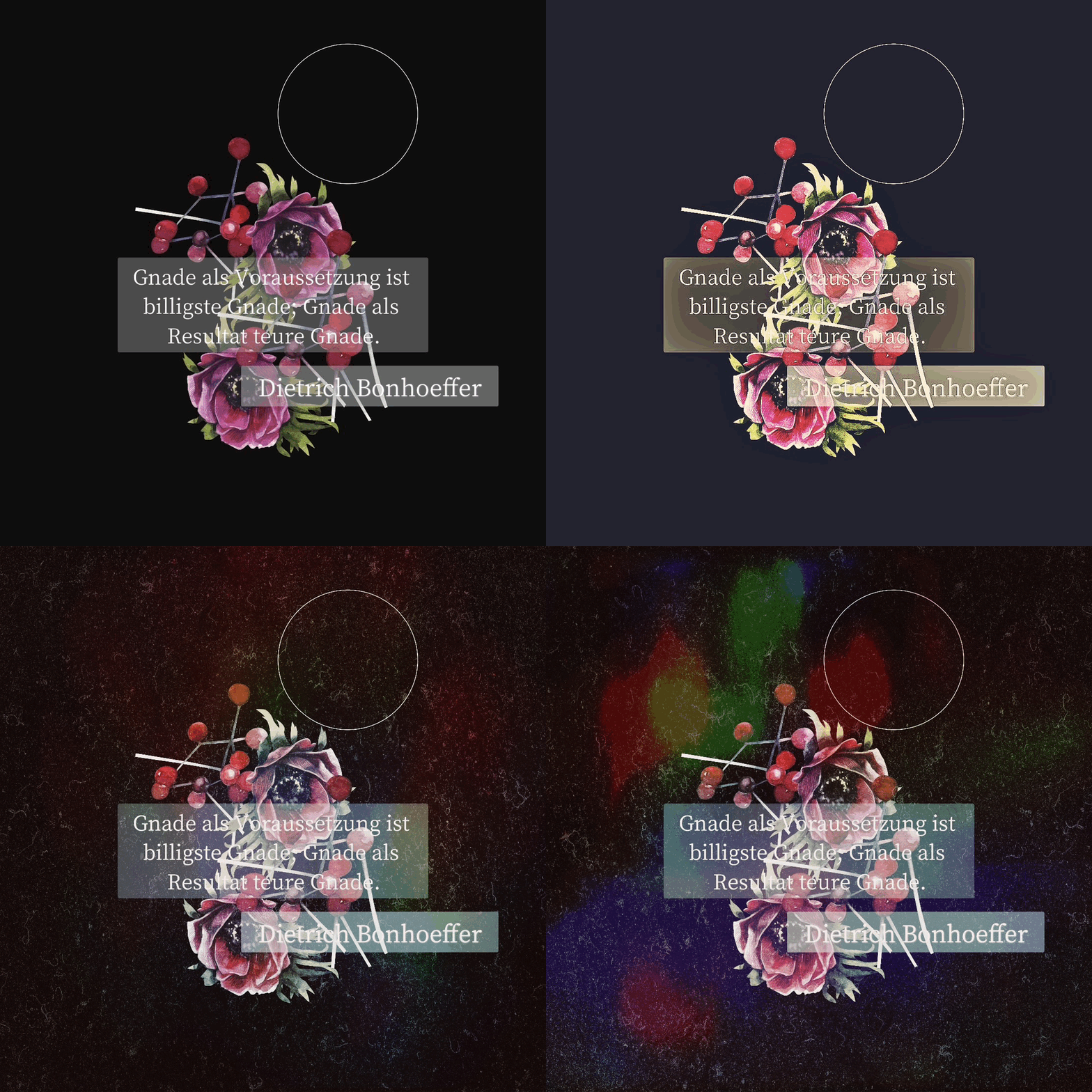
“Gnade als Voraussetzung ist billigste Gnade; Gnade als Resultat teure Gnade. Es ist erschreckend, zu erkennen, was daran liegt, in welcher Weise eine evangelische Wahrheit ausgesprochen und gebraucht wird. Es ist dasselbe Wort von der Rechtfertigung aus Gnaden allein; und doch führt der falsche Gebrauch desselben Satzes zur vollkommenen Zerstörung seines Wesens.”
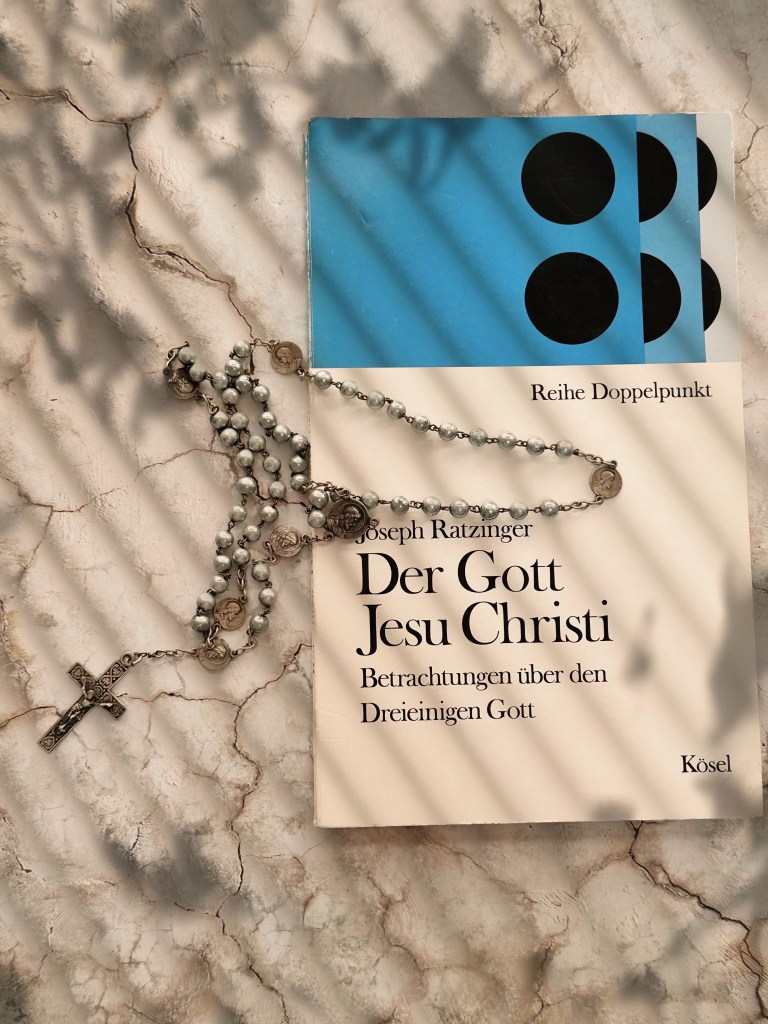
Der Gott Jesu Christi Betrachtungen über den Dreieinigen Gott.
Wieder kann man von hier versuchen, ahnend etwas über Gottes inneres Geheimnis zu sagen: Vater und Sohnsind die Bewegung reinen Schenkens, reiner Übergabe an- einander In dieser Bewegung sind sie fruchtbar, und ihre Fruchtbarkeit ist ihre Einheit, ihr völliges Einssein, ohne daß sie dabei selbst zurückgenommen und ineinander aufgelöst werden. Für uns Menschen heißt Schenken, Sichselbergeben, immer auch Kreuz.(Das trinitarische Ge- heimnis übersetzt sich in der Welt in ein Kreuzesgeheim- nis: Dort ist die Fruchtbarkeit, aus der der Heilige Geist kommt.
English translation:Once again, we can attempt to glimpse something of God’s inner mystery from this point: the Father and the Son are the movement of pure giving, pure surrender to one another. In this movement, they are fruitful, and their fruitfulness is their unity, their complete oneness, without being absorbed or dissolved into each other.For us human beings, giving of the self always entails the cross. (The mystery of the Trinity is translated into the world as the mystery of the cross: It is from this fruitfulness that the Holy Spirit emerges.)
Characteristics of the text
The text mentions ‘God’s inner mystery’, the distinctive parts of which contain mainly religious-philosophical elements.
・ 「Vater und Sohn sind die Bewegung reinen Schenkens, reiner Übergabe aneinander.」:it contains philosophical discussions and analyses of individual words and concepts. The images of parent-child relationships and mutual gifts presented here represent ideas about the existence and nature of God.
・ 「In dieser Bewegung sind sie fruchtbar, und ihre Fruchtbarkeit ist ihre Einheit, ihr völliges Einssein, ohne daß sie dabei selbst zurückgenommen und ineinander aufgelöst werden.」:this statement illustrates the argument about the triune nature of God. It says that God’s existence is expressed as fullness and that this fullness is related to the unity of the Trinity.
・「Für uns Menschen bedeutet Hingabe, Selbsthingabe, immer auch Kreuz (Das trinitarische Geheimnis übersetzt sich in der Welt in ein Kreuzesgeheimnis: Dort ist die Fruchtbarkeit, aus dem der Heilige Geist kommt).」:In the interpretation of the Trinity of God in human experience and faith, the image of the cross and the concept of the Holy Spirit are themes often discussed in religious philosophy and theology and are also illustrated here.
As is characteristic of Benedict XVI’s writings, his texts are highly philosophical and show deep thought. He deals with religious themes and expresses mystical concepts. His writing is concise but dense, and each sentence is full of meaning. His style is rigorous and is used to convey certain concepts clearly. Benedict XVI sometimes uses a dialogical style, explaining his ideas in a supposed dialogue with his readers. This dialogue format may represent the one-dimensional personality of the one and only distant ‘Pope’. His writings show a fusion of rational argument and philosophy of faith. In particular, he uses ethical arguments to show that ‘faith’ and ‘reason’ are compatible. He seems to focus on communicating complex theological concepts in a way that is accessible to the general reader.
Summary
An attempt is made by Benedict XVI to understand the ‘secret of the Trinity’ together with the reader. The Father and the Son are described as engaged in a pure act of giving, in a work of ‘total devotion’ to each other. This work results in their fruitfulness, which is described as their perfect unity and oneness. However, it is also clarified that this process does not lead to their annihilation or merging into each other. It is further asserted that for human beings, giving and self-giving are always associated with the Cross. The secret of the Trinity is seen as manifesting in the world as the secret of the Cross. The explanation offered is that through the Holy Spirit, the Cross holds within it the potential for fruitfulness and abundance.
The difference between philosophical writing and everyday writing.
A philosophical text can be described as a multifaceted yet concise exploration of topics related to deep thinking and philosophical concepts. The term philosophia, coined by Socrates, encompasses the love of knowledge, also known as philosophy. These writings often employ logical reasoning. Both the current Pope, Pope Francis, and his predecessor, Pope Benedict XVI, can be seen as having philosophical elements in their teachings. They delve into concepts such as reflections on existence and religion, including faith, eternal life, the Last Judgement, the law of love, and the relationship with God. However, it is also necessary to provide more specific and succinct explanations using everyday language. For example, ‘Hingabe’ and ‘Selbsthingabe’ are German words meaning ‘devotion’ or ‘devotion to self’. To better comprehend their meanings, specific examples or situations can be used to explain them.
「Für uns Menschen bedeutet Hingabe, Selbsthingabe, immer auch Kreuz (Das trinitarische Geheimnis übersetzt sich in der Welt in ein Kreuzesgeheimnis: Dort ist die Fruchtbarkeit, aus dem der Heilige Geist kommt).」If the original text of the following were to be shown in more everyday terms,
「In unserem menschlichen Verständnis bedeutet Hingabe immer auch Opfer (Das Geheimnis der Dreifaltigkeit offenbart sich in der Welt als das Geheimnis des Kreuzes: Hier liegt die Fruchtbarkeit, aus der der Heilige Geist entspringt)」In our human understanding, devotion always implies sacrifice as well. (The mystery of the Trinity is meant to be unveiled to the world as the mystery of the Cross.)
「In unserem menschlichen Verständnis bedeutet Hingabe immer auch Opfer」The translation is more of an everyday expression than a philosophical reflection on ‘what it means to give of oneself’, in line with the idea that true human commitment always needs to involve some sacrifice (e.g. time, comfort).
Finally, to return to the original again.
Für uns Menschen heißt Schenken, Sichselbergeben, immer auch Kreuz.(Das trinitarische Ge- heimnis übersetzt sich in der Welt in ein Kreuzesgeheim- nis: Dort ist die Fruchtbarkeit, aus der der Heilige Geist kommt.
“The reason why there are two instances of ‘der der’ is that the first one, ‘aus der’, translates directly as ‘from’, indicating that something is coming out of ‘der Fruchtbarkeit’ (abundance). In this context, it signifies the coming out of ‘der Heilige Geist’ (the Holy Spirit) from abundance. The second ‘der Heilige Geist kommt’ consists of the definite article ‘der’ and the noun ‘Heilige Geist’, signifying the arrival of the Holy Spirit. These elements represent the mysteries of the Trinity, which are of different natures yet closely intertwined.
If we were to write this without ‘der der’, for example,…”
Für uns Menschen bedeutet Hingabe, Selbsthingabe, immer auch Kreuz (Das trinitarische Geheimnis übersetzt sich in der Welt in ein Kreuzesgeheimnis: Dort ist die Fruchtbarkeit, aus dem der Heilige Geist kommt.(* Changing ‘Schenken’ and ‘Sichselbergeben’ to ‘Hingabe’ and ‘Selbsthingabe’ maintains consistency in context.)
“This is a trial translation and we would be grateful for any comments.
Following on from the previous edition, we have decided to include a memo-like section called “Cahier.”
Der Gott Jesu Christi Betrachtungen über den Dreieinigen Gott.
Wieder kann man von hier versuchen, ahnend etwas über Gottes inneres Geheimnis zu sagen: Vater und Sohnsind die Bewegung reinen Schenkens, reiner Übergabe an- einander In dieser Bewegung sind sie fruchtbar, und ihre Fruchtbarkeit ist ihre Einheit, ihr völliges Einssein, ohne daß sie dabei selbst zurückgenommen und ineinander aufgelöst werden. Für uns Menschen heißt Schenken, Sichselbergeben, immer auch Kreuz.(Das trinitarische Ge- heimnis übersetzt sich in der Welt in ein Kreuzesgeheim- nis: Dort ist die Fruchtbarkeit, aus der der Heilige Geist kommt.
・ 「Vater und Sohn sind die Bewegung reinen Schenkens, reiner Übergabe aneinander.」:個別の言葉や概念についての哲学的な議論や分析を含んでいます。ここで示されている親子関係と相互の贈り物のイメージは、神の存在や本性についての考え方を表しています。
・ 「In dieser Bewegung sind sie fruchtbar, und ihre Fruchtbarkeit ist ihre Einheit, ihr völliges Einssein, ohne daß sie dabei selbst zurückgenommen und ineinander aufgelöst werden.」:この文は、神の三位一体の性質に関する議論を示しています。神の存在が豊かさとして表され、そしてその豊かさが三位一体の一体性と関連していることが述べられています。
・「Für uns Menschen bedeutet Hingabe, Selbsthingabe, immer auch Kreuz (Das trinitarische Geheimnis übersetzt sich in der Welt in ein Kreuzesgeheimnis: Dort ist die Fruchtbarkeit, aus dem der Heilige Geist kommt).」:神の三位一体を人間の経験や信仰の中で解釈する際に、十字架のイメージや聖霊の概念は、宗教哲学や神学で頻繁に論じられる主題でありますが、ここでもそれが示されています。
哲学的な文章とは何か、一面的でありながらも簡潔に述べると、ソクラテスがフィロソフィア(知を愛する=哲学)という言葉を定着させたことは有名ですが、一般的に思考や哲学的な概念に関連するテーマを探求し、深い洞察を提供することなどがあげられます。これらの文章には論理的な推論が含まれていたりします。現教皇である、フランシスコ教皇や前任のベネディクト16世も、哲学的な要素を含んでいると言えます。彼らが掘り下げる概念は、信仰、永遠のいのち、最後の審判、愛のおきて、神との関係など、存在と宗教に関する考察を含んでいます。一方、日常的な言葉の説明を行う場合は、より具体的で簡潔な説明が必要となるでしょう。例えば、「Hingabe」や「Selbsthingabe」はドイツ語で「献身」や「自己への献身」を意味する言葉ですが、これらの言葉の意味を説明する際には、具体的な例や状況を用いてより理解しやすい説明が求められることがあります。例えば、「Für uns Menschen bedeutet Hingabe, Selbsthingabe, immer auch Kreuz (Das trinitarische Geheimnis übersetzt sich in der Welt in ein Kreuzesgeheimnis: Dort ist die Fruchtbarkeit, aus dem der Heilige Geist kommt).」の原文を、より日常用語として示すとしたら、
「In unserem menschlichen Verständnis bedeutet Hingabe immer auch Opfer (Das Geheimnis der Dreifaltigkeit offenbart sich in der Welt als das Geheimnis des Kreuzes: Hier liegt die Fruchtbarkeit, aus der der Heilige Geist entspringt)」私たち人間の理解では、献身は常に犠牲も意味します。(三位一体の神秘は、十字架の神秘としてこの世に啓示されることになる)
「In unserem menschlichen Verständnis bedeutet Hingabe immer auch Opfer」というのは、人間が真の献身を示す際には、常に何らかの犠牲を伴う(例えば、時間や快適さ)必要があるという考えに即した翻訳で、「自己を捧げると言うこと」ということについて哲学的考察というより、日常寄りの表し方にしています。
最後に、再度、原文に戻ると
原文:Für uns Menschen heißt Schenken, Sichselbergeben, immer auch Kreuz.(Das trinitarische Ge- heimnis übersetzt sich in der Welt in ein Kreuzesgeheim- nis: Dort ist die Fruchtbarkeit, aus der der Heilige Geist kommt.
Für uns Menschen bedeutet Hingabe, Selbsthingabe, immer auch Kreuz (Das trinitarische Geheimnis übersetzt sich in der Welt in ein Kreuzesgeheimnis: Dort ist die Fruchtbarkeit, aus dem der Heilige Geist kommt.(*「Schenken」と「Sichselbergeben」を「Hingabe」と「Selbsthingabe」に変えることで文脈に一貫性を保っている)
Joseph Ratzinger, who served as Pope Benedict XVI, passed away on December 31, 2022. Before his death, he published “Jesus of Nazareth,” another significant work. One of the three volumes was released during his papacy, and his commentary will be used to explore the meanings of prayers and how they relate to Leibniz’s concepts of harmonies and monads.
Common denominator.
Leibniz sought harmony amid the conflict between Catholicism and Protestantism.
Benedict XVI aimed to achieve harmony amidst the ongoing conflicts of religion and the ever-evolving nature of society.
Monadology: by Leibniz.
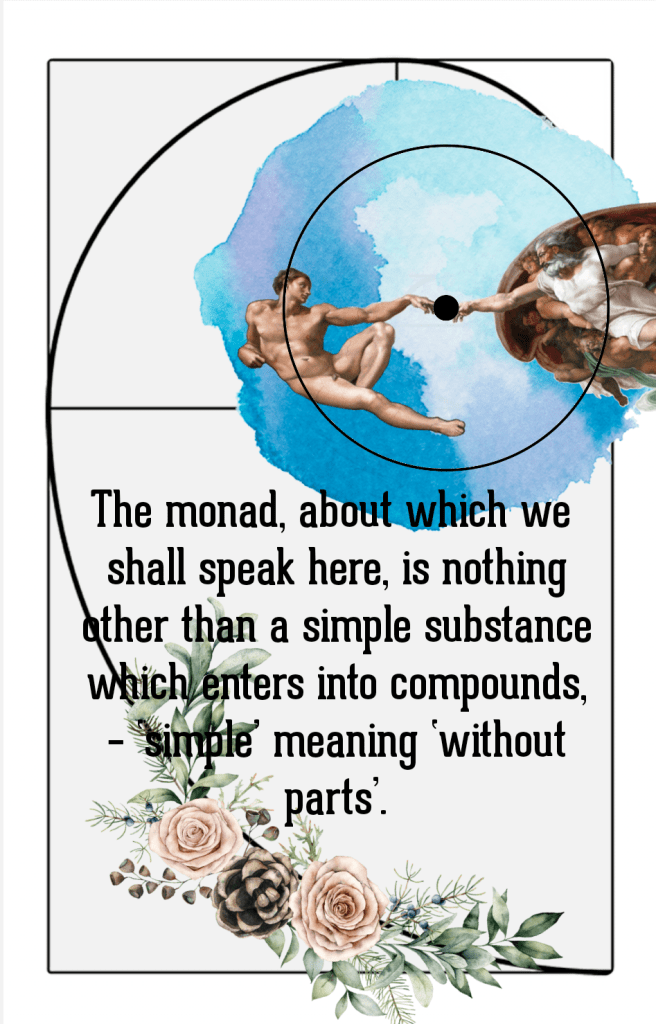
The Monadology, written by Leibniz, consists of 90 chapters but is considered a fragment. The term “monad” is derived from the Greek word “monas” meaning single or one. Living in a time of conflicts between Catholics and Protestants, Leibniz sought to find ultimate harmony in the concept of the unique and singular “One.” A mathematical-geometric point is distinct in its own right, representing an abstract conceptual position rather than an existential one. However, an existential position must encompass the ‘many’ within the ‘one.’ Just like a flock of sheep, individual monads are central to the whole. The center of a circle may be a singular point, yet it contains an infinite number of diameters. The spirit itself exists as a singular entity, yet it embodies an infinity of past, present, and future manifestations. While the spirit may not existentially manifest, it serves to represent and express the multiplicity of existence. The key concepts in Leibniz’s Monadology are “representation” and “expression.”
If the Lord’s Prayer, which I recite daily, allows for both Obedience and Desire, when will my words become sacred? No one can decide that. Prayer has the skyline of the human heart. That is the analogue of human beings, and that is why Descartes’ cogito ergosum is not enough, and there is always me who is not aware of it. The words I chant are more complete than my awareness. That is the language of prayer. The unaware I, the ” small I”, is Leibnizian in its monadic nature. A typical Catholic language of prayer is described as.
Our Father, who art in heaven hallowed be thy name; thy kingdom come; thy will be done on earth as it is in heaven. Give us this day our daily bread and forgive us our trespasses as we forgive those who trespass against us; and lead us not into temptation, but deliver us from evil. Amen.
Prayer is not only directed to God, but also questions the depths of the self. Naturally, we find ourselves constantly questioning who it is that we are praying to, the ‘I’. Many commentaries on prayer say, “Do not pray so that you can be seen in public” (Matthew 6), but for the Japanese, who have a strong sense of syncretism, it is more important to look at the self. Even though there are many desires and selfishness, it is difficult to look at one’s own identity. What the prayer confirms is ‘we’, the community. The Japanese are awakening to what they are as part of that, and to the fact that I, as part of the community, am the only one in the world.
Prayer that is merely sympathetic to a poorly thought-out community is more common today. Leibniz’s famous ‘Monad’ was difficult to serve as an example because it was less familiar than Descartes and modern philosophy. Nevertheless, I decided to write a commentary on the Lord’s Prayer, which he wrote before Benedict XVI (Joseph Ratzinger) returned from serious illness, because it was moving and reminded me of the Monad. Leibniz lived at a time when Catholics and Protestants were in conflict, but Leibniz was a man who thought of a philosophy that would bring harmony, as if preserving an unsolvable mystery.
For a person of belief, God is absolute, and self-consciousness is easily a Cartesian starting point for self-consciousness, whereas for a non-believer, it begins with convictions. Faith is spiritual and does not require a basis. However, it does not mean living a meaningless life. Beliefs and the faith of others do not have a window and do not intersect. But it is flexible, like the soul.
Leibniz discovered microorganisms under the microscope that were invisible to the naked eye, revealing the presence of life in animals and plants, as well as a universe yet unknown. Descartes emphasized the significance of ‘thinking’ as a fundamental aspect of consciousness, whereas in Leibniz’s philosophy, ‘expression’ and ‘representation’ are considered essential actions. Catholic prayer, by nature, focuses on conscious, human-centered prayer. However, the concept that phenomena are not merely ‘appearances’ (Schein) and that the action of the spirit is not an entity, but rather a ‘subject’, serves as a foundational principle in German idealism. Prayer’s essence lies not in mere appearance but in expression, encapsulating a singular point representing the infinity of myriad dimensions that lead back to God at the center. (This perspective contrasts with the conventional image of God and man as perpendicular to heaven and earth; rather, it is likened to a circle with God at the core.)
ⅠOur Father,who art in heaven
――This discretion, which is of the very essence of prayer, does not exclude prayer in common. The Our Father is itself a prayer uttered in the first person plural, and it is only by becoming part of the “we” of God’s children that we can reach up to him beyond the limits of this world in the first place. And yet this “we” awakens the inmost core of the person; in the act of prayer the totally personal and the communal must always pervade each other, as we will see more closely in our exposition of the Our Father. Benedict XVI, Pope . Jesus of Nazareth (p.129). The Crown Publishing Group. Kindle 版.――
How strongly can we be aware of the word Father, we cannot basically see him with the naked eye. In theology, the Lord Father is the root of all good things and the measure of a righteous (perfect) man. ‘But I tell you, love your enemies and pray for those who persecute you, that you may be children of your Father in heaven. He causes his sun to rise on the evil and the good, and sends rain on the righteous and the unrighteous. ” (Matthew 5.44 and following)
This love that loves “to the extreme” (John 13) is fulfilled in the Lord’s prayer for his enemies on the cross, and shows the essence of the Father. The Father is this love. Jesus fulfilled this love, making him fully ‘the Son’. The original of this prayer is part of the Sermon on the Mount in Matthew 6. (Luke: 6)
It is a comprehensive statement of the right human way of being. Nevertheless, John Paul II wrote something interesting on this question of why God is not manifested before us.
From one point of view it is right to say that God revealed too much of Himself to man, too much of that which is most divine, that which is His intimate life; He revealed Himself in His Mystery. He was not mindful of the fact that such an unveiling would in a certain way obscure Him in the eyes of man, because man is not capable of withstanding an excess of the Mystery. Paul II, Pope John. Crossing the Threshold of Hope (p.37). Knopf Doubleday Publishing Group. Kindle 版.
‟Reasons certainly do exist to believe in Him; but—as many have maintained and still maintain—there are also reasons to doubt, or even deny, His existence” So, John Paul II is also quoted here in Descartes’ ‘I think, therefore I am’.‟ It states that this sprouted from the philosophy of rationalism on a different soil from Thomas Aquinas and St Thomas.” No different from St Thomas who said “for whom it is not thought which determines existence, but existence, “esse” which determines thought”.Jesus was executed because he publicly declared that he was the Son of God. That was fair in terms of the legislation at the time. John Paul II did not hide the fact that getting too close to the mystery brings tragedy to human beings, one aspect of which he did not hide.
There is deduction and induction, but Leibniz tried to develop from simple truths by deduction. In principle, ‘Our Father’ is absolute, so there is no hypothesis. Therefore, the basis of theology is deduction. Leibniz’s rationalism developed by deduction was opposed, among other things, to empiricism. If it were derived from experience, religious rituals would not proceed, since it is a philosophy about God, from which it was not removed. He took the further position that certain perceptions were innate and derived from evidential principles.
The novel Sophie’s World tells an interesting story. A non-religious astronaut bragged that he had seen space many times but there was no God. A Christian doctor said. I have had many brain operations but no ‘thoughts’. Sophie replies. ‘But the soul cannot even be divided into two.
Thoughts are quite different from things that can be chopped up into smaller pieces, and delusions cannot be surgically removed. Leibniz said that the difference between what is made of matter and everything that emanates from the spirit is that material things can be divided into smaller parts to any extent. The soul, however, cannot be cut into there are two sides of God’s Fatherhood. The Gospels confirm that God being Father has two aspects. God is our Creator and our Father. Since he created us, we belong to God. As existence itself, it is the essence of the biblical picture of man that God created each and every human being. But what does it mean to accept this? If we try to convince ourselves of this only through ontology and empiricism, we can only create a polarisation of believing and not believing. Naturally, many people today will not believe.
>Thinking as a monad.
Humans are made up of a heart and a brain, but simply piecing them together does not create an ‘I’. So too is God, and God is not made by combining only the languages described by the various Bibles. It is fair to say that this is where the difficulty of proselytising lies. It is that causality alone is difficult for them to understand and even to exist. The empiricist Hume did not believe in the existence of angels, so he told them to burn their theology books. Leibniz was adamant about that one point, ‘God’, which cannot be spoken of by experience alone.
Monads always exist separately, independently and without windows. No matter how often a prayer is explained, there is no fixed point where the goal is. This is because it inevitably requires experience. Explanations are merely to help with feelings, but the language of prayer always exists apart from experience. Its culmination is ‘Our Father’.
While it is possible to consider prayer only in its literal meaning, some people try to understand the details of the word by tracing it back to its etymology. They assume that all the time spent praying is worthwhile, even though their understanding is incomplete. The language of prayer emphasises what kind of people we should be and that we should be irreverent with ‘us’ rather than a heightened ‘ego’.
There is a part of us that is me. The I is inherent in us.
(I do not subscribe to any teaching that causes the loss of the ‘I’. I dislike and strongly reject such religious people)
Monadology is predicate-dominant, with the subject containing the predicate. It is the predicate that is important to God, for example, ‘God is love’. God is not prominently illuminated only by being God. We should not follow for that reason alone. We must focus on the predicate of what God is. The words of the prayer do not relegate God the Father to a star somewhere far away, but that He comes from the One Father, who is the measure and source of the Father. That God is the Father has a greater reality than all earthly fathers have.
we are testifying to the fact that, while we have different earthly fathers, we all come from one single Father,……
God’s fatherhood is more real than human fatherhood, because he is the ultimate source of our being; because he has thought and willed us from all eternity; because he gives us our true paternal home, which is eternal. And if earthly fatherhood divides, heavenly fatherhood unites. Heaven, then, means that other divine summit from which we all come and to which we are all meant to return.
Benedict XVI, Pope . Jesus of Nazareth (pp.141-142). The Crown Publishing Group. Kindle 版.
-In order to distinguish between the action of God and the action of the creature, it is necessary to clarify what the concept of an individual entity (1) is (Metaphysical Narrative, 8) Description of predicate superiority
The changeable state which grasps and represents a multiplicity in one or the other is nothing other than what is called sensation or perception, which is to be distinguished from apperception or consciousness, as will be seen in what follows.(Monadologie v14)
And the action or activity of the inner principle that causes the change or progress from one perception to another can be called desire.(Monadologie v15)
And one creature is more perfect than another / in so far as one perceives in it / something from which one can deduce a priori the reason for what occurs in another thing; and by this one says / that it grows into another creature.(Monadologie v51)
Ⅱ hallowed be thy name
God named his existence in Exodus 3:14, “I am the one who says, ‘I am'”. There were many gods in the time of Moses in the Ten Commandments, “Thou shalt not defile the name of God”. Therefore, Moses asked God for his name in order to demonstrate God’s special authority over those gods. In the world’s view of ‘polytheism’, God has a name. God must answer as long as he is asked. The god who spoke to Moses also had to have a name.
God could not enter the world of the gods with a name as one of them. God’s answer, “I am the one who says, ‘I am’,” expresses both agreement and rejection of Moses’ question. It is therefore correct that the name of God as presented in JHWH should not be pronounced in Israel. God’s name must not be downgraded to polytheism. That leaves the question of what God’s judgement is the Name. Names enable us to call out, but do not indicate our true nature. Adam in Genesis gave the animals names in order to call them. God also made it possible for humans to be called, and then accepted to be hurt. This makes it clear what is meant by the words of the prayer, “HALLOWED BE THY NAME”
We can cling to God in our daily lives some days and forget others. Including such lowered routines, we pray that God will be raised up with ‘HALLOWED BE THY NAME’. God’s answer to the name deserves, in monadology, to be ‘revealed’. The hidden presence of God has been revealed. It must not be a temporary representation. The name of God is not decomposed, (Monadology, v. 4) and the one who prays is doomed to neither generation nor end by God, but to perish by extinction. (ibid., v. 6) The praying side exists with a nature. Each nature must be different. (Ibid., v. 6) Each nature must be different from the other, for what happens in the composite always comes from a single element. But the praying side cannot distinguish between souls. In the single ‘God’. (ibid., v. 8) the principle of sufficient reason, why A is A and not other than A, is sufficiently fulfilled. It also follows that no proposition is just. (ibid., v. 32) While it is done only by the principle of memory, it is the same as the beast (ibid., v. 28) Today, even if it is a day of unenlightenment, experiencing and remembering are not the only means. When we pray on this day, we are praying to “God”, “the Father, the Lord”, whose presence demands the elevation of human holiness.
his plea, of course, is always an occasion for us to examine our consciences seriously. How do I treat God’s holy name?……Do I stand in reverence before the mystery of the burning bush, before his incomprehensible closeness, even to the point of his presence in the Eucharist, where he truly gives himself entirely into our hands? Do I take care that God’s holy companionship with us will draw us up into his purity and sanctity, instead of dragging him down into the filth? Benedict XVI, Pope . Jesus of Nazareth (pp.144-145). The Crown Publishing Group. Kindle 版.
Ⅲ Thy kingdom come
This passage is often misunderstood even by clergy, but even Benedict XVI did not say here that wishing for God’s kingdom will promise a paradise. If anyone, even believers, speaks of religion making them happy, they are not studying hard enough. The life of faith is not a simple matter of abandoning something and automatically moving up in status. The Kingdom of God is the rule of God, which means that God’s will is the standard for everything.
This divine will makes justice, and divine justice should be the measure of human justice. ‘But seek first his kingdom and his righteousness, and all these things will be given to you as well.” (Matthew 6:33) These words give order of priority to all human conduct, to our behaviour in everyday life. Then everything else will be given to you” (Matthew 6:33) These words give order of priority to all human conduct, to our behaviour in everyday life. In the Old Testament, there is this story. The Lord appeared to the young king in a dream and told him to wish for whatever he liked, because he would listen to any wish. Solomon told the people to be able to judge between good and evil. God commended Solomon because he did not choose ego, but asked for what was essential. ‘May the kingdom come’ is ruled by the Lord, but to have a listening and discerning heart, that is the essential desire. He prays for the dispersed and separated humanity to judge good and evil, so that in time it will become one.
The soul is given the function by memory to seek connections between memories. This function is similar to, but distinct from, reason. It can be compared to an animal: a dog that has been hit with a stick will run away the next time (Monadology, xxvi), but humans contain contradictions and do not choose solely on the basis of causality. Humans take even God’s treatment as a trial. Like Job and Jeremiah. Even if the scene in front of them is peaceful, there is war and misery in the land of the invisible. Or perhaps he is unhappy himself. It is important to be fulfilled like the kingdom of heaven and to vow to pass justice for it. Do not pray while you sleep that when you wake up the world will have been a heavenly kingdom. To choose righteousness every day. That is what we chant. This conformity with the only one, the hope for conformity because it cannot be fulfilled, the impulse behind the rational language, the power to seek the mystery is contained in its contradiction, but I think it is pure (cf. Ibid., pp. 49-62).
The encounter with Christ makes this petition even deeper and more concrete……
By the same token, the request for a listening heart becomes a request for communion with Jesus Christ, the petition that we increasingly become “one” with him (Gal 3:28). What is requested in this petition is the true following of Christ, which becomes communion with him and makes us one body with him.
Benedict XVI, Pope . Jesus of Nazareth (pp.146-147). The Crown Publishing Group. Kindle 版.
Ⅵ The will be done on earth as it is in Heaven
Two things are immediately clear from the words of this petition: God has a will with and for us and it must become the measure of our willing and being; and the essence of “heaven” is that it is where God’s will is unswervingly done.
Benedict XVI, Pope . Jesus of Nazareth (p.147). The Crown Publishing Group. Kindle 版.
Numerous holy books assume that man knows the will of God in his heart, that the knowledge of God, called conscience, is deeply rooted in the heart. In Matthew 26:36-46, Jesus came to Gethsemane with his disciples and said, ‘Sit here while I go over there and pray’. He was accompanied by Peter’s and the two sons of Zebedee, who were sorrowful at that time. Jesus prayed thus, saying. ‘Father, if it is possible, let this cup pass from me. But not according to my wish, but according to your will” In this case, the cup is the cross, and Jesus was grieved that he would be killed by this wrong judgement. Therefore, he asked God’s will, not my wish. But God did not answer as Solomon did. This ‘not according to my wish but according to His will’ is taken up by Thomas Aquinas. Jesus then turns to a story about a traitor trying to kill him, and that is how we learn the will of God with Jesus. And it is hoped that this means that even our self-love is defeated.
Aristotle held that the perfect reality is entelecheia. Leibniz states that entelecheia always has an order. (Monadology, v. 63) In simple terms, it is a plant. The plant repeats itself according to the same laws and with the same number of petals. Leibniz’s monadology deals mainly with God’s creation in verses 62 to 66. And with regard to the subsequent verses 67 to 80, it refers to what cannot be explained by order as preestablished harmony. Although this is objectionable, a preestablished harmony is a law that can’t be unravelled. No matter how abstractly and infinitely one speaks of philosophy and theology, even if prime factors are given and finer numbers are given, as in prime factorisation, they do not exceed the original natural number. For example, if we do a prime factorisation of the natural number 60, we get 2 x 2 x 3 x 5 = 60. (Only 13 is a prime factor, so the prime factorisation is 13.) However, God can be likened to the prime number ‘1’ and the natural numbers that are bracketed as prime factors are us, but as long as God is the solution, it is a mystery until we experience the solution. Prime factors are only one expression. And even if the vague view is a scheduled harmony, it is not causal or easy to understand. What God has prepared will never exceed the size of creation, no matter how much it is dismantled and divided by man. Yet the magnitude is unimaginable. To live in this world is The only clues to the mystery left by Jesus were ‘love’ and ‘justice’. It must bring the wounded closer to the ability to notice them, to reach out to them and to help them. Otherwise the kingdom of God will not come.
The gravitational pull of our own will constantly draws us away from God’s will and turns us into mere “earth.” But he accepts us, he draws us up to himself, into himself, and in communion with him we too learn God’s will.
Benedict XVI, Pope . Jesus of Nazareth (p.150). The Crown Publishing Group. Kindle 版.
Ⅴ Give us this day our daily bread and forgive us
This passage is the most ‘human’ petition in the Lord’s Prayer. To the disciples, the Lord says, “Before I tell you, do not worry about your life, what you will eat or drink; or about your body, what you will wear” (Matt. 6:25), and the mission of the people is to food The mission of the people was to pray about their worries about food. Bread is the bounty of the earth, the fruit of labour. This is opposed to the arrogance of the people, who say that they realise the fertility by their own strength alone. Give us daily bread”, the Greek word for ‘daily’ is EPIOUSIOS, which can be translated in two ways. One is ‘the bread we barely need to live’ and the other is ‘the bread of the future’.
It also signifies the bread of the eschatological end. Bread is purely edible. It is difficult to realise for rice staples, but the staple food is necessary for the survival of life, and it is important in daily life that this is available. That bread, that thing, is to be the Logos. From there it becomes religious.
‘Jesus answered, “It is written: ‘Man shall not live on bread alone, but on every word that comes from the mouth of God” (Matthew 4:4) The bread increased by miracles reminds us of the miracle and shows that the original food of man is the Logos, the eternal Word of God. The eternal Logos becomes the bread of reality for man. It corresponds to the food presented to the Israelites by Moses as a gift of God. What would happen if we were to speak of it as a philosophy? The bread that the poor wish for is a mystery that wishes for the necessities of the day, so resolution is not require.
If we dare to speak of the lack of the rule of reason, bearing in mind that this is the first condition, we begin with an account of ‘Buridan’s donkey’ (Buridan’s ass). Buridan the donkey has found a bundle of straw, his favourite food. However, Buridan also noticed another bundle of straw that he could see looking back. The donkey was clever enough to wonder which one he was going to eat. So Buridan couldn’t decide and starved to death. This is similar to the foolish consequence of starving to death because one is wise and rational, and to the fact that one should not look for a philosophical basis, doxa, in the bread of communion. This Buridan is said to be a French philosopher, but the actual source is unknown. Leibniz, however, gives it in a parable in his theodicy.
The donkey that starved to death is foolish, but because of its foolishness, a principle emerges. When food and sacredness coincide, it means that everything loses its meaning if it is not simply accepted as daily sustenance.
Every time we pray daily, “GIVE US THIS DAY OUR DAILY BREAD”, both the “I” who understands the meaning and the “I” who does not try to understand are uniqueness, but the relationship with God to the spirit is not simply that of inventor and machine, but like that of father and son. (Monadology, v. 84) Communion is contradicted as superstition for those without faith and absoluteness for those with faith. Tabula rasa (blank slate) exists in contradiction to eternal truth. However, feeding the poor would be in agreement with both. It is important to pray that the sustenance for the poor and our own sustenance will continue into the future, to our children and to the poor, so that holiness and life will not cease without separation.
He says: We who are privileged to receive the Eucharist as our bread must nevertheless always pray that none of us be permanently cut off and severed from the body of Christ.
Benedict XVI, Pope . Jesus of Nazareth (pp.156-157). The Crown Publishing Group. Kindle 版.
Ⅵ our trespasses as we forgive those who trespass against us
Leibniz’s ‘theodicy’ addressed the differences between Protestants and Catholics. For example, he wrote not only about the conflict between Protestants and Catholics, but also about the conflict between Protestants with regard to the above-mentioned ‘bread’. In Japan, Luther is the most famous Protestant, but Friedrich Zwingli (Zwingli), who also opposed Luther, did not accept sacramentalism. He regarded the participation of Jesus Christ in the Lord’s Supper as a mere figurative expression, and in doing so made use of the philosophical principle that the body can only exist in one place at all times. Luther, on the other hand, is more faithful to the literal sense of the Bible, making it real, including supernatural mysteries. In their opinion, they rejected the doctrine of Transsubstantiation (Total Transubstantiation – the transformation of the bread and wine of the sacrament (Seisan) into the flesh and blood of Christ) rather than that arising from the biblical expression and rejected Konsubstantiatio ( consubstantiatio – Christ coexists with the bread and wine) dogma and the bread, and held these things ignorant.
Although it did not require a union of the two, they were not merely logical, but also important in fulfilling Christ’s final wish. Through faith justification, they chose to maintain the everlasting presence of the Messiah’s body. In modern times, the conflict between Catholics and Protestants goes without saying, but even in Catholicism, the desire to hear the Lord’s petition remains the same. The fifth petition of the Lord’s Prayer presupposes a world of indebtedness, i.e. sin. The theme of forgiveness runs through all the Gospels, with the story of the ‘retainer who would not forgive his fellow man’ in Matthew 18. The man, a high-ranking deputy, had begged the king to forgive him a high debt, but shortly afterwards he blackmailed his fellow strangers into forgiving him a small differential debt. His swearing came to the ears of the king, who forgave him from other retainers, and he had his remission revoked. The king is a parable of the divine father, but the story does not end there.
――In chapter 23 of Luke’s Gospel, two other sinners were to be executed besides Jesus at his crucifixion.
One of the sinners cursed Jesus right up to his death, saying, “If you are the Messiah, prove it by saving yourself”. The other sinner, on the other hand, defended Jesus. Despite being in the same situation, he humbly said to Jesus, “Jesus, remember me when you come into your kingdom”. Jesus said to such a sinner. ‘“Truly I tell you, today you will be with me in paradise’.
The sinner was loved by Jesus just before his execution. Regarding Leibniz’s principle of indistinguishable = identical, Jesus and the sinner are separate entities, even though they are at the same place of execution. Separate and uncrossing clocks of destiny exist for each, but they are bonded by ‘forgiveness’. Christians say that Jesus came down to earth, the cross, whereas crucifixion is raised high for the sinner to be exposed. We know that two people with different vectors can be bonded ‘on the spot’. Unlike the cursed sinner, it is through ‘forgiveness’ that the bond is achieved. ‘Forgiveness’ is, I believe, the beautiful point of contact between Leibnizian philosophy and Catholic theology. The sinner’s turn towards good is an invisible generative change. The prayer, ‘Forgiving Evil’, is the constant wish for a change to goodness over today’s evil intentions. It contains the ‘we’, the I.
Self-awareness does not come from collectivity. The collective enjoyed executions in a state of spectatorship. Community is not a dysfunctional situation where love and justice are in sync. The ‘justice’ awakened by the sinner just before death is love for Jesus. I hope for a world in which it is pervasive, and I use it as a prayer to inspire me.
If we want to understand the petition fully and make it our own, we must go one step further and ask: What is forgiveness, really? What happens when forgiveness takes place? Guilt is a reality,……For this reason, forgiveness must be more than a matter of ignoring, of merely trying to forget. Guilt must be worked through, healed, and thus overcome. Forgiveness exacts a price—first of all from the person who forgives. Benedict XVI, Pope . Jesus of Nazareth (p.158). The Crown Publishing Group. Kindle 版.
Ⅶ and lead us not into temptation
If we are to use the language of Leibniz’s ‘theodicy’, philosophy has ensured that the meaning of words needs to be developed so that mysteries do not become empty words. Throughout the long history of the world, as long as there are words, they are disproved by inference. Once we are tempted by the theory of probability to pray correctly and find that phenomena are connected to each other, we are driven by the assumption that they are always connected. ‘Temptation’ is a stumbling block for people, including human immorality, but who is the one who tempts and leads? Temptation is certainly the devil, but there is also an interesting passage in Jeremiah 20:7.
Jeremiah20:7 Du hast mich verführt, Herr, und ich habe mich verführen lassen; du hast mich gepackt und mir Gewalt angetan. Nun spotten sie immerzu über mich, alle lachen mich aus. Denn sooft ich in deinem Auftrag rede, muss ich Unrecht anprangern. »Verbrechen!«, muss ich rufen, »Unterdrückung!« Und das bringt mir nichts als Spott und Hohn ein, Tag für Tag.
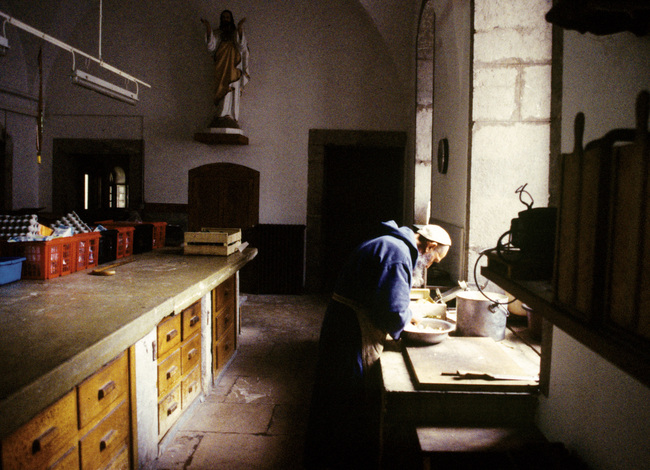
‘Lord, you have enticed me’, which was repeatedly called out in the film Die grosse Stille (The Great Silence), giving rise to questions. In Japanese it is translated in different words, but in the German version of the country of production it is verführt (enticed) The young Jeremiah was made a prophet by the Lord. But because he was righteous, he was estranged from the people. This is more evident in the German version, Tag für Tag and it is repeated ‘day in and day out’, but the constant cries of injustice, ridicule and scorn disgusted him.
It is easier to live when you do what the masses tell you to do. That is why he lamented what God gave him as ‘temptation’. Benedict XVI used the analogy with Job, but this time I have brought out Jeremiah. It is Christian to say that temptation is the devil, but in reality the devil is more incomprehensible than God.
There is scripture in the deeds of God. Even from a philosophical perspective, despite the contradiction between eternal truth and the psychology of chance, God has a fixed point, but existence with regard to Satan does not exist as eternal truth, only as chance. Simone Weil’s ‘Creation. Good is shattered and scattered to evil” would be exactly that. It means that God’s deeds had an original form and were shattered, but the Satan’s are not. The Bible reading allows people to recognise God as common, but as for Satan, it is a coincidence of each. Light does not solve everything. Because, as in John 1, darkness avoids light without understanding it. Jeremiah was chosen by God, but he shouted because he could no longer bear the malice of the people.
In the New Testament, 1 Corinthians chapter 10 says that God doesn’t give us trials we can’t endure. This is a well-known passage even in the non-religious world, but there is a continuation to this, but we are rarely told the rest of the story. Therefore, it is misunderstood as a ‘never-give-up spirit’.
It is a continuation of this: ‘It provides a way out in times of temptation and enables us to withstand temptation’.
Regarding this item, although Benedict XVI was an excellent commentary on the story of Benedict XVI, I judge that it does not extend to practice if I am honest, including the Catholic clergy issue. Therefore, I will end by adding Simone Weil, which I have adopted in my own way. ‘To love the truth means to hold on to the vacuum and consequently to accept death. It is not difficult to imagine such idealism, although it is unclear whether there is such a thing as immunity to temptation. How can we avoid being misguided by collectivity, like a school of fish, including the mistakes of one individual?
Temptation – from what do we protect ourselves, this is a ‘mystery’ but not a ‘mystery’ to leave behind. Loving the truth, by which the soul is likely to turn to good, but still one sins. Truth is not to be kept alive simply by explaining it. If the path leading to truth is cut off, it is tantamount to death. Philosophical rationality that does not leave mysteries unexplained, that looks to mysteries that cannot be solved, this section is not particularly altruistic, rather it is self-reliant. It is an exhortation to the mind of the self, not to the outside world. ‘Awareness’ is a prayer that must not be turned away from, as in the Leibnizian philosophy, which has made it a ‘reflection’ on oneself.
we pray, “And lead us not into temptation,” we are expressing our awareness “that the enemy can do nothing against us unless God has allowed it beforehand, so that our fear, our devotion and our worship may be directed to God—(p163)
When we pray the sixth petition of the Our Father, we must therefore, on one hand, be ready to take upon ourselves the burden of trials that is meted out to us. On the other hand, the object of the petition is to ask God not to mete out more than we can bear, not to let us slip from his hands. We make this prayer in the trustful certainty that Saint Paul has articulated for us: “God is faithful, and he will not let you be tempted beyond your strength, but with the temptation will also provide the way of escape, that you may be able to endure it” (1 Cor 10:13).
Benedict XVI, Pope . Jesus of Nazareth (p.163.164). The Crown Publishing Group. Kindle 版.
Ⅷ but deliver us from evil.
The last petition of the Our Father takes up the previous one again and gives it a positive twist.
Benedict XVI, Pope . Jesus of Nazareth (p.164). The Crown Publishing Group. Kindle 版.
Many people may not even understand Leibniz’s monadology in terms of the soul having no windows. The explanation of monadology itself is straightforward but difficult to understand. It is much like the language of prayer. If you read theodicy, you will be exposed to Leibniz’s view of religion and the meaning of the monad will be more profound, but the monadology is disconnected. ‘theodicy’ and other books are only what he calls experience, accidental truths, but he wanted monadology to be an adjunct to eternal truths. I think it was to adapt it to any age, as it applies to today.
The words of the Lord’s Prayer are simple and can be taken verbatim. It contains the basis of modern morality. As for theology, it seems to be decided what evil is meant here. It seems to mean political evil, scepticism and save us from the evil that ensnares Christians. However, it makes sense to me that the words of the prayer itself do not specify the ‘forces of evil’ or the ‘evil one’. In Greek philosophy, faith was equated with doxa (speculation), which was lower than knowledge. Ancient Greek sexual life was unique, and love between men was considered to be the real thing. Women were only child bearers, and even if a woman had both knowledge and beauty, her status was not superior to that of a man. My writing in this way was, in ancient times, ‘evil’. Evil is subject to current trends.
In reality evil is not always as symbolic as the dragon of the Apocalypse. It is important to rationalise for once that Jesus Christ was not falsely executed. That was the law back then, not false accusations. Plants are determined to repeat themselves with regularity in the number of petals and leaves, but no two flowers are the same. The law also has existed since ancient times that one must not commit murder, but it is not exactly the same as it was in ancient times. The words of the prayer also return to the third time with these words: ‘THY KINGDOM COME’. But this is not a simple repetition. We cannot know the words in the Bible or the truths we have learned, even if we scrape them together. But as we learn more and more, we come to know Jeremiah and many other sufferings and absurdities. We must pray that our desire is not more superficial.
Last: Division does not keep simple love alive.
This time, during Benedict XVI’s critical condition, he bought the remaining copy of a three-volume book called Jesus of Nazareth, which contained a commentary on the Lord’s Prayer. While I was reading it, he died on 31 December 2022. My only impression was this. ‘The Bible says that God calls each of us by a name that no one else knows’ (Revelation 2:17), he was quoted as saying, and just as I was reading that passage I came across the news of his death. I started out only wanting to write down my one word impression, “Did God call him a name that a man as wise as he was did not know? :This is the monad that is impossible to know by memory. I only knew him in books, but I liked books. Maybe that is only part of what makes him up, but I am grateful that he left us books. I loved his books. He wrote seven petitions from the Gospel of Matthew. Three are prayers that call out to ‘you’, four are wishes for ‘us’ and the remaining four are wishes about hope, desire and need.
Having used monadology for simple romance was a consideration due to the unresolved Catholic scandals. Therefore, I could not write the mystery as simply wonderful. There is no fear of criticism from those around me now. Indeed, holiness is truth. However, experience inhibits words of truth when they are ‘hypocritical’. Words distorted by it stink. Just as Benedict XVI himself built a new theology for the harmony of the world’s divisions, so did Leibniz, who saw the corruption and strife in the clergy. What he should have simply looked at God alone, he tried to look at man. What to do with ugly human beings, what to do with precious human beings, what to do with the enigmatic ‘monad’ that neither enhances nor diminishes their value. That act and my current state of mind overlap.
Love simply cannot live in a divided world. It is as easy as possible to say that even injustice is love. Love must live in contradiction with justice. Contradictions, when tamed, are a cradle of stability. Don’t be the kind of person who can sleep peacefully, turning away from those who are suffering in front of you, Leibniz said. ‘We are left with micronised considerations, all the way down to ‘desires’ that we are not even consciously conscious about. ‘Deliver us from evil, that we may always be aware, and that someone in need may be saved.’ Rest to those who are suffering, and may the day when we are released from our burdens, the day when we are called by a name that only God knows, not be a day of sorrow. On that day, may we keep awake to the fact that it is a joyous day.
Amen.
Reference
G.W Leibniz
Monadologie Racle, -German.
Discours de métaphysique.
Versuche in der Theodicée über die Güte Gottes, die Freiheit des Menschen und den Ursprung des Übels: Philosophische Werke Band 4 (Philosophische Bibliothek 499) (German Edition)
Was das Begreifen anlangt, so pflichte ich ihm hierin bei, habe aber schon gezeigt, daß die Mysterien eine Entwicklung des Wortsinnes erheischen, um nicht sine mente soni, leere Worte zu sein: und ich habe auch gezeigt, wie notwendig es ist, auf Einwürfe antworten zu können, da andernfalls die These verworfen werden müßte. Er zitiert theologische
. Er zitiert theologische Autoritäten, welche die Unauflöslichkeit der gegen die Mysterien gerichteten Einwände anzuerkennen scheinen. Einer der ersten ist Luther. Ich habe schon im S 12
sowenig wie die Träume. Wir täuschen uns selbst durch den Gebrauch, den wir davon machen, d. h. durch unsere Folgerungen. Wir lassen uns eben durch Wahrscheinlichkeitsargumente verführen und dadurch werden wir zu der Annahme getrieben, so wie wir die Phänomene oft miteinander verbunden gefunden haben, so müßten sie immer verbunden sein. Da nun alles, was keine Ecken zu haben scheint, für gewöhnlich auch wirklich keine hat, glauben wir leicht, es müßte sich immer so verhalten. Ein solcher Irrtum ist verzeihlich und zuweilen unvermeidlich, wenn wir rasch handeln und das Wahrscheinlichste wählen müssen; haben wir aber Muße und Zeit zur Sammlung, so begehen wir einen Fehler, wenn wir das als sicher hinstellen, was dies gar nicht ist. Die sinnliche Erscheinung befindet sich also oft mit der Wahrheit im Widerspruch, aber unser Urteilsvermögen niemals, wenn es genau den Denkgesetzen gemäß gebraucht wird. Versteht man unter Vernunft ganz allgemein die Fähigkeit, schlecht und recht zu räsonieren, dann gebe ich zu, sie vermag uns zu täuschen und täuscht uns auch wirklich, und zwar sind die Erscheinungen unseres Verstandes ebenso oft täuschend wie die der Sinne: aber es handelt sich hier um die Verkettung der Wahrheiten und um Einwürfe in schulgerechter Form, und in diesem Sinne kann uns die Vernunft unmöglich täuschen.
Dort spendet Gott Gnade und Erbarmen den Unwürdigen; hier spendet er Zorn und Strenge denen, die sie nicht verdient haben; an beiden Stellen zu heftig und unbillig mit Bezug auf die Menschen, aber gerecht und wahrhaft mit Bezug auf sich selbst.
Denn wie das gerecht sein soll, daß er Unwürdige krönt, ist jetzt zwar unbegreiflich, aber wir werden es erkennen, wenn wir dorthin kommen, wo man nicht mehr glauben, sondern das Offenbarte mit eignen Augen schauen wird. Wie es daher gerecht sein soll, daß er die verdammt, welche es nicht verdienen, muß solange geglaubt werden, bis es der Menschensohn uns offenbaren wird.
エレミヤ書20:7(ドイツ語)Du hast mich verführt, Herr, und ich habe mich verführen lassen; du hast mich gepackt und mir Gewalt angetan. Nun spotten sie immerzu über mich, alle lachen mich aus. Denn sooft ich in deinem Auftrag rede, muss ich Unrecht anprangern. »Verbrechen!«, muss ich rufen, »Unterdrückung!« Und das bringt mir nichts als Spott und Hohn ein, Tag für Tag.
「主よ、あなたが私を誘惑した」というところだが、これは映画「大いなる沈黙」(Die grosse Stille)で何度も連呼され疑問を招いた箇所である。日本語では別の言葉で翻訳されているが、制作国のドイツ語版ではverführtと誘惑となっている。若きエレミアは主から預言者とされた。しかし、彼は正しいがゆえに人々から疎まれた。ドイツ語版ではそれがより顕著に表れている。Tag für Tagと、それは「毎日毎日」と繰り返しているが、不正と叫び続け嘲笑と軽蔑され続け、彼はうんざりした。
Versuche in der Theodicée über die Güte Gottes, die Freiheit des Menschen und den Ursprung des Übels: Philosophische Werke Band 4 (Philosophische Bibliothek 499) (German Edition)
Was das Begreifen anlangt, so pflichte ich ihm hierin bei, habe aber schon gezeigt, daß die Mysterien eine Entwicklung des Wortsinnes erheischen, um nicht sine mente soni, leere Worte zu sein: und ich habe auch gezeigt, wie notwendig es ist, auf Einwürfe antworten zu können, da andernfalls die These verworfen werden müßte. Er zitiert theologische
. Er zitiert theologische Autoritäten, welche die Unauflöslichkeit der gegen die Mysterien gerichteten Einwände anzuerkennen scheinen. Einer der ersten ist Luther. Ich habe schon im S 12
sowenig wie die Träume. Wir täuschen uns selbst durch den Gebrauch, den wir davon machen, d. h. durch unsere Folgerungen. Wir lassen uns eben durch Wahrscheinlichkeitsargumente verführen und dadurch werden wir zu der Annahme getrieben, so wie wir die Phänomene oft miteinander verbunden gefunden haben, so müßten sie immer verbunden sein. Da nun alles, was keine Ecken zu haben scheint, für gewöhnlich auch wirklich keine hat, glauben wir leicht, es müßte sich immer so verhalten. Ein solcher Irrtum ist verzeihlich und zuweilen unvermeidlich, wenn wir rasch handeln und das Wahrscheinlichste wählen müssen; haben wir aber Muße und Zeit zur Sammlung, so begehen wir einen Fehler, wenn wir das als sicher hinstellen, was dies gar nicht ist. Die sinnliche Erscheinung befindet sich also oft mit der Wahrheit im Widerspruch, aber unser Urteilsvermögen niemals, wenn es genau den Denkgesetzen gemäß gebraucht wird. Versteht man unter Vernunft ganz allgemein die Fähigkeit, schlecht und recht zu räsonieren, dann gebe ich zu, sie vermag uns zu täuschen und täuscht uns auch wirklich, und zwar sind die Erscheinungen unseres Verstandes ebenso oft täuschend wie die der Sinne: aber es handelt sich hier um die Verkettung der Wahrheiten und um Einwürfe in schulgerechter Form, und in diesem Sinne kann uns die Vernunft unmöglich täuschen.
Dort spendet Gott Gnade und Erbarmen den Unwürdigen; hier spendet er Zorn und Strenge denen, die sie nicht verdient haben; an beiden Stellen zu heftig und unbillig mit Bezug auf die Menschen, aber gerecht und wahrhaft mit Bezug auf sich selbst.
Denn wie das gerecht sein soll, daß er Unwürdige krönt, ist jetzt zwar unbegreiflich, aber wir werden es erkennen, wenn wir dorthin kommen, wo man nicht mehr glauben, sondern das Offenbarte mit eignen Augen schauen wird. Wie es daher gerecht sein soll, daß er die verdammt, welche es nicht verdienen, muß solange geglaubt werden, bis es der Menschensohn uns offenbaren wird.



 Chris Kyogetu