Catholicism had yet to be philosophically organized.
Simone weil
There are many genres of fiction today, One of the things I love about literature is that it makes use of what is really only a record. A simple lost love can be embellished by a single word, a forgotten dead can have a meaning. The loneliness that people tell us to forget, the happiness that seems so ordinary, all depend on our own sensibility, and we can decide whether our life is just a record with oblivion or a shining life.
It is left to the sensibility of the writer to verbalize and leave behind the succession of moments that disappear from the world that no one picks up. Perhaps those who have such a point of view are those who are terrified of the moment disappearing as it is. Some people are happier to forget, others to talk about their misfortunes, so that their loneliness becomes cathartic through monologue.
For these people, the ability to speak their own language is important.
As for me, I create in the fictional world the heat that I did not live in the real world. There may be many emotions that I have killed for social reasons, but the emotions that I could not delete and the place where my faith lives is the fictional world. It is an introversion, but an extroversion that challenges the world. I’ve never been pessimistic about it.
Artists are left with only two choices: mere madness or genius. Van Gogh and Caravaggio are good examples. And Emilie Bronte, whose inner world was immeasurably darker than the one she wrote about in “Wuthering Heights”. A true artist does not look for “genius” to win the admiration of others. The poetic sentiment and the way of looking at things that he could not abandon is a God-given gift, and that is what he is in Christianity. The sensibility that almost killed me many times when I was urged to be social was never socially disadvantageous to me in life. What’s next is to find out if this really was a gift from God.
I want to know the answer to the question of whether it really was. Vladimir Nabokov’s “The Gift” is such a story, and it is also the story of Nabokov’s alter ego in exile in Russia.
One term I have coined is “Soar point”. It has taken me many years to get this theory down to an understanding.
I’m going to write about it in an irregular series.
In the fictional world, there is no standard height of land. It is a world of language.
I try to write about light, temperature, color and space. The writing is plain, sober, rhyming, It is pregnant with poetic sentiment,
The words are like music, even the spaces between the letters are meaningful, and the protagonist walks through the world I have created, manipulating them.
The first work, ‘Pangaea Doll’, is based on a real patient in a laboratory in England. She was a patient who was strange, but who did not know where she had gone in the real world. The intersection of dream and reality was a psychological and scientifically possible delusion. But the name of the disease was something I made up. It was my first fictional world.
In the second work, “Iconograph”, there is no prominent fictional object, but the clock tower of a mechanical clock becomes imaginary. The phenomenology of the “bird’s nest” is based on the 13th chapter of Matthew’s Gospel.
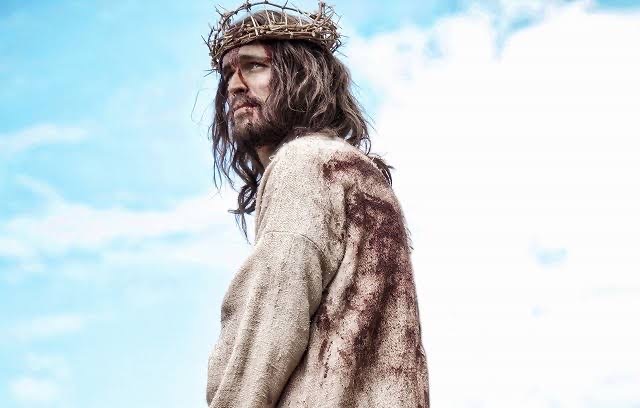
Jesus was at sea, on a boat where no plants could grow. So he compared the Word of God to a seed. Some seeds can be sown in one place, but the birds will come and eat them. Other seeds fell on stony ground, where the soil was not deep enough and they sprouted quickly, but when the sun came up, they were burnt and withered away because they had no roots. It is difficult for the plant, the Word of God, to grow. ”Listen if you have ears.“The boy who hears these words and The protagonist, Kawamura Koune, goes on a journey of thought to hear God’s blessing. In Japan, Christianity is frowned upon if you don’t like it, and the characters cross over from longing for faith to oblivion, to disgust, and back to blessing. If this were the only explanation, people would mistakenly believe that there is no romance in this novel. That’s the trouble. There is love and death in this story too.
But the first reason I don’t say this is because I believe that waiting for the assessment of a mediocre love affair or death is just an emotional assessment. It is a sad fact that the real world is the same way. Death is equal, but there are special graves for special deaths, and classes for the deaths of the unconscious and the body. But the soul is equal, and the literary world can save even the most unlikely of beings. Literature must have the fervor to express what the masses have ceased to say. Love and death cannot be conveyed by begging only for sympathy, even if it is true. The soul may live without emotional sympathy if it is metaphorically told how the world works and how God works in it. The external world is rarely captured. But the enrichment of the inner world can make even an empty life seem like a footnote.
Many times I have been opposed to adding philosophy or religion to literature, but I have never given in. Perhaps it is because I know how cruel it is to assess the feelings of others. It follows that one’s own words do not grow, and that the same is true of God.
If the Word of God is a plant, it is the bird that spins it into a nest that grows beautifully. The bird’s nest is not only a bird’s nest, but also a part of the human world that it picks up and builds.
My fictional world is such a phenomenology. It represents the formation of orientation, the world created by orientation, while waiting for the analysis of existence. My literature is thus an amalgamation of spins, and there is no such thing as a complete lie. The heat that did not live in this world becomes a fiction.
Just as a bird’s nest still does not know exactly how to nest with precision, so I weave my experiences, my fantasies. From the fictional “land” of the precise nest, uncertain of how it is completed, my story takes Soar. And the seeds dropped by these birds of fancy can grow or disappear. The reader’s understanding constructs a third world as a plant that grows. That image is both sad and hopeful.
Explanation: Eternity involves time, while time is finite, eternity represents immutability. However, we cannot perceive eternity. Time is part of eternity and therefore a substitute for eternity.
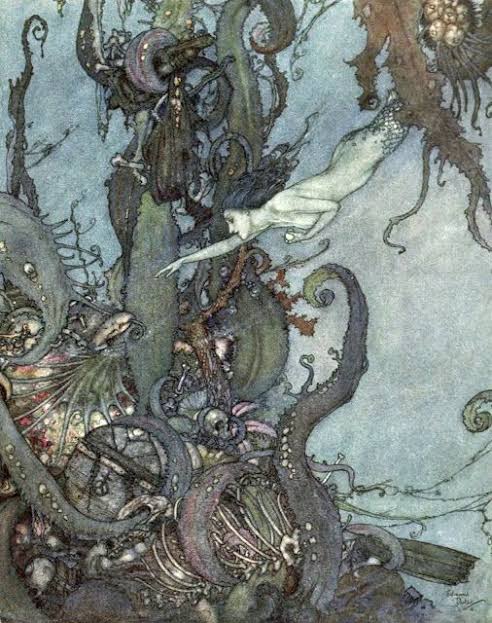
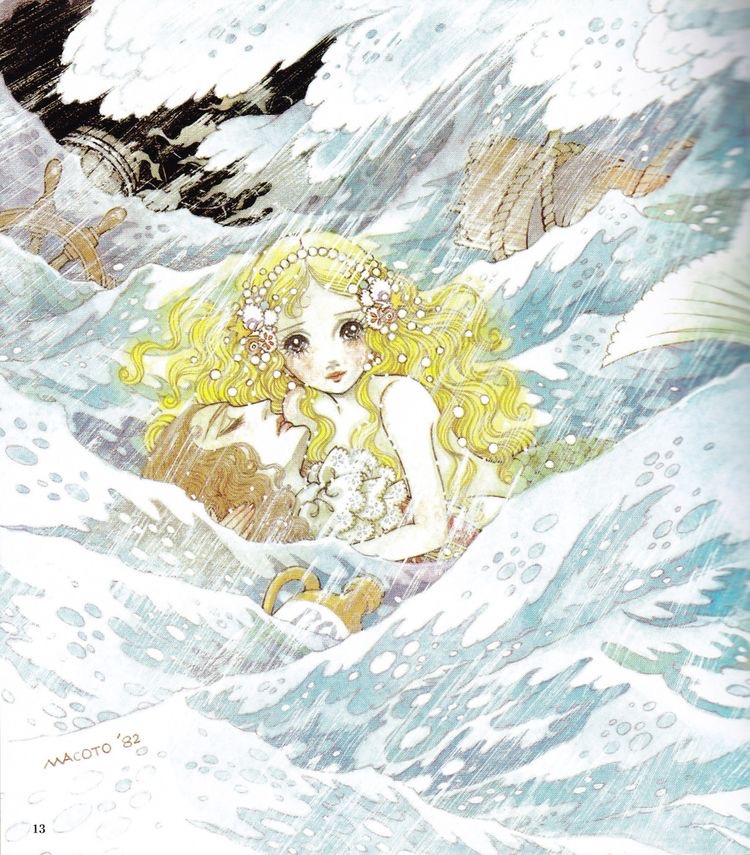
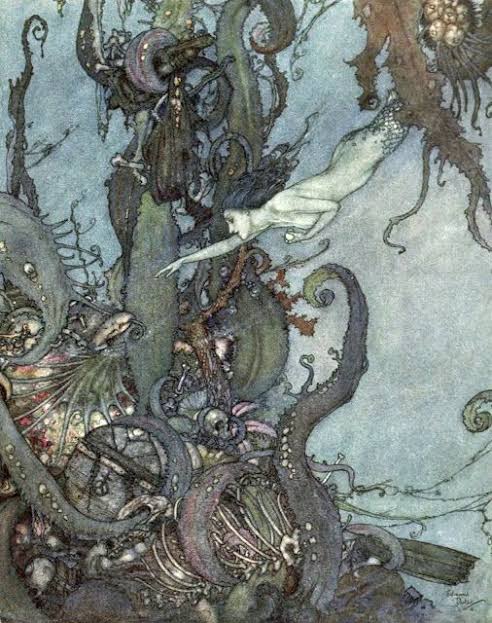
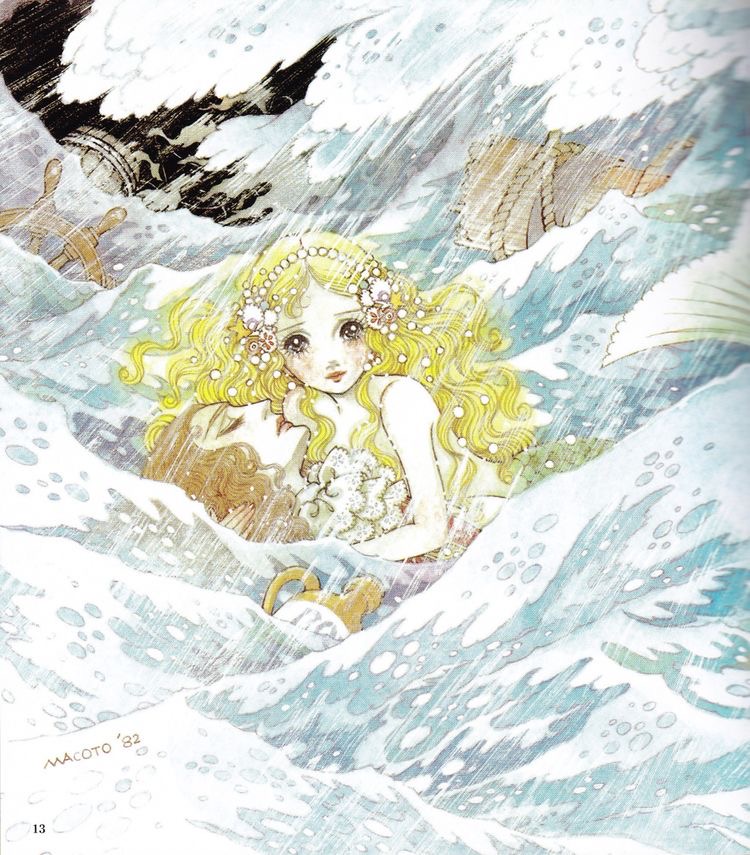
Night after night, morning after morning, the little mermaid went to the beach to see if she could find her prince.

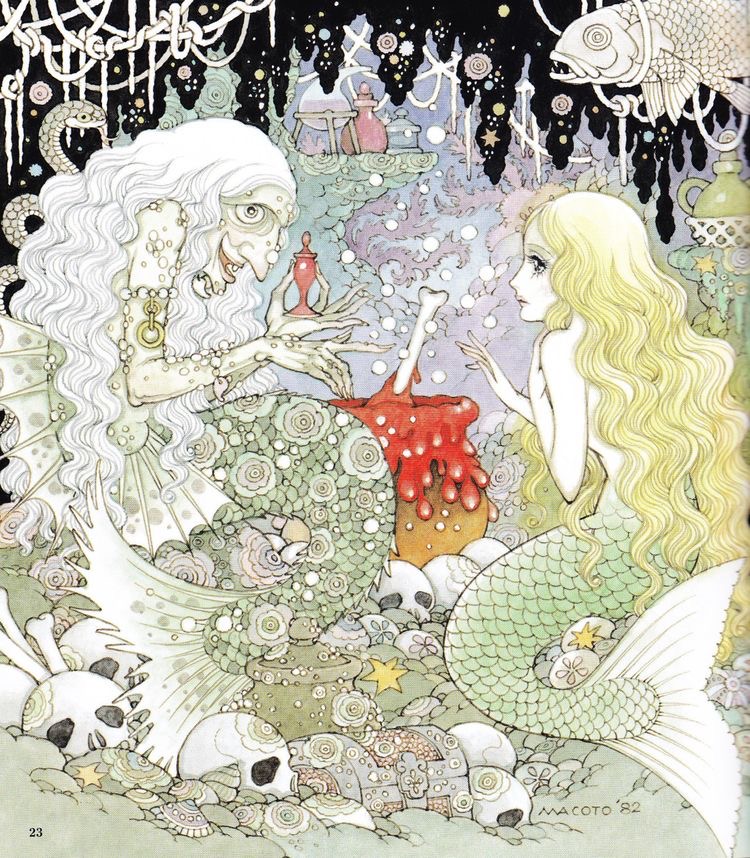
Andersen's The Little Mermaid
This article will be updated as a critique during the winter of 2024
Andersen’s The Little Mermaid has made me think many times. I will not comment on Disney’s version of The Little Mermaid, as I do not care for the story, but many commentaries on the original story end with the mermaid ending up in a bubble and dying, but in fact there is a continuation.
The mermaid who did not get a human soul does not go to heaven, but becomes a genie. It is explained to the mermaid that it is not a bad holy spirit and that after 300 years she can go to heaven. If she touches a good child, that day will come a day earlier, but if she meets a bad child, she will be a day later. Andersen’s message to the children is.
The Little Mermaid was to be a good child so that she could go to heaven as soon as possible.
The Little Mermaid is made up of three main elements.
(i) Existentialism
(ii) Love
(iii) Christian ideology.
The Little Mermaid is said to have been influenced by Fouquet’s Undine. For the Christian world, the Holy Spirit of Water lives apart from the Grace of God. Perhaps it is based on the biblical interpretation that water originally existed at the beginning of Genesis. Such confrontational beings try to become human, thereby forcing the reader to imagine what it means to be human. The mermaid-like beings were set up to not have a short life span like humans. And above all, they are afraid of death: mermaids can live for 300 years, but after death they turn into bubbles. In the mermaid world, the old people have no doubt that they are happy to live 300 years longer and drift away in bubbles, and only the youngest mermaid princess yearns for human death and souls. At the same time, she begins to dream of the eternity of love.
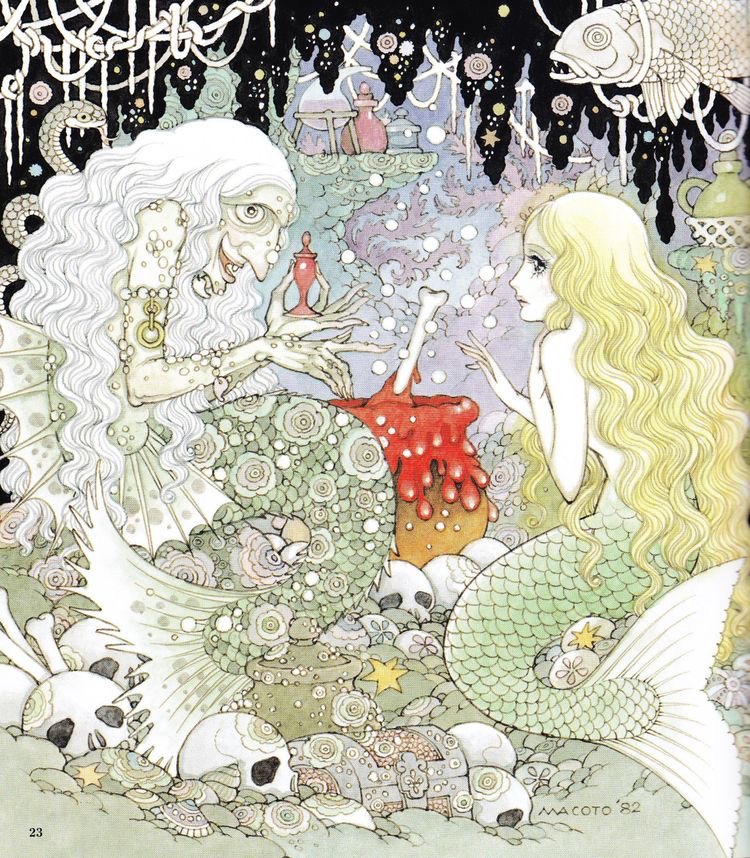
For her, it was one ‘love’ that gave her that opportunity. The mermaid world can ascend to the human world at the age of 15. For these girls, it was their one and only chance to see the world created by God. Each of the sisters has seen many different human worlds. From the bottom of the water to the top of the water, what they see there is different. In Jungian psychology, water is the unconscious, through which girls go through the rituals of adulthood. This different landscape that they witness is also the same for human believers. Just as believers read the same Bible but have different personalities, so the landscape is different for each faith. Just as Kierkegaard said that we must quit chasing ‘truth’ and challenge philosophy by separating philosophy from theology (later refuted by Husserl), the immanent world of the mermaid is existentialist, divorced from the external world. These women live in another time, coexisting with the Christian world. Only the youngest of them, the mermaid, has acquired a ‘love’. First of all, love is the feeling of wanting to connect with the other person, but she has acquired the occult mysticism of a witch and has become human.
However, she loses her voice and her legs hurt. To get rid of this, she had to be discovered by the prince.
The Little Mermaid is also a symbol of the ‘poor’ for Andersen (note 1) It seems to have been an irony that people who had almost no human rights were coolly thinking about how they could gain them, and that it was a financial thing. Language is considered important in the biblical world. That is why in the first chapter of John’s Gospel, the Logos hymn, With God was the Word, which is also considered human, but she is deprived of her ‘language’. What was left of her as a human being was her body, and the pain in her feet, her heart. She had a heart that knew love and hurt.
The Little Mermaid was actually cherished by the prince, as a detailed reading of the original story shows. The commentary often overlooks the fact that the mermaid princess is searched for after she falls and disappears, which is also an important part of the story. The prince and princess are grieving the loss of the mermaid princess and gazing at the sea foam. The irony (sadness) is also expressed in the fact that the poorer people are, the less they are able to achieve substantial happiness and are forced to depend on God’s love, the love of adoration for God and the agape, the love that surrounds them. Andersen held until the end that the Little Mermaid had to obtain something substantial in order to exist as a human being. She had to belong to a prince-like existence in order to obtain human rights, and the marriage ceremony is the most mysterious thing in the Christian world, and is a sign of full-fledged existence, so much so that it is especially important for Catholics. Does the fact that it is unobtainable make a person’s existence worthless? Andersen put the important teachings of Jesus Christ, which are not confined to ritual as a fairy tale, into the ascending soul of the Little Mermaid. Christian existentialism, as I have named it, is also a religion that stands between the relativity of organisation and the absolute. Even if we go through the same Bible and rituals, there are personalities that are drowned out by injustice and relativity. In this context, just as the Little Mermaid chooses love over their determined and structured world, and seeks the existence of being loved by God as a person, so too the Christian has an existentialist philosophy, a ‘justice’ and ‘love’ that cannot be seen without the primacy of real existence over essence existence.
‘I fell in love with a prince’, which at first glance seems like an optimistic dream.
Compared to, for example, Charles Perrault’s read-aloud fairy tale of a nobleman’s daughter, Andersen’s cruelty draws a line in the sand. He portrayed God’s love in The Little Mermaid, where marriage and love were not connected.
He wanted the children to genuinely love the poor little mermaid.
And he wanted them to be good children so that they could go to heaven for a day.
This is not a sad story. It is a look at what we do.
(Note 1: I heard this in a psychology class in the UK, so I don’t know the source, so I can’t be certain)
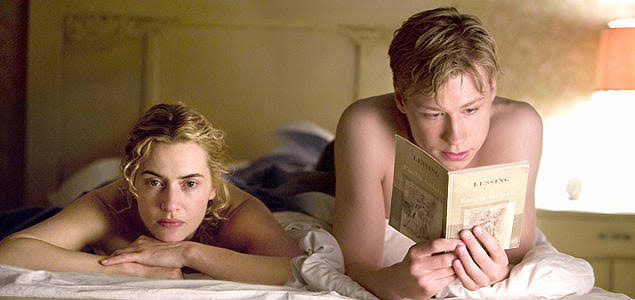
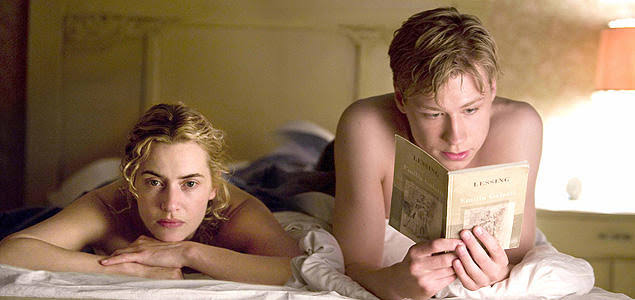
The story takes place in Germany, where Michael, then 15, becomes jaundiced on his way to school and is found and nursed by Hanna, 36, who is a year older than him. They eventually become romantics, but for some reason Hanna invites the protagonist to read some books to her. One of the books, Odysseus, is estimated to have taken place in the 1200s BC, during the time of the Trojan War and the Mycenaean civilization. In the eighth century BCE, Homerosu put together a collection of stories based on the 400 years of Trojan warfare that had been handed down by “oral tradition”. (The Iliad and Odysseas )
The protagonist, born after the Second World War, reads this lore and facts for Hannah.
Hanna has many secrets and suddenly disappears from his sight. The protagonist cannot accept her loss but forgets about it. The year is 1960 and the world is in the throes of a student movement.
He is now a university student. While attending a seminar on the trial of Nazi war criminals, he finds himself standing in front of
Hanna, whom he had once loved.
She was a prison guard in a concentration camp.
As the trial progressed, the hero remembered that Hanna had asked him to read a book. As he watched her trial, the protagonist realised that Hanna was illiterate. She couldn’t read and had moved from one job to another before it became known that she couldn’t read.
Perhaps it had something to do with the fact that she was a Roma from Romania. In front of the print that she could not read, she opened the door to the world only with his voice. She immersed herself in the warmth of his skin and the world that his voice took her to, knowing that one day she would meet her fate. The trial is a life sentence against her, without her realising that she is illiterate.
In the trial of the concentration camp officials, the key question was whether they had intended to kill her or not, but it was recorded that Hannah had read books to the prisoners. At that point, it was false.
Michaela was unable to love another woman, even though she had long since forgotten Hanna.
He has been in contact with his father, a professor of philosophy, about Hannah. Finally, Hanna is pardoned, but thanks to the help of the protagonist, she is able to write, and after.
*****
When “The Reader” became popular, many felt disgusted by the romance between a 15-year-old and a 36-year-old.
Judging them only by their age and their bodies, they called the love of another person, even if it was fiction, freaky.
People are equal in soul if you take off their skin, but they don’t care about that. But they don’t understand what it means to be separated by age. Could they have expressed the intertwining of the protagonist, who had never heard of this war, and the woman whose job was to be judged by the world? At a time when people assumed that people who were like war criminals were evil, there was nothing but love between two people who did not know each other’s position. I don’t dwell too much on the “Nazis”. It is a story of love.
The fictional world, which incorporates reality, allows us to write about love, slipping past the arguments that cannot be conceded in the real world.
Only in stories can the possibility of love be described in the midst of all the hatred.
An American writer once told me that writers can hear the voices of their characters in their heads. The written world is unique, without sound, time or color. It is up to the writer to decide what kind of loneliness and emotion he or she feels within it, but for the writer, publication is just a voice.
In the hands of the reader, he or she constructs a third world out of the world of the novel, and begins to understand his or her own novel. And they wonder. And they wonder. I want a reader. (Perhaps a film adaptation would be the most desirable these days.
I hadn’t looked very carefully, but when I found a reader, the world opened up to me.
Her beloved Michaela had a future to live up to in the famous words of the Odyssey. Hannah is not given such a thing. The author’s choice of this classic has many implications.
Every human being has a monologue. Her life was one in which she was never allowed to have hope again. The reading from him, temporarily young, was a new world, his own monologue. He must have been a spokesman for her.
The author’s choice of the classic “The Odyssey” has many implications: it shows that even among those who must be judged, there is love. Only a novel can do this. There is no other reality in which you can write about unforgivable love in a fictional world and say publicly that even war criminals had love.
****
The film title, oddly enough, was Japanese: ” 愛を読む人”.
The love formed by a voice disappears the fastest. The love formed by the voice fades away the fastest. Of the five senses, it is the voice that we lose first in memory. Next comes sight, touch, taste and smell.
Michael sent a tape he had recorded again for Hanna. With “The Odyssey”.
But he didn’t sound the same as he did then. She did not recognise his love.
She didn’t recognize it as his love, but as a voice that was trying to rehabilitate her.
I thought it was Hannah’s impulse to commit suicide.
Perhaps. The voice of the young man she loved had disappeared.
.
Who was the reader of the Holocaust?
The new reader for her was not the man she loved.
If there had been no war, we would have been souls of the same age and background. And yet it was a sad story of division. But judgement cannot divide us from love. Even if we are torn apart, the past, in which his voice lived, lives on, even if it disappears from our memories.
Love” remained as a residue.
*about Obysseus quote: This is a sentence from Odysseus and is not mentioned in the novel.*
Outline of this post.


In 2018, during my recuperation period after a suicide attempt, I read Yukio Mishima" The Sun and Steel." In it, he wrote about feelings that were neither fiction nor criticism.
He wrote about "confession" at night, "criticism" by day, and a time when he was neither.

I will taste this neither time until 2021.

The book, which was also the subject of a controversial debate at the University of Tokyo (1969), seems not to have been appreciated in Japan at the time. I have been on the road from leaving Catholicism to conversion.
I was struggling to talk about this mortal disease in my story. Would it be non-fiction, or should I force it to be fiction? Whether I choose the sun or the night.

There was also the question of Catholicism and the political uncertainty of the future in Japan. For many years, I had forgotten the poetry of Mishima response to the sun.
In 2021, I have decided to move on to the night (literature).
This involves a lot of interpretation on my part. In Sartre's terms, it is "the other with the subject".

Apologies that this is not a thorough explanation of the sun and Steel.
The” Sun and Steel” was one of Yukio Mishima lesser-known works at the time. After a long time.I read this in 2018 and found much to sympathies with. I read this in 2018 and found much to sympathies with. In the process of writing, some things are difficult to express even as a novel. I too fell into that groove around 2017. Probably every artist. I feel like it comes to every artist. Sometimes we can’t establish ourselves because we are confused by current trends or common perceptions. Mishima described it as an intermediate form between confession and criticism, “a kind of hidden criticism”.
Mishima is perhaps the only person who has focused on the area of twilight that exists between night as confession and day as criticism.
Sartre’s raison d’etre about existence and essence is that existence precedes essence, but this kind of wayward speculation, a combination of fiction and criticism, is a wandering interior that does not know the outer skin of existence, and is itself an embryo that does not know the outer world (essence).
It is the equivalent of inference, prediction and prophecy. When the result is not yet known, even if we think we have grasped the essence, we cannot be sure. A novel does not have enough material to be written, and a criticism is only an assumption made a few years in the future. But there are times when the feeling is strong.
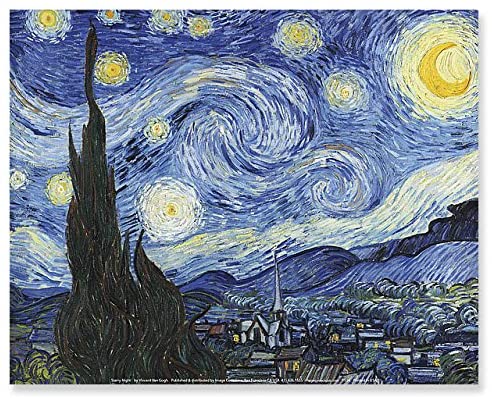
At such times, I think back to Van Gogh’s Madness paintings.
His paintings were first of all existentially unsuccessful. Later, his brother Theo’s wife succeeded in selling Van Gogh’s paintings and made him into the genius that he is today. Over time, they created the essence of Van Gogh’s paintings. Over time, they created the essence of Van Gogh’s paintings, or the world discovered them.
The Starry Night This is one of my favorite Van Gogh paintings. I don’t know of any other painting that depicts the stirring darkness so clearly.
I think Mishima is right when he declares in this book that he is not a poet. Poets, like Van Gogh’s paintings, are not afraid of consequences, and they do not fall between confession and criticism. Hermann Hesse is a genius as a poet and Rubaiyat dances without fear of criticism from Christians.
It seems to me that Iran is famous for its poets. Perhaps they are not afraid of death (or the oppression of others). That free enthusiasm, which neither the cooperation of the Japanese nor the argumentative nature of the West can match, is something to be admired and, as a result of more social experience, I think we will never have it again. We all dream of it and run with it, but the tragedy and happiness that we have created with our speculations, from pacifisms, through physical pain, gradually becomes a reality.
When I was young, I would have run without fear. In the midst of it all, joy and despair, like differential and integral calculus, were repeated, and expectation and despair may have exceeded real reality. In the midst of this repetition of the mundane routine, where sleep brings morning and daily life again, I had my moments of real despair.
In turn, disappointment and disillusionment increased, becoming part of the larger reality of the real world.
Gradually, disappointment and disillusionment increase, and the artist becomes part of the larger existential context of the real world.
That’s the end of the artist. It is only natural that he should lose his individuality.
I’m trying to be unique because of my long established taste, but my body is screaming. The days when I used to write poetry in the evening, even if it was bad, seem like a lie.
It was a mistake in the first place to see it as a defeat. The thought of being abandoned by night and day
It will always go somewhere. It is like a long, inflexible Steel. That is how I see it.
In my analysis, Mishima Steel element probably became the sun and led to his suicide.
I have decided, after a long time, to return to the Night once more. That’s when I retired as a journalist. It is proof that I am no longer outspoken about current affairs. The man who lives by night lives for the invisible presence of human sensibility. The man who lives by day lives for the market and the human condition.
There is no right or wrong, because both are necessary.
But when speech and knowledge are wasted, it is tempting to talk about real problems.
Isn’t it the starting point of a literary person to keep that ” babble ” silent until night?
I will not write directly about why I attempted suicide, or the process of my conversion. Instead, I will start to confess, as if in the night, my memories and records were a wild reflection.
In this fictional world, the person who speaks for me is a man and other women, and the story goes on. There is, in effect, a fictional character (a lie). But the essence is not a lie. Within the non-existent outer skin, there is an interior that I have experienced and gone through.
I have read a lot of Mishima during my illness. But I chose a different path from him.
In his writings he wrote
“Now I no longer believe with all my heart in the idea of classicism, about which I was so passionate at the age of twenty-six. I no longer believe in it with all my heart”
I might not have the awe-inspiring ardor of my youth, either. I sympathies with him in this confession under the sun.
But, like the protagonist of the piano tuner I am writing about, I intend to expand the literature to say that sound does not die. In the despair of the protagonist, my inner light is incorporated.
その記事が見当たらなかった。そのことを思い出したのは、再度、5番を購入したからである。一時期ヴィトンやディオールの香水を愛用していたが、ふとしたきっかけで戻ってきた。すると、香りが以前と変わっているような気がした。見た目からは想像できない可愛らしいピンクのバラ、「Rose de mai 」は薔薇の香りにの中で強香であり、全ての薔薇のイメージをかき集めたようにシャネル5番は演出している。しかし、最近の5番の香りはそれがよりパウダー化し、濃度が薄い気がした。記憶違いなのなら申し訳ないのだが、情勢の影響で配合が変化することは仕方がないのかもしれない。
Job 38:41

Who provides food for the raven
    when its young cry out to God
    and wander about for lack of food?
The Bible is divided into two parts, the Old and the New Testaments, each of which has a different mission.The Old and New Testaments are divided into the historical books, the wisdom books, the prophetic books and the apocalyptic books, while the New Testament is divided into the gospels and epistles. (etc)Some philosophers who are not familiar with religion mistake wisdom literature for prophecy and gospels for apocalypse, and start to talk about conspiracy theories and prophecy from non-prophecy.
Job is the “wisdom literature” of the Old Testament, and a major theme is that “God gives and takes away”. This is often thought of in conjunction with the “Ecclesiastes “where Job is a chapter about suffering given by God and Ecclesiastes is a chapter about facing emptiness and death because of wealth. Wisdom literature leaves behind various stages of wisdom, from the mundane sufferings of everyday life to the lofty and mysterious feelings of the fear of God. These are for the purpose of helping people to escape from suffering and to improve themselves in a life made up to human sins and mistakes.
It is the aim of the book of Job to instil in us the fear of God as well as the wisdom to ask and answer questions. This story is a relatively “literary” favourite of the Japanese.
Job was a righteous and just man. God ‘loved’ Job so much that he boasted of him to the devil.
The devil had already interfered with Job, but Job never turned to evil. God was proud of that and told the devil that it was no use doing anything to Job. But the devil said that he had only flayed him, that he had only given all his wealth for his life, and that if he got any nearer to bone and flesh, Job would curse God. God let the devil go again, on condition that Job’s life not be taken.
The devil caused Job to lose many, Many things. He lost his children, his livestock, his servants, and even a skin disease. The first one to give up was his wife. But Job was still serious and said, “Since God has given me happiness, why don’t I have some misfortune?
However, three of Job’s friends (philosophers) come to comfort him, and during their conversation, Job gradually begins to express his resentment towards God. The friends say, “You must have done something”, but Job finally says, “I didn’t do anything”. His friend tells him to apologize to God and make peace.
But Job was adamant that he had nothing to apologize for. Then there are more questions in which the three men blame Job. After the last argument between Eliph (the philosopher) and Job, the word finally comes from God: “Who is this, that, without knowledge, he should darken the empire with word after word?”
God converses with Job alone, and asks him how much of the world he knows.
Job reaffirmed his acceptance of the existence of an omniscient and omnipotent God, saying that he did not know the depths of the world or how it came to be, and he prayed for the three men involved in the debate.
And Job was rewarded more than before with God’s blessing.
The Bible, including the book of Job, has few “internal monologues”. Therefore, there are many places where we cannot see the direct psychology and facts of the characters. Therefore, it is possible for various people to continue to search for empathy and facts throughout the long history. The book of Job, like Genesis, is written using the direct narrative discourse method. The Lord’s (God’s) other narrators show the inner life of Job and the Lord. The book is written in prose and rhyme, with the prose enlightening Job to his faith in God, and the rhyme accusing him of injustice.
We do not know why God loved Job so much, except that he was a “righteous man”, because there is no “internal monologues” of God. Furthermore, we do not know why God released the devil. We all have a tendency to see suffering as punishment and to be convinced of it. Job is not convinced by the questions and answers of his friends who surround him and continue to pursue the ” Fact of Suffering”.
The reality is that any discussion of God or destiny is only between human beings.
“Who has heard the Voice of the true God? That is the question.
It is true that in reality we can only talk to each other while we are alive. In Osamu Dazai’s “人間失格”, when he is accused by his friend Horiki that “the world will not forgive that”.
It is reminiscent of the famous scene in Osamu Dazai’s “人間失格” where the protagonist pulls back without saying, “Isn’t it you who are the World?
It is reminiscent of the famous scene where the protagonist pulls back without saying, “Isn’t the world about you?”
”The world won’t let that happen”
“Not the world. You won’t let it happen, will you?”
“The world will give you a hard time for doing that.”
“Not the world. It’s you, isn’t it?”
“The world will bury you now.”
“Not the world. It’s you who will be buried, isn’t it?”
This structure is similar to that of the dialogue between Job and his friends.
It is almost impossible to hear the voice of truth directly in the real world. In the real world it is almost impossible to hear the voice of truth directly, but only Job can communicate with God through his stories. The God of the Old Testament spoke directly to Adam, Job and Joseph, or told them dreams, but since the birth of Jesus in the New Testament, God has been silent.
For Christians, this pursuit is done through prayer throughout their lives.
Each with his or her own answers, to die in the end. Will the prayers of life match the prayers of death? The question is a mystery.
The outcome of the pursuit of suffering is the love of God. There is no mistaking that.
The Old Testament was a dialogue from God to humans, a faith from below to above.
In the New Testament, God sent Jesus down. Jesus walked to the people on his own feet.
That is how the mystery descended, when a being beyond human understanding broke through the thick walls of the lower world.
Read the Bible many times and you will find empathy and inspiration before logic. I was sure of it.God is there, beyond our own indwelling, beyond the common sense of the world. God’s love is there.When will we reach it?
We don’t have to force ourselves to think that we have God’s love in our grasp. It is good to live a life of waiting for God’s love. God’s love is not only about grace, it also saves people. What does not reach us is only “economy” and “politics”.An economy and politics without the love of God means collapse. It does not have to be only the voice of man that accompanies our suffering. Like Job.
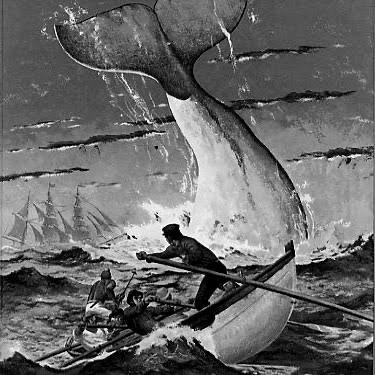
While you take in hand to school others, and to teach them by what name a whale-fish is to be called in our tongue leaving out, through ignorance, the letter H, which almost alone maketh the signification of the word, you deliver that which is not true.”
How vain and foolish, then, thought I, for timid untravelled man to try to comprehend aright this wondrous whale, by merely poring over his dead attenuated skeleton, stretched in this peaceful wood.
Melville, Herman. Moby Dick (AmazonClassics Edition) .Chapter103
(Paul Ricoeur, Love and Justice, a book I would recommend to young philosophers and theologians)
If justice is possible because of love, can we call it love when a person is punished for doing justice, for example, the ” Capital Punishment “? Thus, love and justice are always dichotomous. Paul Ricœur’s book is a dialectical meditation on this dichotomy, trying to bridge the gap.
The point to be kept in mind is that “love” refers to Jesus Christ and “justice” to Moses.
Justice is concerned with social practice, while love is at best a motive. Justice, on the contrary, is more likely to have a narrow effect and less likely to be widely applied. We can see this in the history of Moses, when we consider the number of deaths. Even though the love of Jesus is slow in spreading, it spreads to many people. That movement is also called the grace of God. Justice is the spear, love is the shield. What non-Christians misunderstand is that they do not distinguish between God’s love and justice. (I don’t mean that as an evil thing.)
Particularly the Catholic emphasis on “God is love” has led to a number of misunderstandings.
And these misunderstandings are not limited to misunderstandings, they are also flaws in social practice due to the distorted interpretation of love. At the point where crimes committed by the clergy are covered up, for example, when clergy talk about God’s forgiveness for crimes, they are criticized in social practice as “they are distorting love”. However, through my experience as a journalist, I have also witnessed victim fraud. This experience has made me realize that the distortion of “love” is not enough. The testimony of victims, between lies and illness, takes advantage of people’s conscience and justice. It causes us to lose sight of the direction of justice.
To contemplate the dichotomy between love and justice is labour intensive and unrewarding. Many Hebrews would not have been saved if the revolution had not taken place in the time of Moses. This was the proper love and justice of the time. At the time of Jesus’ birth, it was hoped that he would be a revolutionary like Moses, but he did not make any great revolution. At first people were disappointed, but Jesus went to the poor on his own feet and saved them through love. Love is thus slow to progress and is attacked and persecuted by those who fail to understand it. Jesus’ quintessence of ‘love’ is that his justice was not in escaping justice, but in accepting the death penalty.
His justice was not in escaping justice, it was in accepting the death penalty, which is the essence of “sacrifice”, of love, of covering up all the sins of others. For those who follow Jesus, the practice of this supreme justice is no different from suicide, and whether or not Jesus himself would want people to do this has yet to be archaeologically proven. The same is true of martyrdom itself, which is not yet clear whether Jesus would have wanted it or not. But nowadays martyrdom is considered a virtue and worthy of praise, provided that the conditions are fulfilled. (Song of Solomon: Love is as strong as death)
Reading the Bible is like looking into the mirror of one’s self, a chapter which was originally in the book but was left out in the Japanese version because it was incomplete as a philosophy. This imperfection must be challenged by us, the next generation. We must return to the question of what the Bible exists for. We should read it honestly before we listen to the answers of the clergy. I urge young people to do this especially. The question that arises in the Bible is the self itself. It is a mistake to look for answers in a story, but the questions raised by the story are a guide on the journey to reality. As Paul Ricoeur says of love, it can be spoken of in both shallow and deep ways. The same is true of stories. They are made both shallow and deep. The Bible is considered a deep book, but it is less and less necessary for modern people. It was known that the world was falling according to gravity, though it was also the fall of the world. Probably the reason for the lack of attention is that there is something about Christians and the clergy that is not respected.
The bible has been around for a long time and has been interpreted by many different people. It was important that there were great men in it that we would still want to study. But we don’t have them today. They may exist, but they are not easy to find. When we lose our bearings, we need to go back to the basics of self-image as seen in the Bible. That is why the inscription on the temple of Apollo at Delphi, which existed before the Bible, says: “Know thyself”.
When you ask a Catholic priest a question, you will get a dozen different answers. The views of the Pope and theologians continue to change. However, we will come to realise this. People touched by the love of Jesus do good works voluntarily. It is not that Jesus is the only one, but that people are voluntarily awakening their conscience. I want people to know this glimmer in this age of information overload.
Paul Ricoeur’s philosophy, although it is an application of earlier phenomenology, is a “narrative theology”, the origin of the idea of the existence of Jesus. We recommend his book to many believers and students of theology who, in the future, will encounter incredible absurdities and disappointments. Paul Ricœur is a philosophy of problematic regression.
Remark.
The thought which seeks to understand God is always brought back to the story. God’s thought can only be conceived as a narrated version of a story in which the concept is carefully checked. Thus, if a thought is to think of God, it must hear the story being told.
And again, ” God seeks to be told”
Paul Ricœur (from Love and Justice, original notes)