In this context, it seems reasonable to conclude that Weil is referring to the Catholic Eucharist, or Eucharistia hostia. This is, of course, an intuitive conjecture, yet it remains plausible to suggest that Weil maintained a critical perspective towards the monotonous and arduous nature of factory labour. Moreover, she implies that the hostia has been reduced to a mere habit—an observation aligned with her critique of the increasing materialism and secularisation of the Church. I argue that this insight emerged from her personal experience as a labourer, leading her to realise that the act of consuming food and drink, devoid of the accompanying physical effort, could be seen as a more materialistic pursuit.
My preference for Weil, over many other philosophers and theologians, lies in her focused exploration of the condition of the ‘labourer’. Furthermore, her spiritual ‘turns’, which many find challenging to interpret, are consistently anchored in the figure of Jesus Christ. The issue of poverty tied to labour remains a pervasive and universal challenge, even in modern contexts. It is also worth noting that Jesus himself had a profound connection to labour, given that Joseph, his foster father, was a carpenter.
***
・Travail manuel. Pourquoi n’y a-t-il jamais eu un mystique ouvrier ou paysan qui ait écrit sur l’usage du dégoût du travail ? La pesanteur et la grâce
・(Manual labour. Why has there never been a labourer or peasant mystic who wrote about the experience of disgust towards work?)
・Travail manuel. Le temps qui entre dans le corps. Par le travail l’homme se fait matière comme le Christ par l’Eucharistie. Le travail est comme une mort.
(Manual labour. Time enters the body through labour. Through work, man becomes matter, just as Christ becomes matter through the Eucharist. Labour is akin to death.)
***
This assertion appears in Gravity and Grace (La pesanteur et la grâce), where Weil reflects on the mystery of labour, drawing a parallel between work and the transformation that Christ undergoes in the Eucharist. This connection evokes Christ’s anguished cry from the cross: “My God, my God, why hast thou forsaken me?”—an expression of divine abandonment. Christ suffered fully as a human being, and conveying the meaning behind these beliefs can be profoundly challenging. Faith is often deeply intuitive and internal, making it difficult to articulate through rational discourse alone. From a Catholic perspective, reflecting on why one might embrace Catholicism involves recognising the inherent contradictions within the institution, which may serve as part of its appeal.
In early Christianity, the teachings of Jesus were transmitted orally and through personal encounters, embodying a distinctly spiritual and individual approach to faith. As the Church’s influence expanded within the Roman Empire, however, faith became increasingly institutionalised, with doctrines and rituals formalised over time. This evolution established faith as an entity rooted in institutional authority, often intertwined with political power. Catholicism continues to value mystery and intuition, yet these elements have also been absorbed into its institutional framework. Although Weil’s exact reasons for embracing Catholicism remain unknown, I believe it was the very contradictions within the faith that captivated her. Amidst the materialism and corruption that taints some members of the clergy, she found solace in her connection with the humanitarian Fr Perrin. When I challenged Fr Perrin on the Church’s practice of excommunication, he replied in writing, comparing it to an act of weeping. Regrettably, this letter never reached Weil.
Weil recounts three significant encounters with Catholicism following her factory experience. The first occurred in a small Portuguese village, where she witnessed fishermen’s wives singing sorrowful hymns. This encounter led her to perceive Christianity as a “religion of slaves,” realising that those who suffer need faith for solace—and that she, too, was one of these “slaves.” The second encounter took place in Assisi in 1937, where, for the first time, she knelt in a small chapel associated with St Francis, experiencing a profound reverence for God. She also immersed herself in the liturgy at Solesmes, enduring severe headaches but finding comfort in the beauty of the hymns and words. These experiences offered her a glimpse into the possibility of understanding divine love beyond human suffering, etching the Passion of Christ deeply into her spiritual consciousness.
For her third encounter, Weil committed to reciting the Lord’s Prayer (Pater) in Greek each morning with complete focus. During these prayers, she often experienced a profound silence, sometimes feeling as though her thoughts transcended her physical body, enabling her to sense the loving presence of Christ. This practice of prayer became a vital means of direct contact with the divine for her. Her engagement with Catholicism left a significant imprint on her thoughts and beliefs.
The term “Catholicism” in this context encompasses the formal doctrines, rituals, and institutions of the Catholic Church, along with its social and cultural impact. The Pope is viewed as the supreme authority, and Catholicism emphasises the institutional and public dimensions of tradition-based education and social action. It can be described as an “outward-looking” phenomenon, centred on the officially recognised doctrines and institutions of the Roman Catholic Church. Although personal “intuition” remains vital for practising Catholics, it is noteworthy that Weil—despite her deep involvement—never received baptism, or passed away before she could do so, suggesting that her spirituality transcended institutional boundaries.
Weil’s factory experience allowed her to empathise with the suffering of others and to recognise herself as a “slave.” This realisation profoundly shaped her spirit, leading her to see herself as an anonymous figure within society, much like Christ, who bore the weight of human suffering.
The Psalms of the Old Testament offer a poetic connection between God and humanity, expressing a spectrum of emotions through praise, prayer, and lament. Other biblical texts, such as the Song of Solomon, Job, Proverbs, Lamentations, and sections of Jeremiah and Isaiah, also contain poetic elements. However, the New Testament does not portray Jesus Christ in poetic form.
Why, then, is Jesus not praised through poetry? This absence may reflect the early Christian focus on spreading the faith and establishing communities within the material world. The practical need to communicate teachings clearly and accessibly took precedence over poetic expression, leaving any poetic sentiment about Jesus to the reader’s interpretation. The narrative structure and instructive parables used in the Gospels were essential for conveying the message to diverse audiences across different cultures and languages.
In this context, Weil’s concept of the ‘labourer’ serves as a symbolic connection to Jesus. It is not merely physical sustenance that labourers require, but rather the nourishment of the soul and imagination.
Even today, the issues surrounding poverty and labour are not easily categorised as either social problems or matters of personal responsibility; they remain deeply intertwined, presenting challenges without clear solutions. Viewing poetry solely as an act of creative expression reflects a subjective perspective, reminiscent of Plato’s theories. However, my focus has been on Weil’s engagement with Catholicism, despite her not being baptised.
Can we view labourers not as mere material beings but as individuals who share in Christ’s suffering?
While the hostia, representing Christ’s flesh, may exist within sacred rituals, it is undeniable that institutional corruption often reduces it to mere bread. Labourers need more than this—they require a poetic sentiment capable of inspiring and enriching their lives. Historically, poetry has expressed devotion and reverence towards God, articulating moral and ethical ideals. To what extent, though, can humanity embrace such ideals today?
Weil does not deny the necessity of bread in addressing physical hunger; rather, she distinguishes between this and the spiritual nourishment she seeks. Her writings call for a deeper exploration of suffering and the human experience, frequently referencing Jesus Christ as a guiding figure. In doing so, she reveals a profound religious intuition that underpins her perspectives on contradiction and transformation.
Ⅷ. Reflections
Perhaps you may glimpse poetic sentiment in the theme of ‘light and shadow.’ I wonder what thoughts stir within you as you observe the shadows cast by trees and the way light dances upon an outdoor wall. The delicate interplay between light and shadow conjures countless associations. Shadows, it could be said, are ephemeral—born from the presence of light, yet perpetually shifting and fleeting. If we draw upon Plato’s allegory of the cave, we might surmise that what we perceive as reality is but a shadow of the true essence, a projection on the wall that we mistake for the real. This enchanting scene offers only a fragment of truth, revealing but a glimpse of a larger whole.
In Japanese thought, this interplay evokes the concept of mujo—impermanence—capturing the transient meeting and parting of light and shadow. In Japanese literature, cherishing such seemingly insignificant moments is, in itself, a literary act. Gaston Bachelard, for his part, refrained from naming such experiences, instead drawing profound meaning from the essence of the fleeting moment.
While some may interpret this view as offering solace to labourers, my perspective has been shaped by Christian evangelism. Light and shadow, deeply symbolic throughout tradition, reveal beauty wherever the heart is open to see it. Yet if we are to embrace the full scope of Weil’s reflections on ‘labour,’ we must look beyond the mere interplay of light and shadow. We are called to confront the very symbol of ‘labour’ itself, not in its economic sense, but as a representation of poverty. Symbols, which merge the tangible with the abstract, demand both conceptual understanding and authentic engagement with reality.
One might say that while poetic sentiment grants us a certain freedom, we must also tread the path of poverty that Jesus embodies.
In Matthew 25:40, Jesus offers a parable that illuminates his royal worthiness: “Whatever you did for one of the least of my brethren, you did for me.” Conversely, he warns, “What you did not do for one of these least, you did not do for me.” These words convey that service to the most vulnerable is, in essence, service to Jesus himself. Yet bound within this message are daunting challenges, tangled with complexity, leading us away from the realm of poetry and heartfelt inspiration.
Indeed, those who place their faith in Jesus Christ may encounter moments of profound intuition, a deep sense of spiritual insight. Yet to articulate the poverty that Jesus embraced, and to share its meaning with others, is no easy task. The human heart, it seems, is caught in tension—yearning to draw nearer to the divine mystery, while fearing to lose itself within it. In recognising my own impermanence, I discover within myself a compassion tinged with humility—a challenge that mirrors my understanding of Jesus. This reflection becomes the essence of my redemption: not a pursuit of abstract beauty, but of a beauty that longs to take tangible form.
Amid the complexities of doctrine and the mysteries of faith, I have anchored my thoughts in the figure of the ‘labourer.’ Honouring Joseph, the earthly father of Jesus, I pay tribute to Simone Weil, whose words resonate with this enduring theme. Through her eloquence, Jesus walks the landscape of the heart, emerging as a poetic sentiment. Though the New Testament does not portray Jesus in the language of poetry, it was perhaps Weil who most profoundly conveyed that the journey to discover this poetic truth lies within us.
Lastly, I have chosen to translate “Work” consistently as “Labour.” In English, “Labour” encompasses not only work but also the pains of childbirth, whereas French distinguishes between these meanings with different words. For Weil, however, the shared Latin root may have embodied a deeper connection. She left us with these poignant words in her notebooks: “Writing is akin to childbirth. One cannot help but strive to the point of feeling limits.” This is an experience familiar to anyone who has engaged deeply in writing, regardless of their grasp of Latin. Yet knowing Weil, it is likely she uncovered within this act a profound mystery.
In this light, perhaps she was indeed a ‘teacher’ in the truest and most profound sense.
Comments:
*Although this work does not engage with Kantian thought, it is possible to reflect elements of Kant’s philosophy.
*Les travailleurs ont besoin de poésie plus que de pain is part of the “Workers and Mysteries” chapter in Gravity and Grace, and it continues with Seule la religion peut être la source de cette poésie. (Only religion can be the source of this poetry).
*I hope you will accept this critique, even though it references literature. While it does not mention Kantian thought, it can reflect it as well.
*Les travailleurs ont besoin de poésie plus que de pain appears in the “Workers and Mysteries” chapter of Gravity and Grace, followed by Seule la religion peut être la source de cette poésie. (Only religion can be the source of this poetry).
References:
• Simone Weil 『La pesanteur et la grâce』『La Condition ouvrière』『Attente de Dieu』『La pesanteur et la grâce』
• Tome VI, volume 2, Cahiers 2 (septembre 1941- février 1942), Paris, Gallimard, 1997.
• George G. Humphreys, Taylorism in France, 1904-1920: The Impact of Scientific Management on Factory Relations and Society
• Plato / Allen, R. (TRN), 『The Republic』
• 暗い時代の三人の女性, 晃洋書房
• シモーヌヴェイユ アンソロジー, 河出出版
Please note that, as of now, this paper does not provide references to literature specifically addressing Catholic sacraments. The relevant details will be submitted at a later date.
・Travail manuel. Le temps qui entre dans le corps. Par le travail l’homme se fait matière comme le Christ par l’Eucharistie. Le travail est comme une mort.
*Les travailleurs ont besoin de poésie plus que de pain.は重力と恩寵の「労働者と神秘」の章であり、Seule la religion peut être la source de cette poésie.この詩の源になれるのは宗教だけだ、と続きがあります。
*I hope you will accept this critique, even though it refers to literature. While it does not mention Kantian thought, it can also reflect.
**Les travailleurs ont besoin de poésie plus que de pain. is the ‘Workers and Mysteries’ chapter of Gravity and Grace, and Seule la religion peut être la source de cette poésie. only religion can be the source of this poem. It continues with.
参照文献
Simone Weil 『La pesanteur et la grâce』『La Condition ouvrière』『Attente de Dieu』『La pesanteur et la grâce』
Tome VI, volume 2, Cahiers 2 (septembre 1941- février 1942), Paris, Gallimard, 1997.
George G. Humphreys『Taylorism in France, 1904-1920: The Impact of Scientific Management on Factory Relations and Society
On 22 February 2024, the closing price of the Nikkei Stock Average surpassed the record high of 38,915.87 yen set on 29 December 1989 at the peak of Japan’s bubble economy. Additionally, a new variant of the NISA (Nippon Individual Savings Account) was introduced in Japan. Japan’s business outlook index is at a new high after Nvidia’s strong results. There is a possibility of profit-taking selling. However, this is the start of a new era. The implementation of the new NISA policy has led me to believe that stock prices will continue to rise. This is because Japanese stocks are generally more stable than European stocks, and there are currently no concerns related to real estate, unlike during the bursting of the bubble and the collapse of Lehman Brothers. Additionally, although it is difficult to say definitively, the ongoing war may also be contributing to the positive performance of stock prices. This can be observed from the fact that many companies, who had previously commented on events such as the earthquake in eastern Japan, conflicts in the Middle East, and the war in Ukraine and Russia, have not made any statements regarding the situation in Gaza this time. It is important to note that these observations are not conspiracy theories but rather a reasonable analysis of historical stock price patterns during times of war to gain a better understanding of their impact on the market.
I am not an expert on the subject, so I will not go into detail, but if you are thinking about your future life, I think it is inevitable that you should learn to invest and think about increasing your wealth if you are going to make it in “Japan”.
It can be said that the days of building wealth with fixed-term deposits have returned. However, I decided to address this issue in this column because poverty is still a persistent problem and I wanted to reflect on it a little before criticism of those who did not successfully take advantage of this policy starts years later.
Ⅱ. Amartya Sen and the Capability Approach
Amartya Sen, an Indian economist and professor at Harvard University, has no clear connection with literature, but the economics he proposes is full of elements of liberation, freedom and the pursuit of happiness, which are also themes in literature. He is an authority on welfare economics and social choice theory, which use advanced mathematics and logic in economics, and concepts such as adaptive preference, the capability approach and ‘human security’ are sometimes taught in high school courses in Japan today.
Sen’s interest in poverty and its impact on individuals can be traced back to his childhood experiences in India, particularly observing the devastating effects of the Bengal famine. His research led him to define poverty as the lack of basic capabilities, emphasizing that individuals should have the freedom to live a life they have reason to value.
In 1998, Sen was awarded the Nobel Prize in Economics for his contributions to welfare economics and his analysis of economic policies. Unlike earlier assumptions that focused solely on the macroeconomy, Sen argued that societal progress should be measured by the well-being and freedom of its individual members.
Sen’s emphasis on human happiness and flourishing highlights the importance of individual freedoms and self-determination in economic development. His ideas challenge the notion that a successful economy is solely determined by its sheer size or growth, stressing the significance of ensuring individual rights and capabilities.
In conclusion, while Amartya Sen’s work is primarily within the field of economics, it incorporates a broader perspective that recognizes the importance of human happiness and the freedom of individuals.
That is why various studies have been conducted on poverty. Margaret Thatcher famously stated that ‘poverty is a lack of character.’ Other studies have examined different approaches to addressing poverty, and even today, there are contrasting opinions on whether the solution lies in giving assistance or in changing our way of life.
A century ago, the writer George Orwell experienced poverty firsthand and remarked that it “crushes the future.” In his novels about the struggles of the poor, he also observed that they would often prioritize indulging in luxuries over consuming healthy vegetables.
Amartya Sen’s economics took a further step by focusing on poverty as an inability to exercise choice and initiative. One might question whether studying Sen’s economics is outdated now or if there are aspects of it that need reevaluation from an investment standpoint. However, I have chosen to examine it primarily from an ethical perspective.
Sen’s economics posits that inclusive and sustainable economic growth is achievable by not only improving economic indicators but also by promoting individual freedom and equality of opportunity. A thriving economy alone does not signify true societal success if inequality and poverty persist. Sen’s economics considers not only economic outcomes but also people’s quality of life and well-being as essential indicators of a healthy economy. Assessing the health of an economy requires a broader perspective beyond economic growth rates and rising stock prices.
Ⅲ. Keynesian economics and the Japanese economy.
The benefits of capitalism are described as efficient allocation of resources, innovation and efficiency improvements through competition, and the protection of individual freedom and property rights. It is also claimed that policies based on Keynesian economic theory during the ‘Showa’ period helped to realise the dream. One of the successful policies of this period was the use of fiscal policy. Keynes advocated the use of fiscal policy to promote economic growth and job creation through fiscal stimulus and public investment. Also important is the theory of imperfectly competitive markets. Keynes argued that when markets are not perfectly competitive, prices and wages do not fluctuate flexibly and stimulating demand has a positive effect on employment and output. Stressing the importance of active government fiscal policy and demand management to help the unemployed, Keynes proposed policies to deal with problems such as business cycles and unemployment, taking into account how the economy would function in an imperfect market environment rather than a perfectly competitive market. These included a ‘mainstay industrial policy’, major public works and infrastructure investment, increased economic growth and employment, an independent Bank of Japan and the use of effective monetary policy. In addition, manufacturing industries such as automobiles and electricity gained strength in trade policy and contributed to increased international cooperation.
On the other hand, there were drawbacks, one of which was the risk of inflation. While Keynesian economics stimulates the economy by stimulating demand, it has been criticised that this could lead to inflation in the long run. The second is the ability of the government to implement it. Keynesian economics requires active government intervention, but the government’s implementation capacity is sometimes seen as limited, making it difficult to implement effective policies.
Next, ‘communism’ refers to a political system that emphasises the role of government in solving poverty and focuses on economic and social management by the state. Communism rejects the private property system of capitalism and seeks to share the means of production and distribute resources equally. The first government of communism is the state, whereas the first principle of capitalism and Keynesian economics is the market. Communism differs from Keynesian policies in terms of economic and social structures and the division of roles. In communism, the role of the state is significant, leaving the central coordination of economic activity and the elimination of poverty to the state, whereas in Keynesian policies, while assuming a market economy, economic stability and public welfare are pursued through state intervention.
One of the reasons why capitalism, welfare, and support for the vulnerable have not worked well in Japan is the limited effectiveness of the basic principles of capitalism, such as the pursuit of profit, in addressing social problems and providing adequate welfare. This highlights the limitations of relying solely on the market as a solution. The lack of sufficient welfare and support in recent times presents a challenge that goes beyond the capabilities of the market alone, requiring solutions that extend beyond market mechanisms. Additionally, the issue of political decision-making adds complexity, as welfare and support for the vulnerable are public goods that require government intervention. Furthermore, political decision-making is often complicated by conflicting interests and values.
Ⅳ Well-being and economics
To what extent does economics take happiness into account? First of all, economics is not a discipline that is directly concerned with happiness itself. Economics is difficult to describe in many ways, but it focuses on the allocation of resources and economic activity, and studies the economic factors involved in people’s behavior and choices. Amartya Sen’s economics has brought economics to focus not only on welfare through wages, but also on other factors. Japan has a lower crime rate than other countries, and at the minimum wage level, even without education, you can live above the minimum if you do not choose to work, but this is only one aspect of the guarantee that wages provide.
Although much depends on individual subjective feelings and factors when considering happiness, the suffering caused by poverty should not be dismissed as ‘pampering’ or ‘laziness’. Sen focused on the caste system in India, but what should be done in Japan? One possible solution is to address ‘developmental disabilities’. The increase in the number of reports is said to be due to increased awareness through social media and a lower threshold for identifying the disorder. According to Toshio Kawai, professor emeritus at Kyoto University, “Before the focus on developmental disorders, there were many consultations on self-harm and overeating. This suggests a change in attitude towards mental health issues. In Japan, the need for ‘independence’ has increased compared to the Showa period. In that era, there was a greater division of social roles between men and women, expectations regarding marriage and childbearing, and an emphasis on cooperation rather than individuality. Communities thrived on subjectivity, and lifelong employment and conformity to social norms were the norm. But these dynamics are changing. Developmental disabilities show a wide range of symptoms, but a common feature is considered to be a lack of initiative.
Although the 1995 White Paper on Disability took the positive view that ‘disability is individuality’, we often confuse individuality with subjectivity. Initiative refers to an individual’s ability or tendency to have and act on their own will, beliefs and thoughts. A proactive person is able to pursue goals and express themselves according to their own values.
Individuality, on the other hand, refers to a person’s unique traits and characteristics. It is what distinguishes each person from others and plays a major role in creativity and expression. No matter how talented and brilliant an individual may be, if ‘individuality’ is stifled by social oppression and poverty, it will lead to a lack of self-reliance and even self-determination. The emphasis on subjectivity is therefore linked to Amartya Sen’s concept of capability. This is not just about treating the mind of an individual; it is about tackling the economy and society as a whole.
last
Finally.
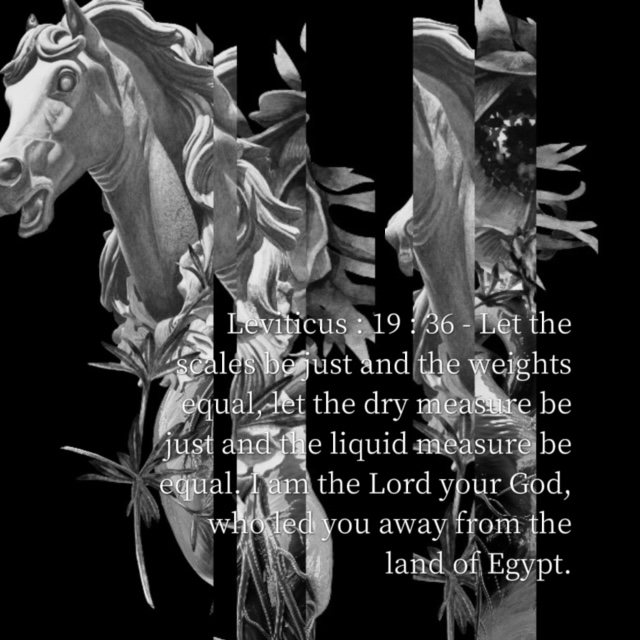
The baptised believer is in the “apostolate of the faithful”, it is said. Spreading the Gospel in society has become a ‘vocation’ in the broadest sense, but in doing so the economy cannot be left out, not only to follow Jesus’ example of saving the poor, but also, as the Lord tells Moses, to ” Let the scales be just and the weights equal, let the dry measure be just and the liquid measure be equal. I am the Lord your God, who led you away from the land of Egypt.” (Leviticus 19:36). It is also important to link this to efforts to create a just society and to tackle poverty and inequality, using economic and other perspectives. The example of developmental disabilities is just one example, but the definition of poverty is becoming more complex as poverty is not only financial poverty but also relative poverty. But we must not be so false as to pretend that we have forgotten, as if faith would resolve everything. It is precisely the suffering that cannot be easily separated from the reward or happiness, nor easily measured or compared, that we must recognize.
If we were to end this criticism without removing the ethical aspect of the criticism, we might be rich and we might be poor. The experience would be different depending on which side of the story you think you are on. Am I poor or am I rich? However, the opposite entity may be the ‘mirror’ that we will eventually become ourselves. For example, we may be successful, but our children may be poor or disabled. We talk about our children as if they will be successful if they go to university, but they may suddenly become disabled. Suppose you now live in a beautiful house, you have acquired many skills and you have worked hard and positively. And you may be proud of yourself for having worked hard without complaining. But that doesn’t mean you can’t criticise people who complain. Because maybe the person who carried or printed the book you studied made it while complaining. There is an invisible ‘poverty and labour’ in this. I separate the words about this for the majority from the words for the few. If someone is in trouble, it may be a matter of friendship to give them a pep talk, but to speak of poverty to the majority is not something that should be done.
Unfortunately, the world is full of such ‘experts’. If you have something to pray about tonight, I hope you will pray with this in mind and think about what you should do.
Let us walk in the footsteps of Jesus, finding our own happiness even in times of adversity.
(Author, original citation to be provided at a later date (after April 2024) due to house moving work.)
*1st Corinthians : 13 : 12: Now we see through a glass darkly. But then we shall see face to face. Now I know in part, but then I shall know, even as I am known.
Joseph Ratzinger, who served as Pope Benedict XVI, passed away on December 31, 2022. Before his death, he published “Jesus of Nazareth,” another significant work. One of the three volumes was released during his papacy, and his commentary will be used to explore the meanings of prayers and how they relate to Leibniz’s concepts of harmonies and monads.
Common denominator.
Leibniz sought harmony amid the conflict between Catholicism and Protestantism.
Benedict XVI aimed to achieve harmony amidst the ongoing conflicts of religion and the ever-evolving nature of society.
Monadology: by Leibniz.
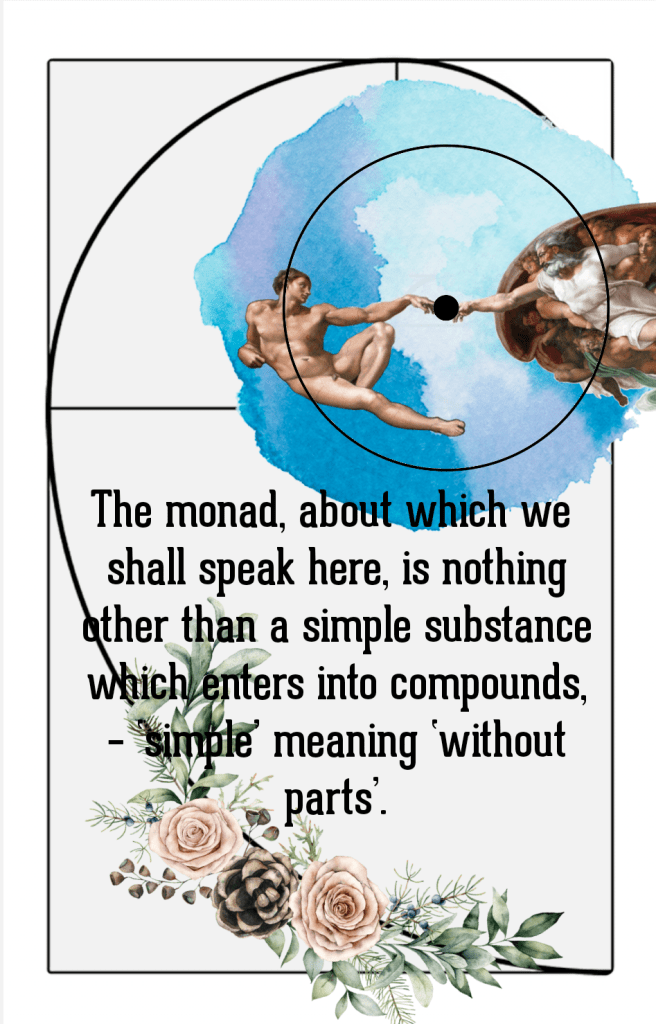
The Monadology, written by Leibniz, consists of 90 chapters but is considered a fragment. The term “monad” is derived from the Greek word “monas” meaning single or one. Living in a time of conflicts between Catholics and Protestants, Leibniz sought to find ultimate harmony in the concept of the unique and singular “One.” A mathematical-geometric point is distinct in its own right, representing an abstract conceptual position rather than an existential one. However, an existential position must encompass the ‘many’ within the ‘one.’ Just like a flock of sheep, individual monads are central to the whole. The center of a circle may be a singular point, yet it contains an infinite number of diameters. The spirit itself exists as a singular entity, yet it embodies an infinity of past, present, and future manifestations. While the spirit may not existentially manifest, it serves to represent and express the multiplicity of existence. The key concepts in Leibniz’s Monadology are “representation” and “expression.”
If the Lord’s Prayer, which I recite daily, allows for both Obedience and Desire, when will my words become sacred? No one can decide that. Prayer has the skyline of the human heart. That is the analogue of human beings, and that is why Descartes’ cogito ergosum is not enough, and there is always me who is not aware of it. The words I chant are more complete than my awareness. That is the language of prayer. The unaware I, the ” small I”, is Leibnizian in its monadic nature. A typical Catholic language of prayer is described as.
Our Father, who art in heaven hallowed be thy name; thy kingdom come; thy will be done on earth as it is in heaven. Give us this day our daily bread and forgive us our trespasses as we forgive those who trespass against us; and lead us not into temptation, but deliver us from evil. Amen.
Prayer is not only directed to God, but also questions the depths of the self. Naturally, we find ourselves constantly questioning who it is that we are praying to, the ‘I’. Many commentaries on prayer say, “Do not pray so that you can be seen in public” (Matthew 6), but for the Japanese, who have a strong sense of syncretism, it is more important to look at the self. Even though there are many desires and selfishness, it is difficult to look at one’s own identity. What the prayer confirms is ‘we’, the community. The Japanese are awakening to what they are as part of that, and to the fact that I, as part of the community, am the only one in the world.
Prayer that is merely sympathetic to a poorly thought-out community is more common today. Leibniz’s famous ‘Monad’ was difficult to serve as an example because it was less familiar than Descartes and modern philosophy. Nevertheless, I decided to write a commentary on the Lord’s Prayer, which he wrote before Benedict XVI (Joseph Ratzinger) returned from serious illness, because it was moving and reminded me of the Monad. Leibniz lived at a time when Catholics and Protestants were in conflict, but Leibniz was a man who thought of a philosophy that would bring harmony, as if preserving an unsolvable mystery.
For a person of belief, God is absolute, and self-consciousness is easily a Cartesian starting point for self-consciousness, whereas for a non-believer, it begins with convictions. Faith is spiritual and does not require a basis. However, it does not mean living a meaningless life. Beliefs and the faith of others do not have a window and do not intersect. But it is flexible, like the soul.
Leibniz discovered microorganisms under the microscope that were invisible to the naked eye, revealing the presence of life in animals and plants, as well as a universe yet unknown. Descartes emphasized the significance of ‘thinking’ as a fundamental aspect of consciousness, whereas in Leibniz’s philosophy, ‘expression’ and ‘representation’ are considered essential actions. Catholic prayer, by nature, focuses on conscious, human-centered prayer. However, the concept that phenomena are not merely ‘appearances’ (Schein) and that the action of the spirit is not an entity, but rather a ‘subject’, serves as a foundational principle in German idealism. Prayer’s essence lies not in mere appearance but in expression, encapsulating a singular point representing the infinity of myriad dimensions that lead back to God at the center. (This perspective contrasts with the conventional image of God and man as perpendicular to heaven and earth; rather, it is likened to a circle with God at the core.)
ⅠOur Father,who art in heaven
――This discretion, which is of the very essence of prayer, does not exclude prayer in common. The Our Father is itself a prayer uttered in the first person plural, and it is only by becoming part of the “we” of God’s children that we can reach up to him beyond the limits of this world in the first place. And yet this “we” awakens the inmost core of the person; in the act of prayer the totally personal and the communal must always pervade each other, as we will see more closely in our exposition of the Our Father. Benedict XVI, Pope . Jesus of Nazareth (p.129). The Crown Publishing Group. Kindle 版.――
How strongly can we be aware of the word Father, we cannot basically see him with the naked eye. In theology, the Lord Father is the root of all good things and the measure of a righteous (perfect) man. ‘But I tell you, love your enemies and pray for those who persecute you, that you may be children of your Father in heaven. He causes his sun to rise on the evil and the good, and sends rain on the righteous and the unrighteous. ” (Matthew 5.44 and following)
This love that loves “to the extreme” (John 13) is fulfilled in the Lord’s prayer for his enemies on the cross, and shows the essence of the Father. The Father is this love. Jesus fulfilled this love, making him fully ‘the Son’. The original of this prayer is part of the Sermon on the Mount in Matthew 6. (Luke: 6)
It is a comprehensive statement of the right human way of being. Nevertheless, John Paul II wrote something interesting on this question of why God is not manifested before us.
From one point of view it is right to say that God revealed too much of Himself to man, too much of that which is most divine, that which is His intimate life; He revealed Himself in His Mystery. He was not mindful of the fact that such an unveiling would in a certain way obscure Him in the eyes of man, because man is not capable of withstanding an excess of the Mystery. Paul II, Pope John. Crossing the Threshold of Hope (p.37). Knopf Doubleday Publishing Group. Kindle 版.
‟Reasons certainly do exist to believe in Him; but—as many have maintained and still maintain—there are also reasons to doubt, or even deny, His existence” So, John Paul II is also quoted here in Descartes’ ‘I think, therefore I am’.‟ It states that this sprouted from the philosophy of rationalism on a different soil from Thomas Aquinas and St Thomas.” No different from St Thomas who said “for whom it is not thought which determines existence, but existence, “esse” which determines thought”.Jesus was executed because he publicly declared that he was the Son of God. That was fair in terms of the legislation at the time. John Paul II did not hide the fact that getting too close to the mystery brings tragedy to human beings, one aspect of which he did not hide.
There is deduction and induction, but Leibniz tried to develop from simple truths by deduction. In principle, ‘Our Father’ is absolute, so there is no hypothesis. Therefore, the basis of theology is deduction. Leibniz’s rationalism developed by deduction was opposed, among other things, to empiricism. If it were derived from experience, religious rituals would not proceed, since it is a philosophy about God, from which it was not removed. He took the further position that certain perceptions were innate and derived from evidential principles.
The novel Sophie’s World tells an interesting story. A non-religious astronaut bragged that he had seen space many times but there was no God. A Christian doctor said. I have had many brain operations but no ‘thoughts’. Sophie replies. ‘But the soul cannot even be divided into two.
Thoughts are quite different from things that can be chopped up into smaller pieces, and delusions cannot be surgically removed. Leibniz said that the difference between what is made of matter and everything that emanates from the spirit is that material things can be divided into smaller parts to any extent. The soul, however, cannot be cut into there are two sides of God’s Fatherhood. The Gospels confirm that God being Father has two aspects. God is our Creator and our Father. Since he created us, we belong to God. As existence itself, it is the essence of the biblical picture of man that God created each and every human being. But what does it mean to accept this? If we try to convince ourselves of this only through ontology and empiricism, we can only create a polarisation of believing and not believing. Naturally, many people today will not believe.
>Thinking as a monad.
Humans are made up of a heart and a brain, but simply piecing them together does not create an ‘I’. So too is God, and God is not made by combining only the languages described by the various Bibles. It is fair to say that this is where the difficulty of proselytising lies. It is that causality alone is difficult for them to understand and even to exist. The empiricist Hume did not believe in the existence of angels, so he told them to burn their theology books. Leibniz was adamant about that one point, ‘God’, which cannot be spoken of by experience alone.
Monads always exist separately, independently and without windows. No matter how often a prayer is explained, there is no fixed point where the goal is. This is because it inevitably requires experience. Explanations are merely to help with feelings, but the language of prayer always exists apart from experience. Its culmination is ‘Our Father’.
While it is possible to consider prayer only in its literal meaning, some people try to understand the details of the word by tracing it back to its etymology. They assume that all the time spent praying is worthwhile, even though their understanding is incomplete. The language of prayer emphasises what kind of people we should be and that we should be irreverent with ‘us’ rather than a heightened ‘ego’.
There is a part of us that is me. The I is inherent in us.
(I do not subscribe to any teaching that causes the loss of the ‘I’. I dislike and strongly reject such religious people)
Monadology is predicate-dominant, with the subject containing the predicate. It is the predicate that is important to God, for example, ‘God is love’. God is not prominently illuminated only by being God. We should not follow for that reason alone. We must focus on the predicate of what God is. The words of the prayer do not relegate God the Father to a star somewhere far away, but that He comes from the One Father, who is the measure and source of the Father. That God is the Father has a greater reality than all earthly fathers have.
we are testifying to the fact that, while we have different earthly fathers, we all come from one single Father,……
God’s fatherhood is more real than human fatherhood, because he is the ultimate source of our being; because he has thought and willed us from all eternity; because he gives us our true paternal home, which is eternal. And if earthly fatherhood divides, heavenly fatherhood unites. Heaven, then, means that other divine summit from which we all come and to which we are all meant to return.
Benedict XVI, Pope . Jesus of Nazareth (pp.141-142). The Crown Publishing Group. Kindle 版.
-In order to distinguish between the action of God and the action of the creature, it is necessary to clarify what the concept of an individual entity (1) is (Metaphysical Narrative, 8) Description of predicate superiority
The changeable state which grasps and represents a multiplicity in one or the other is nothing other than what is called sensation or perception, which is to be distinguished from apperception or consciousness, as will be seen in what follows.(Monadologie v14)
And the action or activity of the inner principle that causes the change or progress from one perception to another can be called desire.(Monadologie v15)
And one creature is more perfect than another / in so far as one perceives in it / something from which one can deduce a priori the reason for what occurs in another thing; and by this one says / that it grows into another creature.(Monadologie v51)
Ⅱ hallowed be thy name
God named his existence in Exodus 3:14, “I am the one who says, ‘I am'”. There were many gods in the time of Moses in the Ten Commandments, “Thou shalt not defile the name of God”. Therefore, Moses asked God for his name in order to demonstrate God’s special authority over those gods. In the world’s view of ‘polytheism’, God has a name. God must answer as long as he is asked. The god who spoke to Moses also had to have a name.
God could not enter the world of the gods with a name as one of them. God’s answer, “I am the one who says, ‘I am’,” expresses both agreement and rejection of Moses’ question. It is therefore correct that the name of God as presented in JHWH should not be pronounced in Israel. God’s name must not be downgraded to polytheism. That leaves the question of what God’s judgement is the Name. Names enable us to call out, but do not indicate our true nature. Adam in Genesis gave the animals names in order to call them. God also made it possible for humans to be called, and then accepted to be hurt. This makes it clear what is meant by the words of the prayer, “HALLOWED BE THY NAME”
We can cling to God in our daily lives some days and forget others. Including such lowered routines, we pray that God will be raised up with ‘HALLOWED BE THY NAME’. God’s answer to the name deserves, in monadology, to be ‘revealed’. The hidden presence of God has been revealed. It must not be a temporary representation. The name of God is not decomposed, (Monadology, v. 4) and the one who prays is doomed to neither generation nor end by God, but to perish by extinction. (ibid., v. 6) The praying side exists with a nature. Each nature must be different. (Ibid., v. 6) Each nature must be different from the other, for what happens in the composite always comes from a single element. But the praying side cannot distinguish between souls. In the single ‘God’. (ibid., v. 8) the principle of sufficient reason, why A is A and not other than A, is sufficiently fulfilled. It also follows that no proposition is just. (ibid., v. 32) While it is done only by the principle of memory, it is the same as the beast (ibid., v. 28) Today, even if it is a day of unenlightenment, experiencing and remembering are not the only means. When we pray on this day, we are praying to “God”, “the Father, the Lord”, whose presence demands the elevation of human holiness.
his plea, of course, is always an occasion for us to examine our consciences seriously. How do I treat God’s holy name?……Do I stand in reverence before the mystery of the burning bush, before his incomprehensible closeness, even to the point of his presence in the Eucharist, where he truly gives himself entirely into our hands? Do I take care that God’s holy companionship with us will draw us up into his purity and sanctity, instead of dragging him down into the filth? Benedict XVI, Pope . Jesus of Nazareth (pp.144-145). The Crown Publishing Group. Kindle 版.
Ⅲ Thy kingdom come
This passage is often misunderstood even by clergy, but even Benedict XVI did not say here that wishing for God’s kingdom will promise a paradise. If anyone, even believers, speaks of religion making them happy, they are not studying hard enough. The life of faith is not a simple matter of abandoning something and automatically moving up in status. The Kingdom of God is the rule of God, which means that God’s will is the standard for everything.
This divine will makes justice, and divine justice should be the measure of human justice. ‘But seek first his kingdom and his righteousness, and all these things will be given to you as well.” (Matthew 6:33) These words give order of priority to all human conduct, to our behaviour in everyday life. Then everything else will be given to you” (Matthew 6:33) These words give order of priority to all human conduct, to our behaviour in everyday life. In the Old Testament, there is this story. The Lord appeared to the young king in a dream and told him to wish for whatever he liked, because he would listen to any wish. Solomon told the people to be able to judge between good and evil. God commended Solomon because he did not choose ego, but asked for what was essential. ‘May the kingdom come’ is ruled by the Lord, but to have a listening and discerning heart, that is the essential desire. He prays for the dispersed and separated humanity to judge good and evil, so that in time it will become one.
The soul is given the function by memory to seek connections between memories. This function is similar to, but distinct from, reason. It can be compared to an animal: a dog that has been hit with a stick will run away the next time (Monadology, xxvi), but humans contain contradictions and do not choose solely on the basis of causality. Humans take even God’s treatment as a trial. Like Job and Jeremiah. Even if the scene in front of them is peaceful, there is war and misery in the land of the invisible. Or perhaps he is unhappy himself. It is important to be fulfilled like the kingdom of heaven and to vow to pass justice for it. Do not pray while you sleep that when you wake up the world will have been a heavenly kingdom. To choose righteousness every day. That is what we chant. This conformity with the only one, the hope for conformity because it cannot be fulfilled, the impulse behind the rational language, the power to seek the mystery is contained in its contradiction, but I think it is pure (cf. Ibid., pp. 49-62).
The encounter with Christ makes this petition even deeper and more concrete……
By the same token, the request for a listening heart becomes a request for communion with Jesus Christ, the petition that we increasingly become “one” with him (Gal 3:28). What is requested in this petition is the true following of Christ, which becomes communion with him and makes us one body with him.
Benedict XVI, Pope . Jesus of Nazareth (pp.146-147). The Crown Publishing Group. Kindle 版.
Ⅵ The will be done on earth as it is in Heaven
Two things are immediately clear from the words of this petition: God has a will with and for us and it must become the measure of our willing and being; and the essence of “heaven” is that it is where God’s will is unswervingly done.
Benedict XVI, Pope . Jesus of Nazareth (p.147). The Crown Publishing Group. Kindle 版.
Numerous holy books assume that man knows the will of God in his heart, that the knowledge of God, called conscience, is deeply rooted in the heart. In Matthew 26:36-46, Jesus came to Gethsemane with his disciples and said, ‘Sit here while I go over there and pray’. He was accompanied by Peter’s and the two sons of Zebedee, who were sorrowful at that time. Jesus prayed thus, saying. ‘Father, if it is possible, let this cup pass from me. But not according to my wish, but according to your will” In this case, the cup is the cross, and Jesus was grieved that he would be killed by this wrong judgement. Therefore, he asked God’s will, not my wish. But God did not answer as Solomon did. This ‘not according to my wish but according to His will’ is taken up by Thomas Aquinas. Jesus then turns to a story about a traitor trying to kill him, and that is how we learn the will of God with Jesus. And it is hoped that this means that even our self-love is defeated.
Aristotle held that the perfect reality is entelecheia. Leibniz states that entelecheia always has an order. (Monadology, v. 63) In simple terms, it is a plant. The plant repeats itself according to the same laws and with the same number of petals. Leibniz’s monadology deals mainly with God’s creation in verses 62 to 66. And with regard to the subsequent verses 67 to 80, it refers to what cannot be explained by order as preestablished harmony. Although this is objectionable, a preestablished harmony is a law that can’t be unravelled. No matter how abstractly and infinitely one speaks of philosophy and theology, even if prime factors are given and finer numbers are given, as in prime factorisation, they do not exceed the original natural number. For example, if we do a prime factorisation of the natural number 60, we get 2 x 2 x 3 x 5 = 60. (Only 13 is a prime factor, so the prime factorisation is 13.) However, God can be likened to the prime number ‘1’ and the natural numbers that are bracketed as prime factors are us, but as long as God is the solution, it is a mystery until we experience the solution. Prime factors are only one expression. And even if the vague view is a scheduled harmony, it is not causal or easy to understand. What God has prepared will never exceed the size of creation, no matter how much it is dismantled and divided by man. Yet the magnitude is unimaginable. To live in this world is The only clues to the mystery left by Jesus were ‘love’ and ‘justice’. It must bring the wounded closer to the ability to notice them, to reach out to them and to help them. Otherwise the kingdom of God will not come.
The gravitational pull of our own will constantly draws us away from God’s will and turns us into mere “earth.” But he accepts us, he draws us up to himself, into himself, and in communion with him we too learn God’s will.
Benedict XVI, Pope . Jesus of Nazareth (p.150). The Crown Publishing Group. Kindle 版.
Ⅴ Give us this day our daily bread and forgive us
This passage is the most ‘human’ petition in the Lord’s Prayer. To the disciples, the Lord says, “Before I tell you, do not worry about your life, what you will eat or drink; or about your body, what you will wear” (Matt. 6:25), and the mission of the people is to food The mission of the people was to pray about their worries about food. Bread is the bounty of the earth, the fruit of labour. This is opposed to the arrogance of the people, who say that they realise the fertility by their own strength alone. Give us daily bread”, the Greek word for ‘daily’ is EPIOUSIOS, which can be translated in two ways. One is ‘the bread we barely need to live’ and the other is ‘the bread of the future’.
It also signifies the bread of the eschatological end. Bread is purely edible. It is difficult to realise for rice staples, but the staple food is necessary for the survival of life, and it is important in daily life that this is available. That bread, that thing, is to be the Logos. From there it becomes religious.
‘Jesus answered, “It is written: ‘Man shall not live on bread alone, but on every word that comes from the mouth of God” (Matthew 4:4) The bread increased by miracles reminds us of the miracle and shows that the original food of man is the Logos, the eternal Word of God. The eternal Logos becomes the bread of reality for man. It corresponds to the food presented to the Israelites by Moses as a gift of God. What would happen if we were to speak of it as a philosophy? The bread that the poor wish for is a mystery that wishes for the necessities of the day, so resolution is not require.
If we dare to speak of the lack of the rule of reason, bearing in mind that this is the first condition, we begin with an account of ‘Buridan’s donkey’ (Buridan’s ass). Buridan the donkey has found a bundle of straw, his favourite food. However, Buridan also noticed another bundle of straw that he could see looking back. The donkey was clever enough to wonder which one he was going to eat. So Buridan couldn’t decide and starved to death. This is similar to the foolish consequence of starving to death because one is wise and rational, and to the fact that one should not look for a philosophical basis, doxa, in the bread of communion. This Buridan is said to be a French philosopher, but the actual source is unknown. Leibniz, however, gives it in a parable in his theodicy.
The donkey that starved to death is foolish, but because of its foolishness, a principle emerges. When food and sacredness coincide, it means that everything loses its meaning if it is not simply accepted as daily sustenance.
Every time we pray daily, “GIVE US THIS DAY OUR DAILY BREAD”, both the “I” who understands the meaning and the “I” who does not try to understand are uniqueness, but the relationship with God to the spirit is not simply that of inventor and machine, but like that of father and son. (Monadology, v. 84) Communion is contradicted as superstition for those without faith and absoluteness for those with faith. Tabula rasa (blank slate) exists in contradiction to eternal truth. However, feeding the poor would be in agreement with both. It is important to pray that the sustenance for the poor and our own sustenance will continue into the future, to our children and to the poor, so that holiness and life will not cease without separation.
He says: We who are privileged to receive the Eucharist as our bread must nevertheless always pray that none of us be permanently cut off and severed from the body of Christ.
Benedict XVI, Pope . Jesus of Nazareth (pp.156-157). The Crown Publishing Group. Kindle 版.
Ⅵ our trespasses as we forgive those who trespass against us
Leibniz’s ‘theodicy’ addressed the differences between Protestants and Catholics. For example, he wrote not only about the conflict between Protestants and Catholics, but also about the conflict between Protestants with regard to the above-mentioned ‘bread’. In Japan, Luther is the most famous Protestant, but Friedrich Zwingli (Zwingli), who also opposed Luther, did not accept sacramentalism. He regarded the participation of Jesus Christ in the Lord’s Supper as a mere figurative expression, and in doing so made use of the philosophical principle that the body can only exist in one place at all times. Luther, on the other hand, is more faithful to the literal sense of the Bible, making it real, including supernatural mysteries. In their opinion, they rejected the doctrine of Transsubstantiation (Total Transubstantiation – the transformation of the bread and wine of the sacrament (Seisan) into the flesh and blood of Christ) rather than that arising from the biblical expression and rejected Konsubstantiatio ( consubstantiatio – Christ coexists with the bread and wine) dogma and the bread, and held these things ignorant.
Although it did not require a union of the two, they were not merely logical, but also important in fulfilling Christ’s final wish. Through faith justification, they chose to maintain the everlasting presence of the Messiah’s body. In modern times, the conflict between Catholics and Protestants goes without saying, but even in Catholicism, the desire to hear the Lord’s petition remains the same. The fifth petition of the Lord’s Prayer presupposes a world of indebtedness, i.e. sin. The theme of forgiveness runs through all the Gospels, with the story of the ‘retainer who would not forgive his fellow man’ in Matthew 18. The man, a high-ranking deputy, had begged the king to forgive him a high debt, but shortly afterwards he blackmailed his fellow strangers into forgiving him a small differential debt. His swearing came to the ears of the king, who forgave him from other retainers, and he had his remission revoked. The king is a parable of the divine father, but the story does not end there.
――In chapter 23 of Luke’s Gospel, two other sinners were to be executed besides Jesus at his crucifixion.
One of the sinners cursed Jesus right up to his death, saying, “If you are the Messiah, prove it by saving yourself”. The other sinner, on the other hand, defended Jesus. Despite being in the same situation, he humbly said to Jesus, “Jesus, remember me when you come into your kingdom”. Jesus said to such a sinner. ‘“Truly I tell you, today you will be with me in paradise’.
The sinner was loved by Jesus just before his execution. Regarding Leibniz’s principle of indistinguishable = identical, Jesus and the sinner are separate entities, even though they are at the same place of execution. Separate and uncrossing clocks of destiny exist for each, but they are bonded by ‘forgiveness’. Christians say that Jesus came down to earth, the cross, whereas crucifixion is raised high for the sinner to be exposed. We know that two people with different vectors can be bonded ‘on the spot’. Unlike the cursed sinner, it is through ‘forgiveness’ that the bond is achieved. ‘Forgiveness’ is, I believe, the beautiful point of contact between Leibnizian philosophy and Catholic theology. The sinner’s turn towards good is an invisible generative change. The prayer, ‘Forgiving Evil’, is the constant wish for a change to goodness over today’s evil intentions. It contains the ‘we’, the I.
Self-awareness does not come from collectivity. The collective enjoyed executions in a state of spectatorship. Community is not a dysfunctional situation where love and justice are in sync. The ‘justice’ awakened by the sinner just before death is love for Jesus. I hope for a world in which it is pervasive, and I use it as a prayer to inspire me.
If we want to understand the petition fully and make it our own, we must go one step further and ask: What is forgiveness, really? What happens when forgiveness takes place? Guilt is a reality,……For this reason, forgiveness must be more than a matter of ignoring, of merely trying to forget. Guilt must be worked through, healed, and thus overcome. Forgiveness exacts a price—first of all from the person who forgives. Benedict XVI, Pope . Jesus of Nazareth (p.158). The Crown Publishing Group. Kindle 版.
Ⅶ and lead us not into temptation
If we are to use the language of Leibniz’s ‘theodicy’, philosophy has ensured that the meaning of words needs to be developed so that mysteries do not become empty words. Throughout the long history of the world, as long as there are words, they are disproved by inference. Once we are tempted by the theory of probability to pray correctly and find that phenomena are connected to each other, we are driven by the assumption that they are always connected. ‘Temptation’ is a stumbling block for people, including human immorality, but who is the one who tempts and leads? Temptation is certainly the devil, but there is also an interesting passage in Jeremiah 20:7.
Jeremiah20:7 Du hast mich verführt, Herr, und ich habe mich verführen lassen; du hast mich gepackt und mir Gewalt angetan. Nun spotten sie immerzu über mich, alle lachen mich aus. Denn sooft ich in deinem Auftrag rede, muss ich Unrecht anprangern. »Verbrechen!«, muss ich rufen, »Unterdrückung!« Und das bringt mir nichts als Spott und Hohn ein, Tag für Tag.
‘Lord, you have enticed me’, which was repeatedly called out in the film Die grosse Stille (The Great Silence), giving rise to questions. In Japanese it is translated in different words, but in the German version of the country of production it is verführt (enticed) The young Jeremiah was made a prophet by the Lord. But because he was righteous, he was estranged from the people. This is more evident in the German version, Tag für Tag and it is repeated ‘day in and day out’, but the constant cries of injustice, ridicule and scorn disgusted him.
It is easier to live when you do what the masses tell you to do. That is why he lamented what God gave him as ‘temptation’. Benedict XVI used the analogy with Job, but this time I have brought out Jeremiah. It is Christian to say that temptation is the devil, but in reality the devil is more incomprehensible than God.
There is scripture in the deeds of God. Even from a philosophical perspective, despite the contradiction between eternal truth and the psychology of chance, God has a fixed point, but existence with regard to Satan does not exist as eternal truth, only as chance. Simone Weil’s ‘Creation. Good is shattered and scattered to evil” would be exactly that. It means that God’s deeds had an original form and were shattered, but the Satan’s are not. The Bible reading allows people to recognise God as common, but as for Satan, it is a coincidence of each. Light does not solve everything. Because, as in John 1, darkness avoids light without understanding it. Jeremiah was chosen by God, but he shouted because he could no longer bear the malice of the people.
In the New Testament, 1 Corinthians chapter 10 says that God doesn’t give us trials we can’t endure. This is a well-known passage even in the non-religious world, but there is a continuation to this, but we are rarely told the rest of the story. Therefore, it is misunderstood as a ‘never-give-up spirit’.
It is a continuation of this: ‘It provides a way out in times of temptation and enables us to withstand temptation’.
Regarding this item, although Benedict XVI was an excellent commentary on the story of Benedict XVI, I judge that it does not extend to practice if I am honest, including the Catholic clergy issue. Therefore, I will end by adding Simone Weil, which I have adopted in my own way. ‘To love the truth means to hold on to the vacuum and consequently to accept death. It is not difficult to imagine such idealism, although it is unclear whether there is such a thing as immunity to temptation. How can we avoid being misguided by collectivity, like a school of fish, including the mistakes of one individual?
Temptation – from what do we protect ourselves, this is a ‘mystery’ but not a ‘mystery’ to leave behind. Loving the truth, by which the soul is likely to turn to good, but still one sins. Truth is not to be kept alive simply by explaining it. If the path leading to truth is cut off, it is tantamount to death. Philosophical rationality that does not leave mysteries unexplained, that looks to mysteries that cannot be solved, this section is not particularly altruistic, rather it is self-reliant. It is an exhortation to the mind of the self, not to the outside world. ‘Awareness’ is a prayer that must not be turned away from, as in the Leibnizian philosophy, which has made it a ‘reflection’ on oneself.
we pray, “And lead us not into temptation,” we are expressing our awareness “that the enemy can do nothing against us unless God has allowed it beforehand, so that our fear, our devotion and our worship may be directed to God—(p163)
When we pray the sixth petition of the Our Father, we must therefore, on one hand, be ready to take upon ourselves the burden of trials that is meted out to us. On the other hand, the object of the petition is to ask God not to mete out more than we can bear, not to let us slip from his hands. We make this prayer in the trustful certainty that Saint Paul has articulated for us: “God is faithful, and he will not let you be tempted beyond your strength, but with the temptation will also provide the way of escape, that you may be able to endure it” (1 Cor 10:13).
Benedict XVI, Pope . Jesus of Nazareth (p.163.164). The Crown Publishing Group. Kindle 版.
Ⅷ but deliver us from evil.
The last petition of the Our Father takes up the previous one again and gives it a positive twist.
Benedict XVI, Pope . Jesus of Nazareth (p.164). The Crown Publishing Group. Kindle 版.
Many people may not even understand Leibniz’s monadology in terms of the soul having no windows. The explanation of monadology itself is straightforward but difficult to understand. It is much like the language of prayer. If you read theodicy, you will be exposed to Leibniz’s view of religion and the meaning of the monad will be more profound, but the monadology is disconnected. ‘theodicy’ and other books are only what he calls experience, accidental truths, but he wanted monadology to be an adjunct to eternal truths. I think it was to adapt it to any age, as it applies to today.
The words of the Lord’s Prayer are simple and can be taken verbatim. It contains the basis of modern morality. As for theology, it seems to be decided what evil is meant here. It seems to mean political evil, scepticism and save us from the evil that ensnares Christians. However, it makes sense to me that the words of the prayer itself do not specify the ‘forces of evil’ or the ‘evil one’. In Greek philosophy, faith was equated with doxa (speculation), which was lower than knowledge. Ancient Greek sexual life was unique, and love between men was considered to be the real thing. Women were only child bearers, and even if a woman had both knowledge and beauty, her status was not superior to that of a man. My writing in this way was, in ancient times, ‘evil’. Evil is subject to current trends.
In reality evil is not always as symbolic as the dragon of the Apocalypse. It is important to rationalise for once that Jesus Christ was not falsely executed. That was the law back then, not false accusations. Plants are determined to repeat themselves with regularity in the number of petals and leaves, but no two flowers are the same. The law also has existed since ancient times that one must not commit murder, but it is not exactly the same as it was in ancient times. The words of the prayer also return to the third time with these words: ‘THY KINGDOM COME’. But this is not a simple repetition. We cannot know the words in the Bible or the truths we have learned, even if we scrape them together. But as we learn more and more, we come to know Jeremiah and many other sufferings and absurdities. We must pray that our desire is not more superficial.
Last: Division does not keep simple love alive.
This time, during Benedict XVI’s critical condition, he bought the remaining copy of a three-volume book called Jesus of Nazareth, which contained a commentary on the Lord’s Prayer. While I was reading it, he died on 31 December 2022. My only impression was this. ‘The Bible says that God calls each of us by a name that no one else knows’ (Revelation 2:17), he was quoted as saying, and just as I was reading that passage I came across the news of his death. I started out only wanting to write down my one word impression, “Did God call him a name that a man as wise as he was did not know? :This is the monad that is impossible to know by memory. I only knew him in books, but I liked books. Maybe that is only part of what makes him up, but I am grateful that he left us books. I loved his books. He wrote seven petitions from the Gospel of Matthew. Three are prayers that call out to ‘you’, four are wishes for ‘us’ and the remaining four are wishes about hope, desire and need.
Having used monadology for simple romance was a consideration due to the unresolved Catholic scandals. Therefore, I could not write the mystery as simply wonderful. There is no fear of criticism from those around me now. Indeed, holiness is truth. However, experience inhibits words of truth when they are ‘hypocritical’. Words distorted by it stink. Just as Benedict XVI himself built a new theology for the harmony of the world’s divisions, so did Leibniz, who saw the corruption and strife in the clergy. What he should have simply looked at God alone, he tried to look at man. What to do with ugly human beings, what to do with precious human beings, what to do with the enigmatic ‘monad’ that neither enhances nor diminishes their value. That act and my current state of mind overlap.
Love simply cannot live in a divided world. It is as easy as possible to say that even injustice is love. Love must live in contradiction with justice. Contradictions, when tamed, are a cradle of stability. Don’t be the kind of person who can sleep peacefully, turning away from those who are suffering in front of you, Leibniz said. ‘We are left with micronised considerations, all the way down to ‘desires’ that we are not even consciously conscious about. ‘Deliver us from evil, that we may always be aware, and that someone in need may be saved.’ Rest to those who are suffering, and may the day when we are released from our burdens, the day when we are called by a name that only God knows, not be a day of sorrow. On that day, may we keep awake to the fact that it is a joyous day.
Amen.
Reference
G.W Leibniz
Monadologie Racle, -German.
Discours de métaphysique.
Versuche in der Theodicée über die Güte Gottes, die Freiheit des Menschen und den Ursprung des Übels: Philosophische Werke Band 4 (Philosophische Bibliothek 499) (German Edition)
Was das Begreifen anlangt, so pflichte ich ihm hierin bei, habe aber schon gezeigt, daß die Mysterien eine Entwicklung des Wortsinnes erheischen, um nicht sine mente soni, leere Worte zu sein: und ich habe auch gezeigt, wie notwendig es ist, auf Einwürfe antworten zu können, da andernfalls die These verworfen werden müßte. Er zitiert theologische
. Er zitiert theologische Autoritäten, welche die Unauflöslichkeit der gegen die Mysterien gerichteten Einwände anzuerkennen scheinen. Einer der ersten ist Luther. Ich habe schon im S 12
sowenig wie die Träume. Wir täuschen uns selbst durch den Gebrauch, den wir davon machen, d. h. durch unsere Folgerungen. Wir lassen uns eben durch Wahrscheinlichkeitsargumente verführen und dadurch werden wir zu der Annahme getrieben, so wie wir die Phänomene oft miteinander verbunden gefunden haben, so müßten sie immer verbunden sein. Da nun alles, was keine Ecken zu haben scheint, für gewöhnlich auch wirklich keine hat, glauben wir leicht, es müßte sich immer so verhalten. Ein solcher Irrtum ist verzeihlich und zuweilen unvermeidlich, wenn wir rasch handeln und das Wahrscheinlichste wählen müssen; haben wir aber Muße und Zeit zur Sammlung, so begehen wir einen Fehler, wenn wir das als sicher hinstellen, was dies gar nicht ist. Die sinnliche Erscheinung befindet sich also oft mit der Wahrheit im Widerspruch, aber unser Urteilsvermögen niemals, wenn es genau den Denkgesetzen gemäß gebraucht wird. Versteht man unter Vernunft ganz allgemein die Fähigkeit, schlecht und recht zu räsonieren, dann gebe ich zu, sie vermag uns zu täuschen und täuscht uns auch wirklich, und zwar sind die Erscheinungen unseres Verstandes ebenso oft täuschend wie die der Sinne: aber es handelt sich hier um die Verkettung der Wahrheiten und um Einwürfe in schulgerechter Form, und in diesem Sinne kann uns die Vernunft unmöglich täuschen.
Dort spendet Gott Gnade und Erbarmen den Unwürdigen; hier spendet er Zorn und Strenge denen, die sie nicht verdient haben; an beiden Stellen zu heftig und unbillig mit Bezug auf die Menschen, aber gerecht und wahrhaft mit Bezug auf sich selbst.
Denn wie das gerecht sein soll, daß er Unwürdige krönt, ist jetzt zwar unbegreiflich, aber wir werden es erkennen, wenn wir dorthin kommen, wo man nicht mehr glauben, sondern das Offenbarte mit eignen Augen schauen wird. Wie es daher gerecht sein soll, daß er die verdammt, welche es nicht verdienen, muß solange geglaubt werden, bis es der Menschensohn uns offenbaren wird.
エレミヤ書20:7(ドイツ語)Du hast mich verführt, Herr, und ich habe mich verführen lassen; du hast mich gepackt und mir Gewalt angetan. Nun spotten sie immerzu über mich, alle lachen mich aus. Denn sooft ich in deinem Auftrag rede, muss ich Unrecht anprangern. »Verbrechen!«, muss ich rufen, »Unterdrückung!« Und das bringt mir nichts als Spott und Hohn ein, Tag für Tag.
「主よ、あなたが私を誘惑した」というところだが、これは映画「大いなる沈黙」(Die grosse Stille)で何度も連呼され疑問を招いた箇所である。日本語では別の言葉で翻訳されているが、制作国のドイツ語版ではverführtと誘惑となっている。若きエレミアは主から預言者とされた。しかし、彼は正しいがゆえに人々から疎まれた。ドイツ語版ではそれがより顕著に表れている。Tag für Tagと、それは「毎日毎日」と繰り返しているが、不正と叫び続け嘲笑と軽蔑され続け、彼はうんざりした。
Versuche in der Theodicée über die Güte Gottes, die Freiheit des Menschen und den Ursprung des Übels: Philosophische Werke Band 4 (Philosophische Bibliothek 499) (German Edition)
Was das Begreifen anlangt, so pflichte ich ihm hierin bei, habe aber schon gezeigt, daß die Mysterien eine Entwicklung des Wortsinnes erheischen, um nicht sine mente soni, leere Worte zu sein: und ich habe auch gezeigt, wie notwendig es ist, auf Einwürfe antworten zu können, da andernfalls die These verworfen werden müßte. Er zitiert theologische
. Er zitiert theologische Autoritäten, welche die Unauflöslichkeit der gegen die Mysterien gerichteten Einwände anzuerkennen scheinen. Einer der ersten ist Luther. Ich habe schon im S 12
sowenig wie die Träume. Wir täuschen uns selbst durch den Gebrauch, den wir davon machen, d. h. durch unsere Folgerungen. Wir lassen uns eben durch Wahrscheinlichkeitsargumente verführen und dadurch werden wir zu der Annahme getrieben, so wie wir die Phänomene oft miteinander verbunden gefunden haben, so müßten sie immer verbunden sein. Da nun alles, was keine Ecken zu haben scheint, für gewöhnlich auch wirklich keine hat, glauben wir leicht, es müßte sich immer so verhalten. Ein solcher Irrtum ist verzeihlich und zuweilen unvermeidlich, wenn wir rasch handeln und das Wahrscheinlichste wählen müssen; haben wir aber Muße und Zeit zur Sammlung, so begehen wir einen Fehler, wenn wir das als sicher hinstellen, was dies gar nicht ist. Die sinnliche Erscheinung befindet sich also oft mit der Wahrheit im Widerspruch, aber unser Urteilsvermögen niemals, wenn es genau den Denkgesetzen gemäß gebraucht wird. Versteht man unter Vernunft ganz allgemein die Fähigkeit, schlecht und recht zu räsonieren, dann gebe ich zu, sie vermag uns zu täuschen und täuscht uns auch wirklich, und zwar sind die Erscheinungen unseres Verstandes ebenso oft täuschend wie die der Sinne: aber es handelt sich hier um die Verkettung der Wahrheiten und um Einwürfe in schulgerechter Form, und in diesem Sinne kann uns die Vernunft unmöglich täuschen.
Dort spendet Gott Gnade und Erbarmen den Unwürdigen; hier spendet er Zorn und Strenge denen, die sie nicht verdient haben; an beiden Stellen zu heftig und unbillig mit Bezug auf die Menschen, aber gerecht und wahrhaft mit Bezug auf sich selbst.
Denn wie das gerecht sein soll, daß er Unwürdige krönt, ist jetzt zwar unbegreiflich, aber wir werden es erkennen, wenn wir dorthin kommen, wo man nicht mehr glauben, sondern das Offenbarte mit eignen Augen schauen wird. Wie es daher gerecht sein soll, daß er die verdammt, welche es nicht verdienen, muß solange geglaubt werden, bis es der Menschensohn uns offenbaren wird.
ツバメが他のツバメよりも6週間も遅れたのは、ツバメは恋をしていたからだ。相手はReed(葦)でした。Shall I love you(君のことを好きになってもいいかい?)と始まった恋、彼女はうんと頷きました。一緒に遠くへ行かないか、というと彼女は首を横に振りました。風と浮気性の彼女、ツバメは彼女に別れを告げて旅立ちました。金の銅像の王子は生まれ変わる前は天使のような存在でした。塀の外を知らない王子は、幸福のまま死にました。彼は「幸福の王子」と呼ばれ、銅像になった。塀の外を知った王子は世の貧しさと卑しさに絶望していました。王子は貧しい人達に自分を飾り立てている宝石や金をツバメに運んでもらいました。











 Chris Kyogetu