
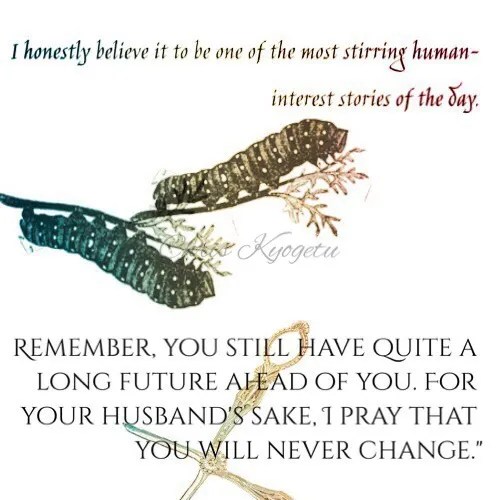
I honestly believe it to be one of the most stirring human-interest stories of the day.
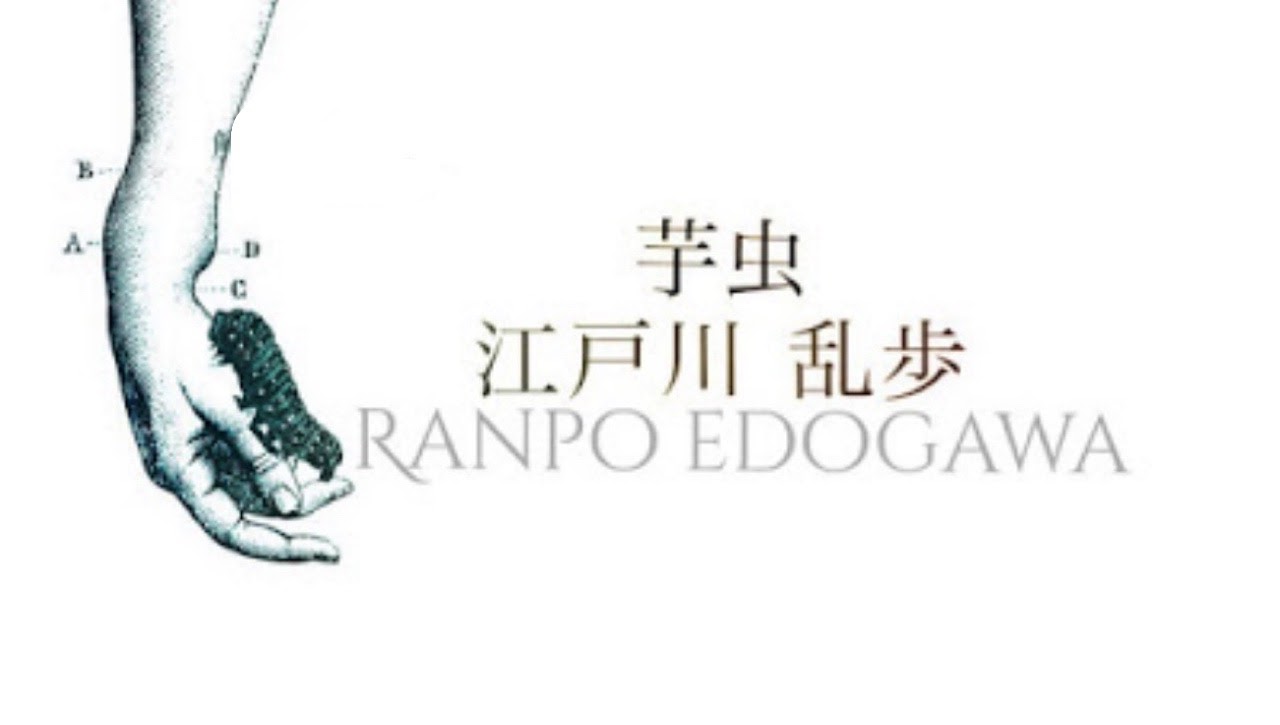
'The Caterpillar', Rampo Edogawa.
- Introduction.
- Ⅰ Case1 :Devotion and sadism
- Ⅱ Case2 :The Form and the Life
- Ⅲ Case3 : The Eye of the World Egg
- Ⅳ Case4:Illusions, dialogue and heroic story
- Dependent Origination
Introduction.
Tokiko’s husband, ‘Lieutenant Sunaga’, was hailed as the pride of the army and regarded as a military god; however, he lost all four limbs in the war. His face was covered with scars, he had lost his hearing and vocal cords and could not speak well, yet his internal organs continued to function, albeit slowly, and he remained capable of living as a man. His appearance could be described as a ‘caterpillar’; however, as the term refers to the larval stage, it is almost impossible to determine his sex. The wife’s mind towards her husband, who could not speak and lacked any semblance of masculinity, transformed into neither husband nor man, but solely her own source of pleasure and despair, a repulsive existence. Even the wife of Edogawa Rampo, who authored this work, criticized it as ‘disgusting’, and it was once banned in 1939 under wartime censorship.
This story flows with the fluidity of a pen stroke and bears no sense of forethought or calculation. It is a strange tale; however, in modern times, such a situation could be interpreted as an example of reduced quality of life. The wife stabs her husband in the eye with an edged tool in an act of lust; however, this seemingly cruel act may today be interpreted as a manifestation of caregiver fatigue, shifting the emphasis towards caregiving from the wife’s perspective. Literature and medical ethics are often said to go hand in hand. The ‘distance’ provided by fiction lends objectivity, and cruelty—while seemingly chaotic at first glance—takes on the form of a kind of law when arranged as a novel. Therefore, a ‘cruel’ story can ultimately challenge and provoke the reader.
This story could indeed be perceived as discriminatory towards people with limbless conditions; however, the third-person perspective preserves ambivalence by focusing on the wife’s introspection, presenting it as a problem arising in the mind of one without physical impairments.
At the beginning of the story, Tokiko’s greatest aversion is to ‘grilled eggplant’, a vegetarian dish that, according to one theory, was invented by monks prohibited from eating meat in order to imitate its texture and taste. Tokiko’s limp bite of aubergine at the outset symbolically foreshadows her desires. When one eats something detested, disgust spreads from the tongue throughout the body. Perhaps only Rampo could be fascinated by the pleasures derived from sensation and touch.
The third-person perspective focuses mainly on the wife’s introspection, yet also highlights the couple’s prolonged frustration, their ensuing conflicts, the transformation of attachment into aggression, and the ambivalence underlying it all. The wife’s actions unfold like passages in a modern psychology textbook, and their home resembles the observation room of a psychologist.
Ⅰ Case1 :Devotion and sadism

The husband, who had lost all four limbs, was forced to crawl or bang his head against the floor in order to express his will. He conveyed his frustration by repeatedly striking himself, and each time his wife responded with polite attentiveness.
“I’m coming now. You must be hungry.”
“I’ve kept you waiting a long time, haven’t I? Be patient for just a moment.”
The wife would hand her husband a piece of paper and a pencil, upon which he would inscribe his frustration in distorted letters.
“Tired of me?”
Her husband, searching for her until his head struck the floor, wrote words as contorted as his body. The wife, however, answered with a faintly teasing calm: “You’re jealous again, aren’t you?” One of her own kisses relieved her anxieties, while her husband’s every movement became another source of excitement and lust for her. To the woman, this “organism” was not merely a spouse, but a perverse and thrilling toy.
“You’re jealous again, aren’t you?”
Tokiko embodied two faces.
“As for you, however, your continued faithfulness has deprived you of all your former pleasures and desires. For three long years you have sacrificed everything for that poor crippled man, without emitting the faintest breath of complaint. You always contend that this is but the natural duty of a soldier’s wife, and so it is. However, I sometimes cannot help feeling that it is a cruel fate for a woman to endure—especially for one so very attractive and charming as you, and so young as well. I am deeply struck with admiration. I honestly believe it to be one of the most stirring human-interest stories of the day. The question which still remains is: how long will it last? Remember, you still have quite a long future ahead of you. For your husband’s sake, I pray that you will never change.”
The world perceived this woman as devoted to her husband, imagining that she had renounced her desires and elevated their union into an ideal of conjugal fidelity. In such a view, the renunciation of ‘greed’ symbolized chastity: the wife caring for her husband with unwavering devotion. However, reality was more ambiguous. The husband remained capable of functioning as a man, and the wife regarded him as a bloated yellow caterpillar, a grotesque lump of flesh through which her sadism was revealed.
Outwardly, Tokiko conformed to the expectations of society, embodying the image of a chaste wife. The world surrounding her was familiar, and this familiarity endured as long as she remained within it. People already possessed a preconceived image of her, and there was no need for Tokiko to disturb that illusion.
One cannot easily destroy the impression of such a familiar world. Desire does not endure eternally; therefore, when one steps outside, it naturally adapts to external norms. In that outside world, Tokiko remained ‘honest’. She would smile, euphemistically embodying chastity as soon as she stepped beyond her front door. There was no falsehood in this performance. However, once she returned home, she was consumed with disgust at her husband’s ugliness, and at her own lust for that ugliness. The recognition that her heart was not governed by pure love, but rather by disordered and unreasonable passions, filled her with fear as much as with pleasure.
Her husband demanded that Tokiko bring him newspaper articles and medals from his military service. At first, he was content to look upon them; however, he soon grew weary of these relics. The only act left to the couple was intercourse, which left them both with an animal-like emptiness, as though imprisoned in a cage. In such circumstances, would his wife realize that beneath the virtues of chastity she was, in truth, a horrible woman hiding behind a mask of devotion? She lived under the weight of condemnation by the world she knew. Moreover, her husband no longer bore the dignity he once possessed; he was now at her mercy. Despite this, he remained immobile, calling out to her whenever she was absent for even a short while, thereby further constraining her. The crescendo of Tokiko’s swelling emotions and introspection halted only when she straddled her husband.
Her control over him, fragile as it was, became uncontrollable. At last, Tokiko placed her hand over his eyes and crushed them with a deadly weapon as he stared at her.
She wrote “Yurushite” (Forgive me) several times across her husband’s chest; however, he offered no response. Unable to bear either the pity of his condition or the burden of her own guilt, she involuntarily abandoned him. Upon her return, she discovered him gone. On the bedpost lay a nearly illegible note, resembling the playful scribbles of a child. She discerned that it read “Yurus” (I forgive you). Yet, her husband had crawled away, bent his neck like a sickle, and cast himself into the well to his death.
The act of bending one’s neck like a sickle is an old Japanese figurative expression, likening the raised head of a snake in fighting stance to the curve of a sickle. Whether his end constituted a soldier’s death or an assertion of will remains unresolved. However, Tokiko imagined the phantom of her husband’s face, interwoven with the certainty that he had forgiven her.
Ⅱ Case2 :The Form and the Life
If Part I may be regarded as a psychological study centered on Tokiko, Part II provides a broader overview. A work of art is never confined to a single interpretation. Rather, incompatible interpretations coexist, representing the complexity of a civilization. When a work of art becomes a form rather than a sound, it becomes deeply tied to the visual. Consider, for example, the motif of ‘hands’: Albrecht Dürer’s Praying Hands conveyed expression through gesture; Caravaggio’s St. Matthew revealed angelic fingers embodying scholastic philosophy; Rembrandt’s St. Matthew, by contrast, depicted hands resembling those of laborers, emphasizing the sheer force of divine dictation. Life is form, and form is life.
The armless Venus de Milo attains this significance by chance. Even without arms, her presence has captivated countless viewers. The absence of arms has rendered the emotions of “hands” more evocative and imaginative. Novels, however, exist in a world without form. They also lack sound. They are left to the construction of a third world in the mind of the reader, a world even the author cannot fully comprehend. Language, too, represents the human psyche, processed in the depths of consciousness as both the world of imagination and the language of God. If language, like vegetation, possesses an ecosystem, then perhaps nothing disrupts that ecosystem more than language itself. Language attempts, sometimes actively and sometimes passively, to become the form of an invisible entity which, from the perspective of vision, ought to remain in the lower strata. Edogawa Rampo’s The Caterpillar may be described precisely as such a work.
It is not difficult to imagine a darkened room, oppressively devoid of light, in which a limbless husband lies at Tokiko’s feet. In the English translation, certain words such as 肉毒楽 are omitted; these terms—“thing,” “flesh,” “lump of flesh”—all referred to the husband. However, it must be remembered that he is not merely “flesh” animated, but rather life in its universal essence, embodied in a particular form. The human spirit is highly susceptible to the shaping power of circumstances and environment. The husband has lost his hands, the organs of expression, and he has no feet, the symbols of independence.
The reader can easily look into the eyes of the woman, Tokiko. We enter the couple’s bedroom, a place concealed from the outside world. In the darkness, the Caterpillar waits for his wife to illuminate him, and she becomes that light. As we enter this space, the reader is gradually manipulated by the couple. Eventually, we become entangled in the psychological portrayal of Tokiko herself. A number of metaphors emerge concerning the gaze directed at the husband’s form: first Tokiko’s gaze, then that of the neighbors, then society, then past glories, and finally the husband himself. Above all, the husband’s gaze constituted the sole human expression of emotion.
A house is not merely to be looked at; it must be lived in and fashioned. (Francis Bacon, Essays.) This is why the husband grew weary of the past glories represented by his military order. One cannot live each day simply to look upon them. Nocturnal activities are not only biological, but also become habitual. Just as Louis XIV required a finely crafted chair, so too does a man require customs that constitute his role. As husband and wife, they were expected to enact movements that become cultural and customary. However, for the husband who had lost all four limbs, this role as husband was replaced by that of a “caterpillar.”
If her husband’s body were a sculpture, Tokiko might even have found it beautiful to behold. However, like a sculpture, the lifeless had not acquired life; rather, the living had been reduced to lifelessness. Their function as husband and wife, which should have extended into the living space they shared, had dissolved into illusion. It did not even leave room for the “fantasy” of imagining what their household might have been had he retained his limbs. Instead, the narrative draws us ever deeper into the inner life of the husband whose eyes were crushed.
It was not only the wife’s virtue that was tested. The husband’s virtue, too, was placed on trial. This is where the endgame unfolds. Could he maintain his dignity as a husband with a wife who had once been devoted and supportive? He no longer expressed his will by furiously banging his head against the wall—that was his only means of protest. The muffled sound of water ultimately signaled the death of the man who had no limbs and could not swim. There seemed to be nothing left but the presence of a living soul within a fragile form.
Yet the husband acted as if he were still a man with arms, even though he could only write by holding a pen in his mouth. Not merely as a body with limbs,
but as a person endowed with a heart,
he inscribed the word 「ユルス」—I forgive you—to his wife.
Ⅲ Case3 : The Eye of the World Egg
The invisible gaze constructs the illusion and the very space of a “heroic story.” It is not altogether clear to what extent “love” in Japan at that time shared features with what we recognize today. However, why do these two individuals seem to embody a sense of love not so different from our present experience? Perhaps it is because modern “free love” does not guarantee universal happiness or the capacity to cultivate character. Love can be a blessing; however, it can also descend into sin, powerful enough to drive another person to death. At its foundation, love requires, in Erich Fromm’s words, “discipline.” Nevertheless, we cannot deny that love is fleeting, particularly when we turn to classical Japanese literature. For it is also libido, the raw energy of life.
There was never any doubt in my mind that Tokiko had a loving husband. Yet when love and sexual desire coexisted, she assumed the initiative and became violent. Crucially, she was not unconscious of her actions but remained acutely self-aware. Her guilt restrained her from altering her course, and she trembled before the invisible censure of the world. After she blinded her husband, she repeatedly traced the word 「ユルシテ」 (forgive me) across his chest with her finger. Rampo’s narrative traverses darkness, pleasure, fear, and sudden acceleration through his wife’s introspection; however, from the moment she pleads for forgiveness, she appears strangely calm, without surrendering to despair. To some readers, her repeated ユルシテ may appear as genuine reform; to others, it is merely a self-centered cry for absolution.
At the same time, Tokiko began to weep, longing to see the ordinary faces of the outside world, leaving her disfigured husband behind. Unable to endure solitude, she fled. Many people tend to distinguish between husband-and-wife and love itself; however, I do not. For love, hate, and all negative emotions are inescapably entangled in human intimacy. The woman did indeed love her husband; however, she was devoured by her own greed. Yet the absence of virtue does not negate the existence of “love.” The fact that only memories shine, while the present yields no shadows, does not mean that the bond has been severed.
What criteria determine the end of a relationship? Married couples may divorce; even Catholic marriages can be annulled. However, where does the past itself reside while its memories continue to live on?
This is equally true of our relationship with the dead. The crucial difference is that memories with the dead halt at a fixed point, and the dead themselves cease to change beyond that point. Therefore, the living can continue to love a “record” that no longer evolves. Memories shift their perspective under different lights, becoming imaginatively fluid, yielding new interpretations, and thereby allowing affection for the dead to remain alive. In contrast, when both parties remain alive, “change” is often far more difficult. Alienation can emerge, particularly when one can no longer utter words of love. For the unmarried, separation usually follows; however, in marriage the situation is profoundly different. Divorce may exist in law; however, it remains exceedingly difficult to speak of the bond between two people who have reached such an impasse. Even when two individuals have resolved never to meet again, a residue of love persists somewhere within the hidden corners of the heart. Returning to the couple in The Caterpillar, I felt the strength of their bond when the wife continued to inscribe 「ユルシテ」 across her husband’s back.
In childhood, many Japanese may have played the game of tracing letters with a finger on another’s palm or back, challenging the recipient to guess the words. Yet unless the letters are simple hiragana or katakana, recognition becomes difficult. One wonders whether the husband truly understood his wife’s words, especially in his weakened state. Reading also requires confidence. Perhaps the sensation of his skin was dulled by the trauma of his eye injury. Whether his body truly received those words in full remains uncertain. Nevertheless, the husband left behind a final note: 「ユルス」.
It may be that her words were never understood.
It is precisely because of this uncertainty that I cannot help but feel the profound weight of his soul in that final 「ユルス」. The weight of the soul cannot be measured by superficial love.
Indeed, perhaps he did not understand at all. And yet, paradoxically, this seems the truest answer.
Dialogue is not always possible, even under ordinary circumstances. One may, in fact, receive another’s words only in the manner one wishes to hear them. To be told simply “forgive” may itself be a word the victim does not desire to receive, given what has transpired.
Stimulation between man and woman does not always follow order. It is not simple to discern how much derives from affection and how much from sheer stimulation. Between men and women there are times when we may conclude deductively that it is love, and times when we can only infer inductively that it must be so, by virtue of their being man and woman. Every individual is destined to embody both.
The severing of their relationship in “this world” culminated in the husband’s suicide. The impulse that compelled him remains difficult to explain.
Schopenhauer, in his reflections “On Suicide” (The World as Will and Representation), referred to the Latin punctum saliens (the “salient point”) as “the egg of the world.” The phrase is difficult to translate, signifying a minute source or spring, yet Schopenhauer employed it to designate the very focal point of existence. In contrast to phenomena such as human desire and human love, he identified the act of reproduction as the highest expression of will. Whatever the historical context, reproduction stood in stark contrast to the unfolding of phenomena surrounding something as sacred as the Lord God, as a “tiny spring-like source” of human functioning, untouched by fluctuations of love, will, or passion. That much remains undeniable.
Another thinker, Simone Weil, also meditated on the punctum saliens. In her chapter on “de-creation” in La Pesanteur et la grâce, she wrote: “That a fictitious divinity has been given to man.” She further remarked that “there are only two moments in life when we are completely naked and pure: the time of birth and the time of death,” seeking thereby to remove the self through uncompromising inner exploration.
If we strip Schopenhauer’s and Weil’s notions to their common ground, we discover a dark gaze surrounding phenomena that may appear disturbing, loving, or disappointing. In human presence and in human absence alike, we become anonymous observers. Rampo himself confessed: “My character as a dreamer does not feel an itch, no matter how I am treated by the real world” (in reference to political meaning). Indeed, it is true that this story possesses a distinctly subjective perspective, a fantasma of shifting phenomena. In contrast to mere fantasy, a fantasma parallels the relationship between perception and sensation. Is The Caterpillar not perhaps an attempt to define conjugal love beyond the values of its age, rather than a story of simple fantasy? Yet it remains fantasy nonetheless, for Tokiko continued to behold visions of the Caterpillar even after her husband’s death.
The couple’s task was the source of both life and death—the primal force creeping between all phenomena, the “original sin” of humanity. No matter how a relationship ends, no matter how life and death divide, no matter how memories fade or are embellished,
the eye, the egg of the world, remains at the very center of human life.
Ⅳ Case4:Illusions, dialogue and heroic story
Concerning the difference in dialogue between man and woman, one recalls the story from chapter 5 of the Song of Solomon. The bride’s affection for the groom had cooled, and she refused to open the door when he called. While the groom eagerly devoted himself to her from behind the door, the bride eventually changed her mind and opened it—yet he was already gone. “His words made me faint. I sought him, but he did not answer me” (Song of Solomon 5:6).
Just as the “bridegroom” is replaced by the Lord in biblical teaching, so too do relationships bound by love seek a Lord-like fidelity, intersecting and yet betraying one another. Tokiko and her husband might well be understood through this lens of crossed dialogue. Although the meaning of “love” in modern Japan differs from that of the past, the connection between beautiful stories, the sacred, and the Lord remains relevant. Love is the one reality to which human beings will swear allegiance, the one force that gives coherence to existence. It is loyalty. Even when not religious, even when conceived as a familial contract, eternal bonds and fidelity are demanded. We help one another and live together under the expectation that we are always recognized, even when unseen. Understanding and respecting differences, while cultivating inclusion, becomes indispensable. The pursuit of happiness requires that love precede comprehension, that goodness act before it can be named as love. However, despite its deceits and betrayals, reason persists as the part of the soul that still longs for fidelity.
In The Caterpillar, her husband inscribed 「ユルス」 in katakana, holding the writing pad with his mouth in his limbless state. It was only possible because of the concise form of Japanese katakana. By contrast, the English phrase “I forgive you” would have been exceedingly difficult to form in such conditions. What if he did not truly know what his wife had written, but instead grasped it inwardly? What if, as in the Song of Solomon, despite the crossing of words and gestures, a dialogue nevertheless occurred? If so, then her husband’s act embodies the ideal of dialogue in love. Dialogue does not always reside in words, and yet, ultimately, words are needed to express both will and heart. He understood this with profound clarity.
What remained for Tokiko was the redemption of her husband’s phantom, the recurring “caterpillar” that visited her each spring. Human beings and their emotions are frail, even hopeless; however, there exist treasures that can only be uncovered through contact with this very frailty.
Rampo himself plunges the reader into illusion. He repeatedly unsettles us with the question of where his tale finds its resting place. The uncanny story of the Caterpillar—his wife’s plea, her husband’s forgiveness, his death as a god of war—remains, in my view, the most haunting of Rampo’s works. Each time Tokiko saw a caterpillar, she was reminded of him. Though her personality was once distorted, her form altered, she continued to see only her husband, and he lived on for her. The story may even be perceived as an expression of single-minded devotion.
Earnest? No—mysterious. It is, in truth, a strange and wondrous story.
Dependent Origination
Do you think this story is cruel? To me, it appears as love. To protect and to love that which is fragile is, in truth, profoundly complex. And through doing so, I myself become fragile. I accept the balance of both the sacred and the profane. It is precisely because of human weakness that the sacred can be discerned. This is, I believe, a worldly tale—yet one that is also a metaphor, even a parable.
Notice on Historical Expressions
This work contains expressions that reflect the social and cultural context of its time. These terms may be perceived as discriminatory or outdated today, but they have been preserved in this translation to remain faithful to the original text. Readers are encouraged to approach them as part of the historical and literary background of the work.

 Chris Kyogetu
All the stories have beautiful morals! Well shared 👍
いいねいいね
Thank you for your kindness. Please visit us again!
いいねいいね
Yes sure ☺️
いいねいいね