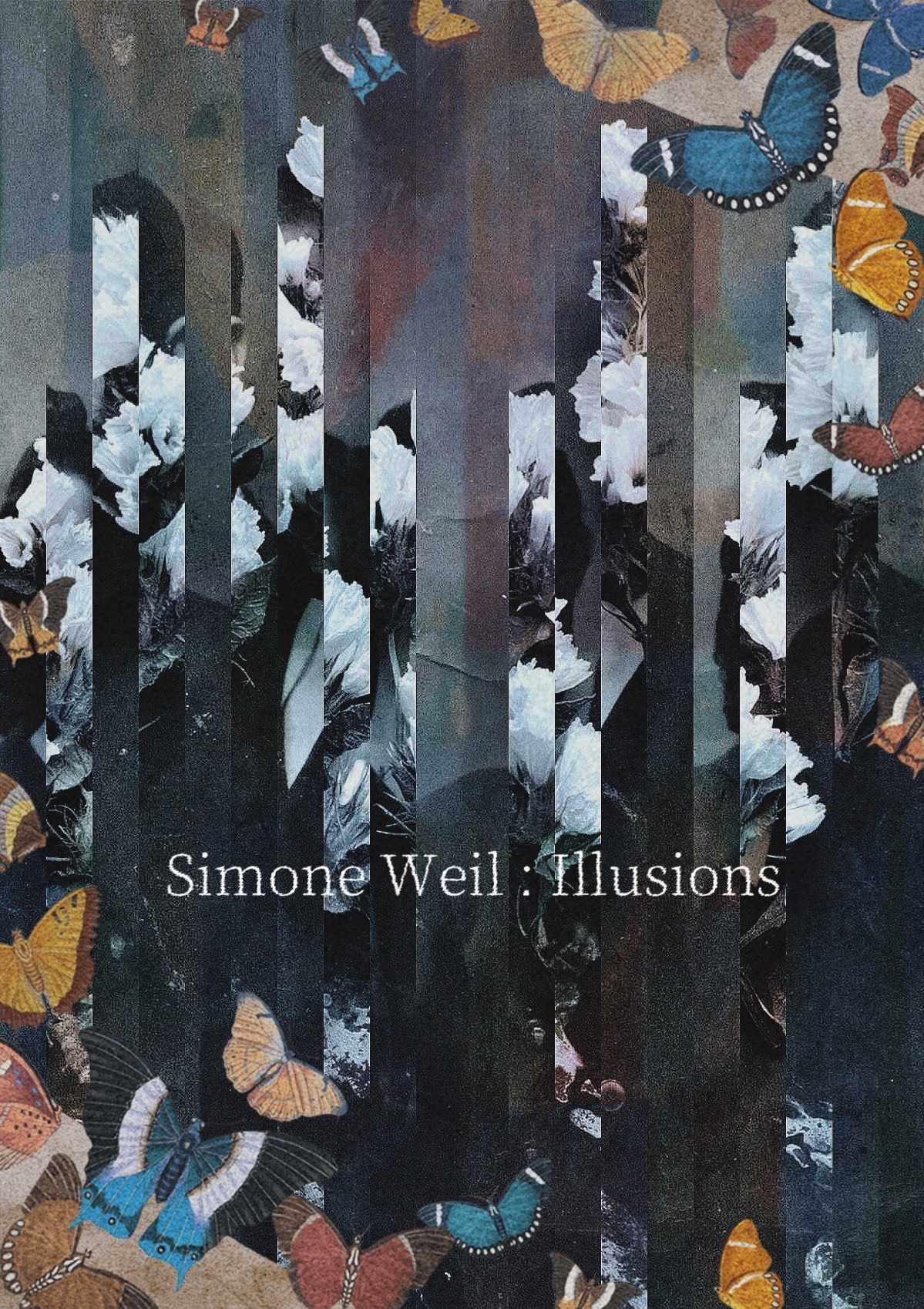
Simone Weil, ‘Illusions’ (Gravity and Grace).La pesanteur et la grâce
・On se porte vers une chose parce qu’on croit qu’elle est bonne, et on y reste enchaîné parce qu’elle est devenue nécessaire.
・Les choses sensibles sont réelles en tant que choses sensibles, mais irréelles en tant que biens.
・L’apparence a la plénitude de la réalité, mais en tant qu’apparence. En tant qu’autre chose qu’apparence, elle est erreur.
・L’illusion concernant les choses de ce monde ne concerne pas leur existence, mais leur valeur.
・L’image de la caverne se rapporte à la valeur. Nous ne possédons que des ombres d’imitations de biens. C’est aussi par rapport au bien que nous sommes captifs, enchaînés (attachement). Nous acceptons les fausses valeurs qui nous apparaissent, et quand nous croyons agir, nous sommes en réalité immobiles, car nous restons dans le même système de valeurs.
・ceux qui ont nourri et vêtu le Christ ne savaient pas que c’était le Christ.
English
・We are drawn to something because we believe it is good, and we remain attached to it because it has become necessary.
・Sensible things exist as sensible things, but are unreal as goods. Images possess the fullness of reality, but only as images.
・The illusion regarding the things of this world pertains not to their existence, but to their value.
・The illusion concerning the things of this world does not concern their existence, but their value. The image of the cave is related to value. We only possess shadowy imitations of goods. It is also in relation to goodness that we are captives, bound (through attachment). We accept false values that appear to us, and when we believe we are acting, we are actually immobile, as we remain within the same system of values.
・Those who fed and clothed Christ did not know that it was Christ.
1L’apparence
L’apparence means ‘appearance’ in French, but in legal philosophy and sometimes in psychology it is translated as ‘provisional image’. While a virtuality has the integrity of reality, it can also be misleading, not only with regard to the appearance of reality, but also with regard to other objects. This may be a feeling that is not common in Japanese concepts. Although Husserl distinguished between ‘imaginative action’ and ‘fantasy’, in phenomenology Husserl provided an approach to the idea of the provisional and value. The distinction between phenomena (physical sensation) and value (provisional representation) is also mentioned in Weil’s quotation.
・ceux qui ont nourri et vêtu le Christ ne savaient pas que c’était le Christ.
・Phonological beauty: in this sentence there is a balance between vowels and consonants and a sense of rhythm. For example, the phrase ‘nourri et vêtu’ feels beautiful because the sounds are delicate and echo each other.
2 ’provisional image’ versus ‘conjectural’.
Provisional image refers to an image in the mind of an object or event that has not been directly experienced in the real world, based on imagination or speculation. Assumption is an unquestioning perception distorted by subjectivity with concepts that are different from provisional images. In essence, provisional images are realistic and contain misperceptions, but they are also correctable. Assumptions, on the other hand, are often not correctable. For example, in advertising and marketing, provisional images are used to attract people and make them stick to a product or service. We need to make sure that we do not miss the real value and benefit behind individual products and services. In the area of self-development and relationships, it is also important to focus on one’s own true needs and wellbeing, rather than getting caught up in the provisional images and expectations of others.
3 ’Good’ and ‘justice’.
Weil’s declamations seem to have philosophy at their heart, even though they are poetic in nature. This quotation, for example, may be based on the ‘good’ and ‘justice’ of ‘Platonic’ philosophy. In Plato’s ‘Republic justice is attributed to the soul. I think that the image of a ‘cave’ here is undoubtedly an analogy for the cave in Plato’s ‘Republic’.
The parable describes a situation in which people are trapped in a cave and live by seeing shadows projected on the walls by a fire at the back of the cave. They believed the shadows to be real and never left the cave. However, when a person escapes from the cave and sees the outside world, he or she discovers true reality for the first time. There were concepts and things that were different from the shadows he saw in the cave, such as light, colour and shape. This person discovered new knowledge and truths and tried to communicate their existence to the others in the cave, but they were convinced of the shadow world and refused to accept the truths of the outside world. This parable represents Plato’s ideas about the acquisition of knowledge and truth. The cave symbolises the material world and sensory experience, while the shadow represents knowledge through perception. On the other hand, the world outside, as seen by the person leaving the cave, would refer to the world of ideas and metaphysical truths. Plato’s parable of the cave is a metaphor for the fact that we can only see things in their provisional image or shadow form, not in their real form. The people in the cave only see shadows projected on the walls and cannot know the true reality, so although there are ‘provisional images’ in the cave, they cannot be said to be the true existence or reality. It suggests that the world we perceive is part of reality and that there is a truth or essence beyond it. It emphasises that ‘provisional images’ exist in some sense, but that they are not a complete picture of truth or reality.
This is also an example of the fact that truth and knowledge must be obtained through reason, and that true understanding is impossible as long as we are trapped in the material world and sense experience.
In Plato’s Republic, the desire to know the truth about justice interacts with the idea of the good, which is also characteristic of the French word Nous ne possédons que des ombres d’imitations de biens. C’est aussi par rapport au bien que nous sommes captifs, enchaînés. In Bient in, it can mean ‘good’, but it can also mean ‘possession’.
For example, what does it mean when translated as ‘property’?
We are trapped in a cave whose walls reflect the shadows of our possessions. But these shadows are not real possessions, they are only imitations. Because we are trapped in these shadows, we cannot know true ownership and luxury. If we could come out of the cave, we would experience true possessions and true wealth.
Even as ‘property’ he points to our obsession with material possessions and our missing out on true happiness and abundance.
So what if we think in terms of the good, which is the correct translation?
Trapped in a cave, what we see is not the real world but shadows, which are imitations or representations of reality. Shadows reflect true reality, but are themselves incomplete, and we cannot know true reality accurately. Goodness’ becomes the knowledge and rational understanding of true reality. By going outside the cave and seeing true reality directly, we can understand and accept true goodness. However, trapped in the cave, we cannot have knowledge of the true good and remain trapped in the shadow of mere imitation.
This parable is consistent with Plato’s advocacy of an ideal state and his insistence that philosophers should play a role in pursuing the true good and communicating it to others. It also suggests that in order to gain knowledge of the true good, we need to go outside the cave and engage in self-knowledge and self-transcendence.
Continuing the section, Weil adds a passage from the biblical Gospel of Matthew, chapter 26, verse 37, where he gives him food and clothing without recognising him as Jesus. This shows the difficulty of understanding Christ’s presence and the need to open people’s spiritual eyes. By treating this account in a provisional image, Weil may have been trying to express the universal theme of people’s contact with Christ (or a divine being) but their inability to understand his presence and truth, as well as the difficulty of mystical experience.
The biblical position on ‘property’ (in money),
Matthew : 6 : 19 – 21
Do not choose to store up for yourselves treasures on earth: where rust and moth consume, and where thieves break in and steal. Instead, store up for yourselves treasures in heaven: where neither rust nor moth consumes, and where thieves do not break in and steal. For where your treasure is, there also is your heart.
This is not just a denial of material possessions, but a question of where the heart is. Those who gave food and clothing without knowing Jesus may have earthly possessions, heavenly treasures and ‘heart’. This is also related to Platonic ‘goodness’ and ‘justice’. As Plato wrote in the Republic, biblical ‘goodness’ and ‘justice’ do not just enrich the inner life of an individual. He believed that an individual’s goodness and justice is made up of a collection of individual goodness and justice. He taught that through the pursuit and practice of goodness and justice by individual souls, the nation as a whole can also realise goodness and justice. Reality, however, exists alongside provisional images and is difficult to put into practice. Provisional images’ are questions for the philosopher.
*This is not an explanation.

 Chris Kyogetu
He is a savior! 🙏
いいねいいね